
Translated material
"Brothers" and sisters
The Egyptians are again preparing to massively go out onto the streets, but this time - to the election urns. The coming on May 23–24 Presidential elections for the first time in the history of Egypt give them a chance to make an independent political choice. The voting results largely depends on which path the key country of the Arab world will go. Supporters of the secular path hope for the victory of the ex-head of the League of the Arab states (LAG) of the diplomat Amra Musa, Islamists put on the former activist of the Muslim Brotherhood, the doctor and trade union leader Abdel Abel Abu Al-Fattuh-he has more chances in the second round. What kind of political force is behind him, what are her intentions and goals - The New Times found out on the spot
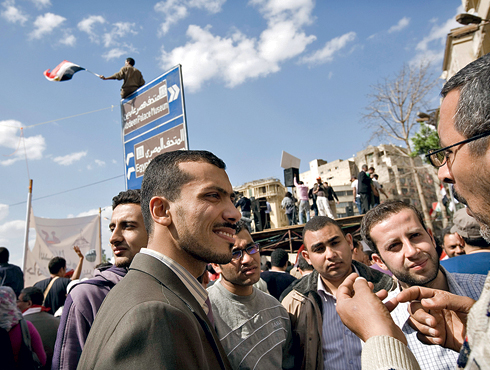
29-year-old Ahmed El Biali (in the center) works in the Al-Faruk hospital financed by the Brothers
In the balloon - 13 names. But now we can talk about the two leaders of the campaign, which will not cost one round of voting. 87% of the Egyptians surveyed by the Center for Political and Strategic Studies Al-Ahram have already decided on the choice, of which about 40% prefer Amra Musu, 27%-for Abu al-Fattuha, excluded from the ranks of the brothers for the unauthorized nomination of their candidacy. In the bipolarization of the election campaign, the tough confrontation between secular and Islamist candidates-Amra Musa and Al-Fattuha-one of the election features. The severity of the situation is also that the Islamist Al-Fattuha will probably support the Islamist-Radikals in the second round, who are represented by Mohammed Mursi, the leader of the Freedom and Justice (PSS), the successor of the Muslim Brothers, who received 130 out of 330 seats in last year’s elections. “The Qur'an is our constitution, the prophet is our leader, jihad - our path and death in the name of Allah is our goal,” said Murcy, speaking at the University of Cairo.
For decades, the “brothers” have been considered as a dangerous semi -underground movement, striving for power to establish the laws of Sharia. But now the attitude towards them has changed: after many years of repression, this organization became the leading political force in Egypt. True, there is no unity among the “brothers” themselves: in their ranks, the struggle for power between the old leadership and the young generation of the “brothers” and “sisters” who are ready to take the reins of government into their own hands flare up in their ranks. 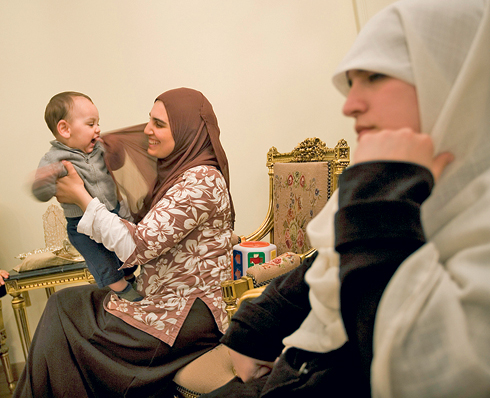
Requests of young
We are sitting in a bar in a shopping center on the outskirts of Cairo, and Ahmed El Biali, sipping tea, leisurely talks about his participation in last year's Egyptian revolution. He has a quiet voice and pleasant manners, the beard is neatly trimmed, and he speaks with obvious pleasure about the events that forever changed his life: “I walked 50 kilometers to the center of Cairo. I was not scared - even when the policeman shot my leg and I got to the hospital. " El Biali, a 34-year-old doctor from the city of Mansur, is one of the approximately three million young members of the Muslim Brothers living in Egypt. Like many of his like -minded people, during the revolution he took part in clashes with the police and spent the night on Tahrir Square with his family. “Much has changed,” he says. - Previously, they looked at us as radical Islamists, but now more and more Egyptians join us. We must use new opportunities as much as possible. ”
| The main points of the political program “Muslim Brothers”: • The Priority of the Koran and the Laws of Sharia in the Constitution • Economics based on the laws of the market • Following the main civil freedoms, including freedom of assembly and freedom of the press, in relation to all religious and political forces in Egypt • Women and Christians cannot apply for the president of Egypt, but may be part of the Cabinet of Ministers |
Now the youth wing of the movement requires radically changing the role of youth and women within the organization itself, the principles of choosing leaders, as well as relations between the “Muslim brothers” and its political wing-the Party of Freedom and Justice. The old leadership would like to maintain close ties with the PSS, while young members require a complete separation of these structures.
“How can we influence the ideology of a new party, if all the same old leaders will lead it? -asks 28-year-old Mohamed Otman, a member of the left wing of Brotherhood. “We strive to build democracy according to the Turkish model, but our leadership is concerned only to preserving stability and does not want any changes.” “The contrast between young and old generations within our organization is obvious, as in the entire Egyptian society,” explains another member of the Muslim Brothers, 34-year-old Ahmed Abelgavad from the city of El-Minya. “We strive to speed up the process, but the older generation does not want this.”
Although the Muslim Brothers did not join the revolution from the very first day, they supported it until the fall of the Mubarak regime. Ahmed Abdel Hadi, 37-year-old manager of an international company, in the most difficult days of the revolution was among the “brothers” who remained to spend the night on Tahrir Square, despite the cold and threat from law enforcement. “Eighty percent of those who spent the night there were members of the Muslim brothers,” says Abdel Hadi. - And only we remained in one of the nights there. My friends called me and persuaded me to leave the square, because troops had to come there soon. It was the worst moment in my life, ”he recalls. But, oddly enough, that night passed without incidents, and in the morning people came to the square again. “I have never been so glad to see women in short dresses and smoking men: we were not alone in the square again,” Abdel Hadi says with a laugh.
Revolutionary events in the country also affected the young “Muslim sisters”-this is how Muslim brothers call women entering the organization. If under the previous regime they could not participate in public life for security reasons, now many of them felt that the time had come. “The founder of our movement Hassan al-Banna spoke many times about the important role of women in Brotherhood. Unfortunately, our current leaders did not share this point of view, but now everything should change, ”says 33-year-old housewife Rehab Hassan Goud. She is supported by the 35-year-old avateph Saad, the owner of a small personnel agency: “Historically, women have always played a significant role in the activities of the Muslim Brothers. We also want to participate in the decision -making process and be able to occupy high posts. ”
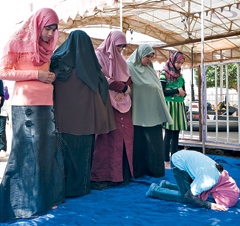 |
| Prayer on the day of orphans. This holiday was invented by the "Brothers" themselves |
The path to the temple
It would seem that, in addition to religious considerations, it can lead a young Egyptian to the “brothers” and hold there? However, the answer to this question is not so unambiguous. Social aspects of the organization’s activities are no less important than religious. “We cannot easily and simply leave the Muslim brothers, because over many years the party has become part of our daily life. My children grew up with the children of other members, ”explains Mohamed Otman. “And this, perhaps, is the strongest side of our organization - not religious or political beliefs, but personal relationships.”
Many joined the organization while still children, such as 15-year-old Anass Gamal Mustafa. When his father introduced him into the ranks of the “brothers”, he began to take part in the monthly campaigns to the pyramids and in the desert, which were organized for children and relatives of the organization. “Adults taught us how to navigate at night in the desert in the stars,” he says. - It was so interesting. When I grow up, I will study astronomy. ” Now Mustafa attends the Muslim brothers twice a week, sweeps the streets in his village and collects donations for non-governmental organizations and various associations related to movement.
Eighty percent of those who spent the night on Tahrir Square were members of the Muslim Brothers, ”says Abdel Hadi. - And in one of the nights there were generally only we
"
Football and the Prophet
Help poor and needy has become another way to win the hearts and souls of people. In Egypt, there are non -governmental organizations related to the “brothers” that are engaged in the construction of housing for those in need and allocate funds for wedding ceremonies for those who cannot afford them - regardless of religious or political views. In addition, the movement finances four hospitals, including the Al-Faruka hospital in Cairo, where they take about 60 thousand patients per day and where the poor receive free treatment, and also supports social centers that participate, for example, in the annual bottom of orphans.
“Brothers” and such a popular sport as football pay attention. Once a week, young members of the organization gather in the training field in the Cairo district of El Talaa. Before training, one of the brothers addresses the rest with a short speech. “I want you to remember the sermon that we listened to last night,” he says to his teammates. - Remember that our life can break at any time. That is why it is so important to follow the teachings of the prophet ... ”And only after that they begin a football match.
Participating in the implementation of the same essentially social programs and events that Christian churches in Europe, “Muslim brothers” seek to identify their presence in all spheres of Egyptian society. 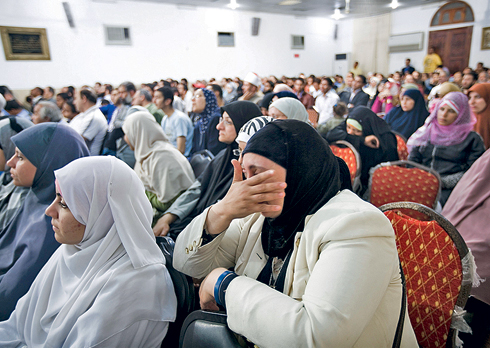
The connection of generations
Another important field of activity of the Muslim Brothers is education and work with adolescents. Boys and girls are divided by age into groups of 8-10 people with whom one of the older “brothers” or “sisters” is engaged in twice a week: they read the Qur'an, help solve various daily problems. “I have been doing this for eight years, and this gives the meaning of my life,” says 30-year-old Marva Mokhsen, who conducts classes with two groups of girls aged 13 to 18 years. - This is a difficult matter, because I have to study a lot to answer their questions. On the other hand, I myself discovered a lot of new things for myself. ”
It is this connecting link between the organization and its future members - young “brothers” and “sisters” - best helps to understand the new trends that arise in the Egyptian youth environment, and how they can affect the future of the organization. “Do not worry,“ Muslim brothers ”will change without losing the connection between generations,” says Mokhsen. - Previously, we could not directly contact people, but now we have such an opportunity, and we must use it. Our "Brotherhood" will not change because of the revolution, but thanks to gained freedom. "
"Muslim brothers"
The movement was founded in 1928 in the city of Ismailia as a young primary school teacher Hassan al-Banna-he advocated the revival of Islam, not only as religion, but also as a form of organization of society, state and all sides of everyday life on a more fair and moral basis. The ultimate goal of this struggle was to restore the Arab caliphate, extending from the Atlantic to the Indian Ocean. In their tactics, along with the patient explanatory work, the “brothers” also resorted to the acts of violence. The periods of its legalization interspersed with its ban. In the late 40s. The number of members of the organization, according to some reports, reached 2 million in 1949. Al-Banna was killed in Cairo by government agents. After the Egyptian revolution of 1952, which the “brothers” supported, they soon encountered Nasser's regime in the struggle for the influence of the masses. A number of their leaders and activists were executed, many were thrown into prisons. Many “brothers” fled to neighboring Arab countries, where the local cells of this international organization founded. In the 70–80s. The main nucleus came to the denial of violence and the transfer of stops to a peaceful political struggle. However, radical fractions and groups were constantly abandoned from the organization-such as, for example, al-Jihad al-Islami and al-Jamaa al-Islamia, which be responsible for a series of bloody terrorist attacks of the 90s-insisting on consistent armed jihad.Translated from English by Nikolai Makhlayuk