
Translated material
Almost a planet
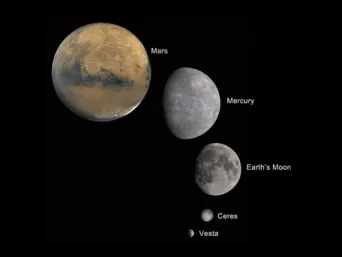
In early May, the results of tests of the asteroid Vesta conducted by the Dawn (Dawn, NASA) spacecraft were published. Six articles summing up the intermediate results of the mission are published in the next issue of Science magazine [1]. A special press conference was held by his publication in NASA. Briefly its essence can be formulated as follows: although Dawn did not make sensational discoveries, a detailed description of Vesta, one of the largest bodies in the main asteroid belt, gave exclusively a lot of information for reflection on the past of the solar system and about the processes of the evolution of planets.
According to previous hypotheses, Vesta is a protoplanet - a celestial body, large enough for it to go through the stage of internal melting and the differentiation of the substance is possible: a nucleus, a mantle and a bark appear. Theoretically, West could wait for further development through the “extension” of the mass, however, the close proximity of Giant Jupiter with its powerful gravitational field prevented the formation of a full -fledged planet of the earth type. So between Mars and Jupiter since the formation of the solar system and the asteroid belt remained.
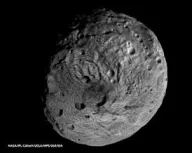
Vesta's dimensions are 289x280x229 km, it is more than twice further from the sun than the earth. The preceding observations of the asteroid were limited mainly by ground; In addition, the surface of the asteroid was observed by the telescope. Hubble. Dawn entered the orbit around Vesta in mid -2011 and since then circled around the asteroid, gaining information from different heights (it reached the least height in December 2011 - 210 km). Scientific tools can be called a "gentleman's set" to study the composition of the celestial body: it included a spectrometer of an infrared and visible range, camera and neutron and gamma spectrometer. In addition to the American organizations of the Society named after the American organization of scientific equipment. Max Planck (Germany), German aerospace agency and Italian space agency.
As a result of the study, a detailed map of the surface of the asteroid was built. According to the spectral characteristics of the surface, the distribution of minerals was studied. According to the accurate measurements of the position of the device, the gravitational field of Vesta was studied, which gave the grounds for hypotheses about the internal structure of the protoplanet.
The data obtained confirmed the hypothesis that Vesta is a complex body. Her bark was most likely formed as a result of melting chondrites. The size of the nucleus, according to the mass, volume and gravitational field of the celestial body, can have an average radius from 107 to 113 km. With such sizes, melting is already possible in which the iron core is formed. In addition, the spectral characteristics of a substance that can not be observed in craters also confirm the hypothesis that the substance of Vesta differs at different depths.
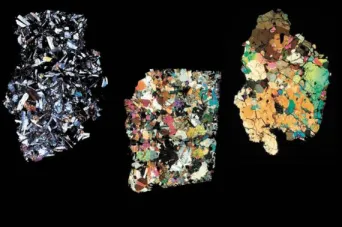
The second important result: Dawn confirmed the hypothesis that it was Vesta that is the source of a certain family of asteroids (“Vestoids”), as well as parts of the meteorites that are on Earth-Howard, Evkrites and Diogenites (HED-meteorites related to meteorites-Achondritis). Moreover, according to Dawn, we can assume when and where they were knocked out from. Probably, this happened during the appearance of the rendering crater (500 km wide and 19 km with a depth of 19 km) in the southern hemisphere of asteroid, which partially blocked the older crater of Veneneia (400 km wide). These are the two largest formations in this part of the asteroid. The blow that gave rise to the crater of Reyasilvia was truly terrible - as a result, Vesta lost about 1 % of her mass. It is also interesting that both formations are quite young: their age is estimated at 1-2 billion years, which means that they appeared much later than the late heavy bombardment period (approximately 4.1-3.8 billion years ago), the traces of which we mainly see on the moon. This period, however, includes other craters on the surface of Vesta, which resembles a lunar in this. In addition to craters, furrows (in equatorial areas), landslides are well distinguished on the surface-and there are no traces of volcanism, although, apparently, for some time under the outer bark of Vesta was the ocean of molten magma.
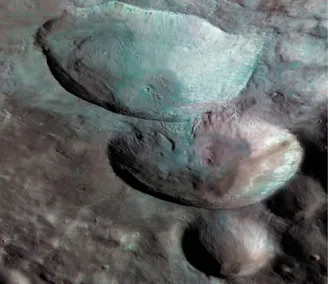
Vesta's surface is its annals that reflected the formation of planetosimals and the further fate of the protoplanet. According to the spectrometry in the visible and infrared ranges, the distribution of rocks in the upper layers of asteroid was studied. So, in the area of the rendering basin, diogenites are observed, while eucritors prevail in the equatorial areas. According to researchers, this reflects the distribution of material in the bark: its upper part is eucritis, and the deeper layers are diogenites that were “revealed” as a result of clashes.
Now Dawn is still in Vesta, but it is gradually deleted: from a low orbit (LAMO - Low Altitude Mapping Orbit), it switches to a high (Hamo2 - High Altitude Mapping Orbit), at a distance of about 680 km from the surface. The device has already been in such an orbit during the first mapping of Vesta from the end of September to December 2011. The “repetition” is interesting in that over the past eight months, Vesta has advanced in orbit, and, like on Earth, the seasons were replaced by it due to a change in the angle of the fall of sunlight. As a result, researchers hope to examine the northern hemisphere in more detail Protoplanets.
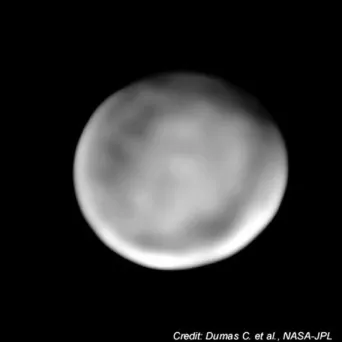
The initially planned Dawn stay, Vesta was extended by 40 days, so that the device will have to leave this celestial body in August. Then the flight to the dwarf planet Ceres will follow - the first largest in the main asteroid belt (the middle radius is 470 km). Unlike Vesta, Cerera is unlikely to be a differentiated body. In addition, on its surface, apparently, there are minerals containing tied water, which Vesta does not have.
The device should reach Ceres in February 2015, and in July of the same year, to complete the initial mission.
Olga is a snack
1. Science 11 May 2012: Vol. 336 No. 6082 doi: 10.1126/science.1219381