
Translated material
Multifaceted radiolaries
About the reprint of the book D.D. Morduhai-Boltovsky "Radiolaria Geometry"
The URSSS Publishing House (URSS.ru) was published by the reprint edition of the book of outstanding domestic mathematician D. D. Morduhai-Boltovsky- “Geometry Radiolaries” ( http://urs.ru/cgi-bin/db.pl?lang=ru&blang=Book&id=162059 ).
We publish a version of the preface to this publication specifically prepared for a three-hobby, explaining why the book, published in 1936 and laid the foundation for the development of new science-mathematical biology in our country, today will cause interest among representatives of different branches of knowledge, in particular the science of nanomaterials and nanotechnologies.
"The last of the Mogican"
Dmitry Dmitrievich Morduhai-Boltovskaya (1876-1952) is an outstanding Russian mathematician and teacher, the author of the Russian translation of Euclid and the “mathematical manuscripts” of Newton, as well as the original and independent philosopher (in all likelihood, one of the last representatives of the brilliant galaxy of Russian ideal philosophers). His scientific, pedagogical and social activities lasted more than fifty years, not the easiest in Russian history, including the revolution, war, the death of relatives, evacuation and moving from city to city, Stalinist terror and ideological dictates, poverty of material existence.
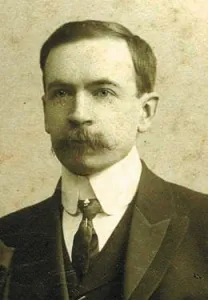
The scientific interests of Mordahai-Boltovsky were unusually wide and included different areas of mathematicians as integrating differential equations, the theory of transcendental numbers and hypertrant functions, the theory of algebraic curves, topology, differential geometry, including in the space of Lobachevsky.
Many students of Mordokhay-Boltovsky subsequently founded their scientific schools and new areas of science. I will name only a few names. Mathematician and cybernetic Academician V.M. Glushkov is rightfully considered the creator of the first samples of domestic computer technology. B.M. Shchigolev founded the department of computational mathematics of Moscow State University and was its first manager. One of the founders of the Soviet historical and mathematical school M.Ya. Vygodsky was the co -author of his teacher for work on the publication of Euclid. Among the students of Mordahai-Boltovsky are A.F. Bermant, B.Ya. Levin, N.V. Efimov, mathematician and astronomer M.F. Subbotin and, oddly enough ... A.I. Solzhenitsyn. Former student of the Physics and Mathematics Faculty of Rostov University brought his longtime professor on the pages of two novels-“March Seventeenth” and “In the Circle of the First” (in the second novel-under the name of Dmitry Dmitrievich Goryainov-Shakhovsky).
In the book "Geometry of Radiolaries", published in 1936 at the publishing house of the University of Rostov, D.D. Morduhai-Boltovskaya acts as a pioneer completely new at that time of science-mathematical biology. Today she is experiencing her star hour, and this is why the book is provided with reader interest.
I want to look at this classic work from a somewhat unusual point of view and pay attention to the apparent paradoxical connection of this work with modern nanotechnologies, and specifically with the research and development of nanomaterials based on full -and -basis. In order not to be unfounded, I will have to explain what Fuller is, what is their structure and what is common in it with the structure of radiolaries.
Fullerenes "open the door" into the world of carbon nanomaterials
In 1985, the C60 molecule, consisting of 60 carbon atoms, was experimentally discovered by the English astrochemist G. Kroto (Sir Harold W. Kroto) and American physicoki-Mikami (Richard E. Smallley) and R. Curl Jr., all three were awarded Nobel Chemistry Prizes, 1996).
Researchers suggested that carbon atoms in this molecule are at the tops of the truncated icosahedron - a polyhedron resembling a football in shape. This polyhedron has 32 faces (20 correct hexagons and 12 correct pentagons) and 60 peaks (carbon atoms). The new molecule was named after Bakmminsterfuller in honor of the American architect R. Bakminster Fuller, the author of the concept of geodetic domes-buildings-murals.
Following C60, other fullerenes were opened- the family of closed multifaceted molecules of pure carbon, having only five and hexagonal faces.
Studies of the methods of obtaining fullerenes subsequently led to another remarkable achievement - the opening of carbon nanotubes. These discoveries were a kind of “golden key” in the new world of nanometer structures and the “trigger” of today's nanotechnological revolution.
The decisive role in the understanding of the structure of Fullerenes was played by the use of a theorem formulated and proved by the great Leonard Euler (1707-1783): “In any convex multi-group the number of vertices (B), ribs (p) and faces (g) are subordinate to the ratio of-p + g = 2”.
From the famous theorem it follows that there is no convex polyhedron, which would have all the faces of the six -angles. This, in turn, means that it is impossible to construct a multifaceted molecule only through hexagons. Therefore, in the C60 molecule, in addition to hexagonal, there are pentagonal faces necessary for the curvature of a flat (hexagonal) graphite structure and its transformation into a closed shell.
Moreover, the ratio of Euler “requires” the presence of 12 (no more and no less!) Pentagonal faces in any of these molecules. But the number of hexagonal faces can vary, and at the same time, the number of the vertices of the multi -graph (carbon atoms) always remains even. According to this logic, the smallest Fullarena molecule, C20, consists of only 12 pentagons. The next Fuller-C24, then C26, C28 C60, ... C70, C72, ... etc. The use of Euler's ratio also allows us to explain the uniqueness and special stability of C60 in comparison with other full-time.
Radiolaries - full -like structures in living nature
Structures like Fullerenes are also used by living nature. Many viruses and, of course, radiolarials - marine unicellular microorganisms (Radiolary) (see drawing) have a full -like structure (see drawing). In any case, whether it is a virus, microorganism or even the creation of human hands, for example, architectural structures, the ratio of Euler requires in such a structure along with an arbitrary number of six -angle faces of 12 pentagons.
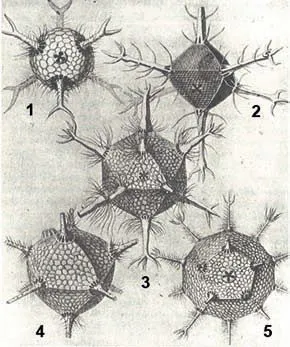
It is curious that the conclusion above was borrowed by the researchers of the Fullerenes from the analysis of the form and structure of the radiolar skeleton described in the book “Street and Form” by the outstanding Scottish mathematician and biologist D'Arcy Thompson (Sir Darcy Wentworth Thompson, 1860-1948).
The book “Growth and Form” is a masterpiece of scientific literature, the author of which, according to Henry Weil, “combined a deep knowledge of geometry, physics and biology with a humanitarian culture and an unusually original gift of penetration into the essence of scientific problems.” It is thanks to this rare combination of qualities that the book “Growth and Form”, in which for the first time in such an extensive and detailed manner, summarized the results of the application of mathematical and physical methods to the study of wildlife objects, became a desktop for many generations of readers.
Radiolaries - planktonic organisms in size from 0.04 to 1 mm. These are truly unique creatures (although which of the creatures of wildlife is not unique?!). They themselves build their skeleton from silicon salts, absorbed by them from sea water. From everyday life, each of us knows that when you do something yourself, for yourself and at your own expense, you will most likely try to fulfill this in the most effective and economical way. The life of the radiolaria proceeds in a state of soaring in sea water, therefore, lightness and strength should be combined in the structure of their skeleton, which is ensured by a full -like structure. It was this combination of the requirements that led Bakminster Fuller to the concept of the geodetic structure of his grid buildings.
Thompson or Mordohai-Boltovskaya?
The fact that the discoverers of Fullerenes used the approach set forth in the book of D'Arsi Thompson are not in doubt. But the fact that D'Arsy Thompson performed this analysis first for me since some time is not so obvious. Or the first was not only him. In 2004, working on the book “Fuller, carbon nanotubes and nanoclasters: genealogy of forms and ideas”, I came across a link in the article by Yuri Voitekhovsky [1] on the book of D.D. Morduhai-Boltovsky "Radiolaria Geometry".
The name Morduhai-Boltovsky then did not tell me anything, and finding his work seemed absolutely impossible. And I really wanted it!
A long search on the Internet brought me to the website of the researcher of creativity D.D. Morduhai-Boltovsky, collector and keeper of his archive-Vyacheslav Pyrkov from Rostov-on-Don. Thanks to the materials sent to me by Vyacheslav and posted on his site, I learned a lot about Mordohai-Boltovsky, read the “radiolaria geometry”, his other works, letters and fragments of unpublished manuscripts, and, most importantly, was, without exaggeration, simply amazed at the scale of the personality of this scientist and thinker.
"Radiolaria geometry" affects the thoroughness of the problem and power of the author’s mathematical arsenal. To analyze the forms of radiolaries, the author uses the theory of polyhedra, which he was engaged in throughout the long creative life, elements of variational calculus, topology, differential equations.
The first chapter of the second part of the book, called The Situational Geometry of Radiolaries, is devoted to the analysis of their structure using Euler's theorem and contains almost all the considerations that we cited above.
Morduhai-Boltovskaya could get acquainted with the book of Thompson, for example, through A.A. Lyubishcheva [2], with whom he was in intensive correspondence. But if this happened, then, most likely, after the writing of the “Radiolaria Geometry”. In any case, scrupulously listing the sources, Mordohai-Boltovskaya does not mention Thompson’s book either in the preface to his book, nor in the materials available in the Archive of Pyrkov.
In the “radiolaria geometry”, Morduhai-Boltovskaya mentions only E. Haeckel as his predecessor: “Starting the geometric research of the forms of organisms, I must note that the geometric point of view is not completely new. Haeckel in its “protomorphology” classifies organic forms as crystals, based on elements of symmetry. ”
And not a word about Thompson.
I am practically sure that d'Arsy Thompson read the book D.D. Morduhai-Boltovsky. I made such a conclusion after meeting with V. Pyrkov’s passage sent to me from the unrelated manuscript “Autobiography of Professor D.D. Morduhai-Boltovsky dated February 7, 1946 ”, where the scientist writes:“ From the mathematical and biological work (part of which died), it was possible to print only about the shelves and flyers of plants and the appropriate apparatus of the lower aquatic animals and the geometry of the radiolaries. Some foreign biologists got acquainted with the latest work thanks to the translations, and d'Arsi-tompson in Scotland knew to some extent Russian. I received a very good review from the latter. ” This review V. Pyrkov has not yet been found. The fact is that during the war the apartment and absolutely all the property of the Mordahai-Boltovsky family burned down, including rich correspondence with foreign scientists.
Two questions seem important in the context of our history: when the chapter was written by Thompson about the radiolarials and the Euler theorem and how does it correlate with the time of acquaintance of the Scottish scientist with the work of Mordahai-Boltovsky?
The vast majority of modern readers, including the above -mentioned researchers of Fuller, got acquainted with Thompson's book on posthumous (post -war) publications. In the preface to the 1963 publication, the author writes that the second edition (1942)- and only to it- the book was significantly supplemented. More recently, in the library of Harvard University, I managed to find the first edition of Thompson's book (1917) and answer the first question: there is no analysis of the analysis in this publication, i.e. It was added to Thompson to the book only in 1942, which means that Morduhai-Boltovsky was first completed and published in 1936.
Getting an answer to the second question is probably not at all easy. It is quite possible (and this option seems to me the most plausible) that both researchers came to similar results independently of each other.
On the other hand, the study of the structure and properties of Fullerenes has caused in recent decades a completely extraordinary research boom. This has already allowed to accumulate new knowledge, which, now, on a modern round of spirals of scientific knowledge, are used for a deeper understanding of the structure of radiolaries, viruses, bacteriophages and other full-like objects of wildlife. It was about them that the already mentioned Ernst Haeckel wrote: "Nature feeds in its bosom inexhaustible number of amazing creatures, which, in beauty and diversity, far surpass all the forms created by the art of man."
Evgeny Katz,
Professor University
them. Ben-Gurion in Negev (Israel)
1. Voitskhovsky Yu. L. Nature, 2004, No. 8.8-18.
2. Alexander Alexandrovich Lyubishchev (1890-1972) is one of the largest Russian thinkers of the 20th century, an outstanding entomologist, philosopher, author of classical works on systematics, comparative anatomy and evolutionary teaching, an ardent supporter of the application of mathematical methods in biology.