
Translated material
Kasparov vs Blinkin
The price of reputation. The question that again arose by the rib after the promotion of objects in the media on members of the Public Chamber and recent appointments to the government and the presidential administration: where is the limit when cooperation with the authorities becomes impossible for the authority, the director of the Institute of Transport and Transport Policy of the Public Chamber Mikhail Blinkin, the 13th champion of the world in the world in the world of the Public Chamber of Transport and Transport Policy, argued about this in the editorial office of The New Times. Harry Kasparov chess 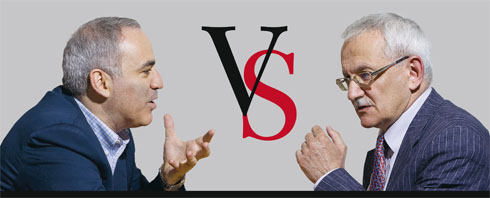
Mikhail Yakovlevich, in the characteristics that you were given, as the media suggested, in the domestic policy of the presidential administration, it is said: “Active. Important (respected specialist in the industry, convinced). Associated with the highest school of economics (Y. Kuzminov). " And the conclusion: "To establish cooperation." Are you satisfied?
Mikhail Blininkin: Well ... since the time of the Komsomol youth, I have not received such a thing. There are logical and grammatical absurdities for starters. Say, "associated with Kuzminov." It is enough to go to the site of the Higher School of Economics and see that I have been working there since December 2011, the director of the Institute of Transport Policy. Further: "Learn." To whom? "Convinced". What? And finally, what does it mean to “establish cooperation”? I am a member of all conceivable advice - public, advisory, scientists - within the framework of my interests. I had a case when I reported the same presentation about the Moscow general plan of Yuri Luzhkov at the seminar with Mikhail Kasyanov (one of the leaders of Parnassus), and then in the conservative club United Russia.
On the verge
126 “lenses” were published on members of the Public Chamber (OP), but only one says: “It really values a reputation, is ready to cooperate on topics that will not contradict his beliefs” - this is about the famous defender, President of the Russian Bar Chamber Henry Reznika.
Harry Kasparov: Such words are expensive. And on Mikhail Yakovlevich the characteristic is good: I am in great respect for people who, by the standards of the current FSB, are not reflected. After all, it is written: “To establish cooperation” - that means, so far it has not been possible. The most important thing that we learned from these lenses is what the authorities believe, relieving our teeth, but believes to find such people within public institutions necessary to maintain a reputation of power - if the word “reputation” can be used in such a context.
We also learned that a number of people who took place in the category of decent, and “active”, and “loyal”, and “never refuse the requests of UVP” (administration of domestic policy. - The New Times) , are ready for “spot interaction” and so on. That is, we thought that they say, do, do, do, but it turns out-“at the request of UVP” ...
Kasparov: People turned out to be flexible, yes. But the current polarization of the socio-political situation, especially after May 6 and all that happened on the streets, when a commandant hour was introduced in Moscow, they grabbed people, put it into auto-zats, condemned for 10-15 days, as Navalny, Udaltsov, Yashin-so, this is no longer allowing to balance on the verge, pretending to be over the fight. This forces some people to make a moral choice, and others to think about the fact that maybe this regime is not forever. And therefore, the topic of reputation today becomes so relevant. By the way, you noticed that in the State Duma when voting for these dragon amendments to the rallies' law, providing for crazy fines, there were 226 deputies, that is, only deputies from United Russia? Everyone else, including the LDPR, voted against. For the first time, when voting on the political issue, the EP remained alone - this also says something.
Blinkin: In these pieces of paper, some information about some people is absolutely biased. For example, Lena Topoleva -Soldunova. I know her well. The person is constructive and decent, and they wrote about it: his own in the board * * * Elena Topoleva-Soldunova, director of the Agency of Social Information: “Active. Controlled ". Conclusion: "Provide media support" ..
Or here is the story of Vasily Bychkov, director of the Central House of Artists. He was bent at one time, forced to abandon the art action in defense of Artemy Troitsky, which was supposed to take place on his site. What did he do? He refused Artemia Troitsky, but told the whole story in details * * in the “lens” on Bychkov concludes: “There is no potential for cooperation” .. Why did he do this? Because then the question was about the demolition of his building. Is it possible to condemn a person for this?
Choice
Could he lose the building of the Central House of Artists if he allowed the action to hold the rally in support of Troitsky?
Blinkin: I think that his chances in bureaucratic bargaining would have worsened. And behind him people, structure. I was not a anyone boss for a while, I only answer for myself. What should I lose? I have a computer and some knowledge of how the world works. And when a person has an orchestra, the surgeon has a clinic, followed by dozens, hundreds of people - here the choice becomes very difficult. 
Why do you need participation in the Public Chamber? How did you end up there?
Blinkin: In the summer of 2011, a young man from the presidential administration called me and said that the president was inviting me to the Public Chamber on the list of 42, that is, according to his list. Then, by e-mail, a letter came: so and so, Mikhail Yakovlevich, they would ask you to become part in accordance with such and such an article of the Law on the Public Chamber. I replied: thanks, I agreed.
Does this give some benefits, benefits?
Blinkin: No, nothing at all.
Then - why? On the Echo of Moscow blog, you wrote: "... there, in the Public Chamber, several discussions were held that justify the existence of this instance."
Blinkin: So I will give you an example of the last discussion in OP - there was a conversation about Moscow events on May 6–7, the active organizers of these rallies were sitting at the table ...
Kasparov: Navalny and Udaltsov at that time sat in special -reception No. 1.
Blinkin: There was Yashin ...
Kasparov: ... who is now sitting there ...
Blinkin: There was Davidis, one of the organizers and there were three police officers and Colonel Biryukov. Plus there were representatives of the journalistic corps, political scientists. People were sitting at the table. At least they spoke to each other. Does this solve any problem? No, does not solve. Do you need to say? It’s better to speak better than fighting. I am absolutely convinced of this. I am absolutely convinced that any socially significant issues must be pronounced publicly. Where else could I tell the police generals that when the Yakimanka walked a human stream 30 meters wide, and then he had to make a turn (to Bolotnaya Square) at 90 degrees on the roadway 20 meters wide, this means creating a Bottle Neck - a bottleneck. This is all, I said, your policemen is written in the throughput manual, you should have understood that inevitably in such a situation, a crush is being created. Which happened.
And what did the police generals answer you?
Blinkin: They did not answer, but I think that it was very inconvenient for them to listen to the argument that this crush was arranged artificially, they organized it themselves.
Kasparov: And some decision was made?
Blinkin: The Public Chamber does not make decisions at all.
Kasparov: Was there one government decision that would be changed in favor of citizens after discussion in the Public Chamber? Name me. Khimkinsky forest, maybe?
Blinkin: You are asking a question, the answer to which you know better than me ... 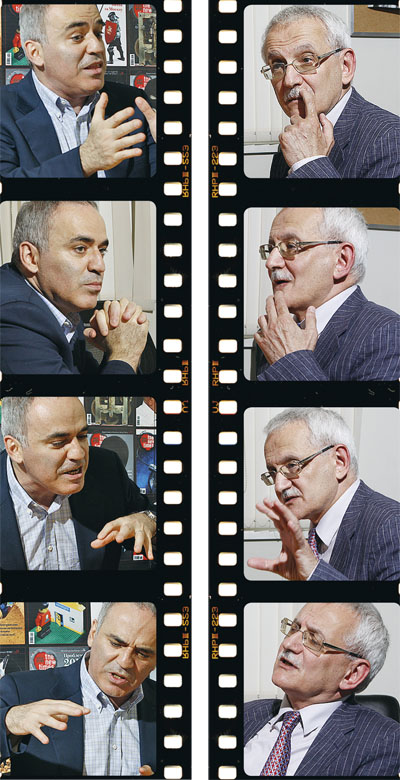
Kasparov: No, no, wait. You are a person of business, so the efficiency of any action should, it seems to me, is interested. So, we have now established that all discussions in the Public Chamber do not lead to the fact that the government is changing its position on issues in which it comes into conflict with the interests of citizens.
Blinkin: There was a discussion, very sharp, General Plan of Moscow. And further events showed that the shift in the part of the city planning policy of the city occurred quite intelligible. Naturally, there are a lot of coincidences ...
Kasparov: Namely, a change in the Moscow government.
Blinkin: Discussion of the head section of the Moscow-Sank-Petersburg highway was extremely stormy, they gave everything to speak out, I also spoke very actively there. It ended ... It didn’t end in anything, yes.
Kasparov: You once again confirm my idea that the Public Chamber and other simulacra, they are created by power in order to imitate the discussion. Because even your reasonable opinion of a major expert, it, by and large, descends into the toilet when the interests of the Rotenberg brothers are at stake. When the interests of those close to the imperial person come to the fore, everything else is just a concussion. You also confirmed that on May 6, the traffic of people's movement was grossly violated. Moreover, this was done deliberately, in violation of the process of passing the procession, which was on the map of the Central Internal Affairs Directorate in the morning of that day. And I would like to ask you: is there a certain limit of this interaction with the authorities? What should the power still commit, so that even such a form of communication with it, which you talked about, would become impossible for decent people?
Blinkin: My profession is a transport politician. Of course, I can give private consultations to some companies, sometimes I earn money, but in principle, in order to write on a topic that is interesting to me, or count on a topic that is interesting to me, I need to interact with the authorities. If I do not interact with the Moscow transport administration, go to federal ministries and so on, in a year I will be just a journalist who writes on a transport topic. I need to know what is being discussed, that in the conjuncture, why such and such an idea passed, but this one has not passed. If you are not invited to all these gatherings, you are out of context very quickly. Another question is that there is a border for which I will not intercede.
Bets
What action of the authorities would such a border mean?
Blinkin: Introduction of visiting visas.
Kasparov: Let's say criminal cases, for example, against Navalny and Udaltsov? 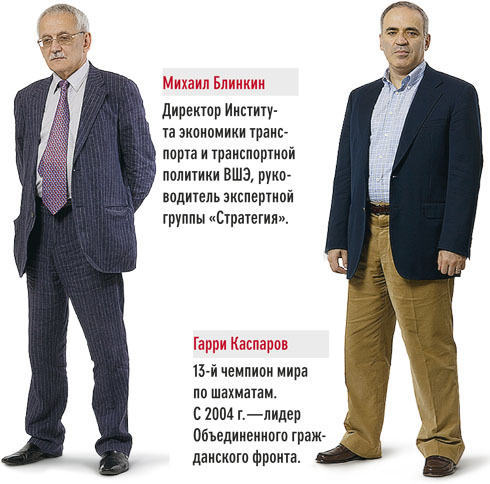
Blinkin: criminal cases against respectable, progressive journalists, say, Parkhomenko or Shenderovich, this is a thing, after which I would have thought at all ... But, for example, Udaltsov - he chose such a path, he draws. The police plays his game, cruel, he plays his game, sacrificial. He chose it.
Kasparov: Both Udaltsov and Navalny were arrested on or near the scene during the officially permitted rally and in the perimeter of its holding. If, according to the results of this banditry of the authorities, criminal cases against these two worthy people will be instituted, for you this is not a criterion that you can no longer communicate with this power? They are accused of organizing riots.
Blinkin: The accusation is absolutely unfair. But am I ready to change my social status and my position in public space, make sharp, irrevocable movements in this regard? No, not ready.
Kasparov: What is so irrevocable in the exit from the Public Chamber? Do you agree that this is an unclaimed, non -state -constituent body, people are not elected there, and in this sense it is illegitimate, it does not solve anything? 
Blinkin: This is a political step that complicates my professional activity. This choice is quite serious, and I'll think about it.
Harry Kimovich, in the report of the CSR just released (interviews with his head Mikhail Dmitriev - on page 14) , it is said that radicalization is both from the opposition and from the authorities to a very sad version - reaction, twisting of nuts, etc. So, maybe Mr. Blinkin is right: you need to negotiate with the authorities, but for this you need such a platform as OP?
Kasparov: Firstly, about the fact that there is a conversation with the authorities. This is not a conversation in which there is a full exchange of views that affect decision making. This is camouflage. You can conduct a discussion, talk about the Khimki forest, about the roads. But as soon as you fit a hill into the sphere of interests of specific boys, this will end with your opportunities to show your professionalism. You will, like Fetisov, let go of the puck from Putin - this ends when the great athlete simply spreads his legs so that Putin drove the puck into the goal. As Vitya Shenderovich said well: suppressing the remnants of professional skill. This power will not allow any changes, it is simply now trying to make a variety of measures, including to drive a protest into the stall.
But power does not exist in a vacuum, it can bend her fingers, show a naked torso, talk about its steepness, but not a single government can resist it that she had a sufficiently powerful professional support. Because in fact, you need to do a lot of things that no sechin can do. And here the role of experts is absolutely determining.
Here you, Mikhail Yakovlevich, said that a number of people - directors, director of the clinic, director of large institutions, that is, people who are behind teams are forced to cooperate with the authorities, even if they understand that the elections are falsified, power is illegitimate.
Blinkin: In the framework of my profession, non -proceeding with power means access to quiet pensioners, at best - to writers ...
Kasparov: And someone protects his team. But the whole problem is that while the professional class in Russia will consider to be acceptable to cooperate with this power, to ensure its functioning, the authorities can safely use riot police. The conscious boycott of this power will certainly radically change the situation.
Blinkin: I will give a very simple example. Moscow during the reign of Luzhkov became the way it became, that is, from the point of view of life in the city is simply terrible, for two reasons. The first is the selfish interests of a certain circle of people around Yuri Mikhailovich. The second is a dense ignorance. The task of the expert, as the task of the doctor, to say: guys, stop making nonsense, die! And I have no right to leave this position. I was born in 1947, I remember a lot of things: we still live in a completely different country. Now, as for radicalization ... Here in the theory of games there is a model called Chicken (chicken): this is when two rush towards each other and from some point there is no longer possible to avoid a collision: the one who leaves the road will lose. This game today is played not only by power, but also by radical people from the opposition. The same Udaltsov.
Kasparov: Putting his own life on the end.
Blinkin: Yes, he plays this game obviously. He wants us, people are absolutely moderate and dissatisfied with this power, to be his supporters.
Kasparov: Violence is provoked on the streets only by power. There is a process of non -violent resistance. Even those whom you consider to be radicals, left -wing, Limonovites, since 2005 have abandoned the use of any violence - for Russia this is a historical step. Tens of thousands of people take to the streets - not a single broken glass, not a single broken window! So who pushes you and what? Power or those who go out with a peaceful protest on Occupyabai, and they are thrust into autozaki?
Blinkin: Our conversation made me think about it, exacerbated the question that I already put in front of myself. You know, when I was 18 years old, I accidentally got to the Komsomol asset at the MHMAT MSU: there was a discussion about the possibility of multi -party socialism. And I made a speech about the fact that it is necessary to eliminate the only party that is. This ended my dreams of graduate school, and I was a good mathematician, and I ended up in the gateway, in the road research institute. In fact, I was forced to change the profession. The second time I somehow do not want to put my professional career under politics, besides, I have not been 18 years old for a long time. The second time in my life - it will turn out steeply ... but I will think.
Let's summarize a result of this conversation.
Kasparov: I got the impression that today a significant part of the professional corps, which provides in my various hypostles the normal functioning of economic and state mechanisms, is categorically not ready to risk personal position in order to change the situation in the country. Meanwhile, the question of whether the authorities will go to tighten the regime or will be forced to retreat largely depends on the position within the elite, inside the professional community: this power will not stand on bayonets and gabsch wiring.
Blinkin: I think that the vast majority of the Russian expert community, if this exists, will not go to any sharp steps towards power in the foreseeable future. I communicate with hundreds of people, even my position, absolutely loyalist, consonant, many of my colleagues seem to be terrible extremism.
The discussion was led by Evgenia Albats