
Translated material
Flexible alternative
Modern mobile phones, readers, tablets and other gadgets develop at incredible speed. The capacities are becoming more and more, the screens are higher, the devices themselves are easier and more compact, but so far no company has yet launched the market what rumors have been actively going on for many years - a flexible device. For the past few years, technical publications regularly write about new projects, but not one of them has reached a full -fledged practical implementation. It is possible that this year the situation will change.
The British company Plastic Logic (known to the topics, 44% of its shares belongs to the Rusnano Corporation, which is going to build an electronic textbooks for Russian schools in Zelenograd) presented its flexible color display for electronic books. Made using the Electronic Paper technology, this display of the size of a little smaller of the A4 sheet is capable of displaying 4 thousand colors when resolving 75 points per inch.
Prior to this, the color E-SINK displays were presented only in the American electronic books Ectaco Jetbook Color. This reader is made on the basis of the E-Ink Triton screen, and has, according to manufacturers, the ability to display “thousands” of colors, but numerous reviews of dissatisfied users say that the 500-dollar reader does not cope with his promises.
It is obvious that Triton is still a “raw” technology, and rumors that it will be used in the following models of the famous Amazon Kindle Reader, most likely are not true.Perhaps the screen from the Plastic Logic will show the best results. Of course, 4 thousand colors and resolution of 75 PPI are not too many, especially compared to the latest liquid crystal monitors, however, it must be taken into account that the “electronic ink technology” works according to a completely different principle-the E-Ink displays do not glow themselves, and for the eyes they look like real paper, this is why they are so actively considering their commissioning in schools.
In fact, the screen resolution from the Plastic Logic is 150 pixels per inch. The fact is that the color is transmitted using a special filter - it is placed on top of the main screen, which displays shades of gray. It is the color filter that reduces the screen resolution, since three pixels are required to display colors: red, green and blue. The fourth pixel remains, which shows shades of gray.
However, approximately the same technology is used in the E-Ink Triton screen. The uniqueness of the Plastic Logic development is that they used both the screen and the light filter not a glass base, as is done on all modern readers, and plastic, and most importantly, they could make the color filter not diverted relative to the screen and the image is not distorted. Moreover, as shown at the presentation, this screen can even be cut with scissors, and it will continue to work.
So unique for electronic readers, the strength makes the screen from the Plastic Logic really a good option for working with children.And although the screen resolution is not enough for serious graphic tasks, it is quite enough to display schemes, illustrations, graphs, geometric tasks and other school needs.
LG Korean Corporation also announced the imminent issue of flexible E-Ink displays-however, black and white. According to the press release, the screen from LG 0.7 millimeters will weigh only 14 grams and have a resolution of 1024 × 768 pixels with a diagonal of 6 inches. The manufacturer also claims that the screen can be bend at an angle of 40 degrees without prejudice.
LG does not disclose by what principle their display is arranged, but it claims that their “electronic paper” is made using technology similar to the production of thin-film transistors for TFT displays. This is an important and promising aspect: it means that soon the E-Ink displays will be able to produce companies that do not have special production lines for the production of “electronic paper”. There will be a fairly ordinary TFT line, which means that the E-IC displays will also have a lot of E-Ink corporation, which produces displays for most Reiders, new competitors will appear.
However, flexible displays are not limited to "electronic paper". Another Korean electronic “giant” Samsung in March 2012 announced that by the end of the year the first devices with a flexible AmoLED display called YouM will appear on sale. The technological solution, as in the case of a flexible “electronic paper”, is to refuse glass as an element of the display design. In the design of the usual AMOLED display, two layers of glass; Samsung claims that they were able to replace the glass with flexible plastic.
The refusal of glass will make the display not only flexible, but also much more durable.Of course, in order to create a flexible electronic device, there are few displays alone. Most likely, despite the lack of glass in the displays, the first devices from Samsung, LG and Plastic Logic are unlikely to be turned into a tube, as in a fantastic film. For real flexibility, flexible electric circuits are needed.
Today there are technologies that allow you to print electronic circuits on a flexible basis. Thinfilm and Parco have jointly developed a technology that allows flexible CMOS miches. They are literally printed, on a device similar to an ordinary jet printer, but instead of paint, special ferromagnetic polymer ink are used. Instead of semiconductors and transistors, different types of ink are used.
This technology allows you to produce extremely cheap, thin and flexible microcircuits, but they have one significant drawback that greatly limits the scope of their application: one -dimensionality.
Inkjet technology does not allow you to print complex electronic structures.
Thinfilm microcircuits are unlikely to be able to be used in complex electronic devices in the near future, but have a great future as “smart” labels-for example, labels signaling the packaging temperature or warning about the expired product of the product, or working “in a pair” with RFID tags, automating logistics operations on wrappers.
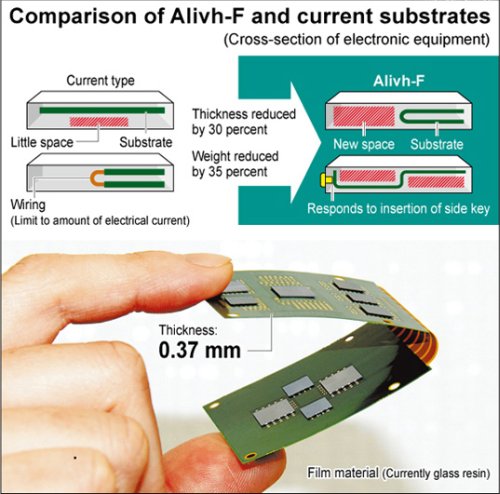
The development of “complex” flexible chips is engaged in Panasonic. On May 10, 2012, she presented a new technology for creating printed boards called Alivh-F. Unlike conventional boards, Panasonic boards are made not from the latest and non -bent fiberglass, but from a special polyamide film. Thanks to this, the board can be folded several times, and get a complex electronic circuit of 8 layers, the thickness of which will be only 0.37 millimeters. Such boards will not only save the precious space inside the housings of mobile devices, but, in the future, create a full -fledged flexible device.
Panasonic plans to start supplying samples of its new boards in June, and launch mass production in December 2012.
Probably, in 2012, several more flexible displays projects will appear when competitors can study prototypes from LG, Plastic Logic and Samsung. However, counting on the appearance of completely flexible mobile phones and electronic newspapers that can be turned into a tube is still early. Most likely, these technologies will be used to increase the strength of the devices, as well as to create a certain form factor, that is, it is quite possible to expect the release of the phone with curved or even “wrapped” around the housing with the display, the case itself and the microcircuits hidden into it will be rigid. In this case, the bending display will be more likely an advertising move - the first flexible display! - than real technical necessity. But with the development of flexible microcircuits, especially after manufacturers can get acquainted with the last Panasonic development, we can expect the appearance of the first completely flexible devices. Perhaps already in 2013.