
Translated material
For the slate!
What will happen to the global gas market?
For the slate! The global gas market will radically change by the end of this decade - primarily due to a sharp increase in the production of shale gas. This is warned by analysts of the Center for Macroeconomic Research by Sberbank, who prepared a report on the prospects of "blue fuel". The New Times studied the problem
The idea that the United States will flood the whole world with gas, obtained using the new technology from shale breeds, has existed since this technology appeared more than ten years ago ** The New Times wrote in detail about this in No. 14 of April 19, 2010. In the presentation of the head of the Macroeconian research of Sberbank, Ksenia Yudaeva, can develop as follows. The United States is increasing the production of shale gas, refuse to import liquefied gas (LNG). Everything that was previously imported to America goes to Europe. When the infrastructure is ready, America also begins to export liquefied gas, including Europe. The European spare market is growing, consumers, having seen enough of the difference in prices in America and on the border with Russia, begin to more persistently demand from Gazprom a new contract system with prices tied to a spawning market, and not “fixed” and tied to oil, as now. Gazprom will be forced to agree and lose both the volume and the difference in price.
Fuel of the future
Russia, in which in 2011, gas exports brought $ 64.3 billion (over 12% of all export revenues), to a radical change in the global gas market that is happening before our eyes, is clearly not ready. For many years, Gazprom convinced European consumers that long -term contracts were needed for gas, and the monopoly itself invests giant amounts (an investment program for this year - 844 billion rubles) in pipeline transport. However, now that the gas market has undergone such significant changes, these investments may never pay off.
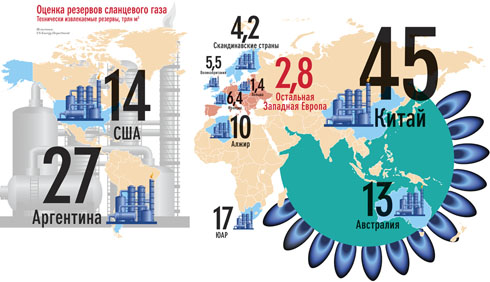
For ten years, the share of shales in gas production grew from zero to 29% in 2010. Last year, liquefied gas trading accounted for 30% of the total global gas market. Its volumes increased by 22.6%. Deliveries of gas through pipelines lose to liquefied gas: over the past year they increased by only 5.4%, mainly due to an increase in gas exports from Russia to Europe.
America refused imports and provides itself at the expense of the growing shale gas market. In 2011, in America, 1300 wells per month were drilling in search of shale gas. As a result, gas in the United States over the past three years has fallen in price by 80% and is now cheaper than in Russia, Yudaeva notes *** in April, gas prices in the United States were $ 70 per 1000 cubic meters, in Russia - about $ 100 for 1000 cubic meters ..
America has become a country with the fastest growing gas production in the world, the main source of growth of global hydrocarbons, the chief analyst of Citigroup for raw materials Edward Morse notes.
An example of the United States was contagious. Four years later, industrial gas production in India will begin. Intelligence was conducted by the state oil and gas company ONGC, and it will produce gas together with Conocophillips.
The cooperation of developing and developed countries in the extraction of shale gas is inevitable: technologies for its extraction are only developed and rather complicated. Therefore, the traditional “resource egoism”, when authoritarian leaders like Hugo Chavez carefully do not allow foreigners to develop a “national treasure”, in the case of shale gas, it is hardly possible. One of the main problems is how to prevent gas from shale pollution of groundwater during gas production.
Thanks to shale gas, Australia will double its reserves, it will be possible to extract gas as early as 184, the recently said Australian Energy Minister Martin Ferguson.
In 2014, commercial production of shale gas and Britain will begin. Could start earlier, but the pumping of gas from shales led to the island to two earthquakes - in April and May last year. Officials suspended the prey by setting the maximum maximum (an earthquake of 0.5 points), in which the production should stop. Apparently, the growth of seismic activity in the extraction of gas from shales is inevitable-it occurs due to slats of water, sand and chemicals (which are needed to produce a hydraulic lines of the layer and extract gas). But most of all shale gas, American researchers say, in China - 45 trillion cubic meters * * * According to the Chinese Ministry of Earth and Natural Resources - 25.1 trillion cubic meters .. China's goal is to extract 6.5 billion cubic meters of shale gas by 2015 and 60-100 billion - by 2020. To bring the explored deposits to commercial production, it will take 3-5 years. Private Chinese companies will be allowed for the extraction, while the Chinese offer foreign to invest in projects that local firms lead. "
Gas in the United States over the past three years has fallen in price by 80% and is now cheaper than in Russia
“In the next 5-10 years, the United States will turn from a gas from an importer into gas exporters, Canada will become a global player, and China will be a large manufacturer of shale gas, which will reduce imports, Yudaev believes. The worst prospects for shale gas production in Europe are small, and the high population density interferes with production.
Caution: Prices
However, the future of shale gas is not cloudless. Firstly, the environmental consequences are still unclear due to the hydraulic fracturing of the layer. Perhaps they can be reduced, but so far it is problematic. Secondly, due to the growth of production, gas has so much became more expensive that at the current prices in the United States, mining from many wells has become unprofitable. But shales require investments. The construction of infrastructure for export and gas consumption (gas stations, etc.) will lead to an increase in prices for it, Yudaeva believes. So far, the alteration of the current cars from gasoline to gas is too expensive ($ 5-10 thousand), and the engine power decreases by 5-10%.
Finally, shale gas will not cover all needs. By 2030, China will have to increase LNG imports from the current 51 billion cubic meters to 114.5 billion cubic meters, and only 68 billion cubic meters will amount to pipeline from Russia, Graham Tyler from Wood Mackenzie believes. In order for gas gas production to be profitable, China can tie its price to the price of oil for several years, Tyler believes. But then one of the advantages of shale gas - its cheapness - will evaporate. 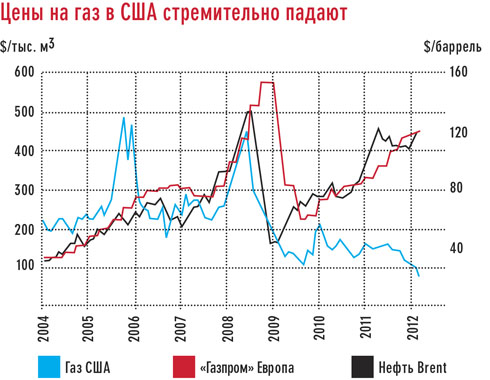
However, so far, contrary to expectations, American shale gas manufacturers are quietly experiencing a drop in wholesale prices below the cost of production. The drilling of new wells in return for those who returns continues, and the market is gradually changing, the demand for gas is growing: transport goes to it, infrastructure is being prepared for export deliveries.
And, for example, in Australia, local companies and world grades (Conooco and Mitsubishi) have already promised to invest $ 600 million in gas production, says Andrew McManus, vice president of the Wood Mackenzie gas consulting company. It is possible that the ecology will force the current forecasts of shale gas reserves. But even in this case, the overall trend is undeniable: the gas will be much larger than now, and it will be cheaper. Citigroup analysts predict that thanks to this, the United States expects “new industrialization” - a rapid growth of oil and mechanical engineering, which depends on the gas, and the acceleration of the average growth rate of GDP from 2% to 3.3%. World gas trade will decrease - more will be mined in the same place where it is consumed.
In the next 25 years, the gas will not rise in price, but, most likely, will fall in price, the forecasts of overseas colleagues are confirmed by specialists of the Institute of Energy Research of the Russian Academy of Sciences. Another argument in favor of this thesis is the switching of consumers to alternative types of fuel. According to the calculations of the Inei, an increase in the share of non -traditional gas in mining by two percentage points leads to a decrease in prices by 10%. And this means that Gazprom is time to seriously think about changing the strategy: just waving a gas club over Europe will no longer be possible.