
Translated material
Above the neck of Mubarak
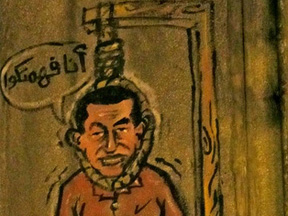
Former President of Egypt Hosni Mubarak, who lost power in January last year as a result of an uprising, was sentenced on Saturday by life for the execution of 800 demonstrators. This was reported by Reuters .
A similar sentence was received by the former head of the Ministry of Internal Affairs of Egypt Khabib al-Adley, who gave orders for the execution of the demonstrators. In addition, the court lifted the “prescription” of the charges with the sons of the ex-president Ali and Gamal.
Six high -ranking police officials who were accused of involvement in the murder of protest shares also received an acquittal.
But only four of them came to the wild. Former Head of the Security Service of the Egyptian capital, General of the Ministry of Internal Affairs Ismail Ash Shaar, was taken to the hospital with a heart attack after the announcement of the sentence. And another person involved in the high -profile case, the former head of the State Security Service, General Hassan Abdel Rahman, must again go through the courts on the fact of the destruction of documents.
If you summarize, then from prisons in the coming days will be released: the former head of the general security service, General Adley Fayed, ex-director of the central unit of the internal troops Ahmed Ramsi, as well as Osama al-Murashi and Omar al-Farmaui, who headed the district divisions of the Security Service.
After the end of the process, the state prosecutors expressed indignation at the court decision.They believe that Mubarak and Adley can be applied to be recognized by innocent, writes Kiama Independent . Given this, the prosecutor general of Egypt on Sunday protested the court’s decision, Fox News notes.
It is reported that the convicted person of the 84-year-old ex-president became ill with his heart when he was transported by helicopter to the Torah prison. However, this did not prevent the crowd gathered at the court of the court, to chant: "Enough conversations, we want execution." In this, she was in solidarity with the prosecutor’s office, which in January demanded for Mubarak the death penalty by hanging.
Opponents of Mubarak, representatives of revolutionary and youth movements, began to gather on Tahrir Square after the announcement of the court decision.
The demonstrators condemned the “too soft” sentence for the ex-president.At the same time, about 100 people were injured on Saturday and riots, 20 of which were hospitalized.
A day later, the revolutionary movements of Egypt called for an unlimited protest on the central square until the requirements are fulfilled: the suspension of the presidential election, the creation of revolutionary folk courts over representatives of the Mubarak regime. At the moment, several tens of thousands of people have gathered on Tahrir, notes the New Sabah Times .
The greatest outrage of the crowd, as noted by BBC , caused not even a lifelong time for Mubarak and Adley, but the acquittal to police officials.
Demonstrators demand to call the guilty of the protesters in order to execute them - since the police officials were innocent.Note that the protesters are determined. They do not diverge from the square even at night, claiming that they cannot allow the conquest of the revolution. The radicals installed a memorial there, which is a miniature cemetery of the regime victims.
Participants in the demonstrations who are afraid that the presidential election can win the Prime Minister of the government of Mubarak Ahmed Shafik, supported the Islamic Muslim Brothers Islamist movement and his election candidate Mohammed Mursi. He, along with Shafik, will participate in the second round of the presidential campaign.
Recall that Mursi, in particular, on Saturday stated that in the event of his election he would seek a fair court decision in the case of Mubarak and his supporters.
In response, Shafik on Sunday accused the “Muslim brothers” of intimidation of voters and warned that the Islamists would lead Egypt to a religious war between Muslims and Christians, Washington Post reports.
“I represent the movement forward, and they want to move back. I lead the Egyptians to transparency and the light, and the “Brotherhood” - to darkness and secret, ”Shafik said at a press conference, emphasizing that no one in Egypt and in the world, except for narrow public groups, did not accept radical Islamists.
Shafika had to pay for his position.On Sunday, several regional offices of the presidential candidate were attacked, and the Chamber’s election headquarters in Cairo was defeated on Monday.
According to the results of the first round of the presidential election, Mursi scored 24.3% of the vote, and Shafik - 23.3%. The second round will be held on June 16-17.
Recall that over the past year, several state leaders have been convicted or killed.So, at the end of May, the tribunal for war crimes in Sierra Leone, working under the auspices of the UN in The Hague, sentenced the ex-president of Liberia Charles Taylor to 50 years in prison.
The former head of state was convicted of supporting the rebels in Sierra Leone, who destroyed the civilian population during the civil war in 1991-2002. During this conflict, 50 thousand people died. The accusation claims that many of the crimes Charles Taylor committed personally. Taylor himself refused to find himself guilty.
Earlier at the hands of the rebels, embittered by the murders of the civilian population and a protracted confrontation with the ruling regime, the Libyan dictator Muammar Gaddafi died. He was mortally injured when he tried to escape from his hometown of Sirte when he was attacked by an armed opposition. The leader of Jamahiria was secretly buried.
Gaddafi's son was more fortunate: the detainee, while trying to escape to Niger, the safe al-Islam will appear before the trial in Libya. But the international community, which seeks to transfer his case to the Hague, is afraid of an unfair trial of him in his homeland.
The President of Yugoslavia Slobodan Milosevich died in 2006 during the process over him in the International Tribunal in The Hague. Former Prime Minister Thailand Taksin Chinavat was sentenced in his homeland to two years in prison for corruption, since 2009 he has been looking for Interpol.
The political career of President Iraq Saddam Hussein, who was deprived of the authorities as a result of the American invasion in 2003 and was executed in 2006, by the verdict of the Supreme Court of Iraq, ended even more sadly.
At the same time, a number of political figures, even if they committed crimes against their own people, managed to avoid execution and even atonements in court. So Prime Minister Cambodia Paul Pot (Salot Sar) left Kara for the murder of 1.5 million of his fellow citizens, paying for this only his post. And Shah Mohammed Reza Pahlavi during the Islamic Revolution in Iran to try to suppress the demonstrations escaped with emigration.