
Translated material
: Young smart after new boring

Students and graduates of the Rodchenko school made exhibitions “ Show and Tell” at E.K.Artburo and “ without exception” to mamm, from which it became clear that contemporary art is not just the fun of financially secured elites, but research, which contributes to both the awareness of the social situation and the knowledge of oneself. That is, you can recommend contemporary art instead of yoga and together with rallies.
In Moscow there are only two institutions that give an education in the field of contemporary art - the Institute for the Problems of Contemporary Art (he is also the “Institute of Bakstein” named the founder and director), and the school of modern photography and multimedia named after Rodchenko. A couple of years ago it was impossible to say anything concrete about who these schools release. About the Rodchenko school-at least simply because it was opened only in 2006 and the graduates were still not enough to bring some results. And the Institute of Bakstein, although it has been conducting educational activities since 1999, and clearly shows that most young artists now -famous artists have studied there, it was also clear that some of the students disappeared nowhere.
However, now we can talk about the latest issues of Bakstein as a generation, and thanks to art critic Valentina Dyakonov, in 2010, the name “ new boring ” appeared. One of their features, as he writes - "these are boys and girls who have chosen the path of maximum adaptation to world moods." Bakstein, actually, had long told his students about the need to be internationally clear, but for some reason no one had strove for this before. Either the experiences of senior artists who remained national, sought international success were still too close, or the globalization simply did not go so far and was not realized, and there were much fewer opportunities to ride and see what they were doing in other countries. And the groups and sensations of the generation were not born, probably because practical classes, a series of master classes leading to the “thesis”, each year of different artists, adults, famous, and strong. Therefore, their teaching went for the future only to those who could feel a kind of kinship with the ideas of the teacher. But for several years now, the master classes have been led by Stanislav Shurip, an artist and theorist, who, by age, is closer to students and conducting consistently the ideas of formalism (in a good, western sense of the word), from which it is logical to derive “new boring” ones.
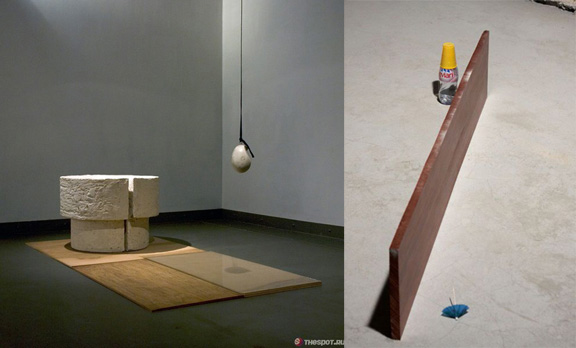 Work of Alexandra Sukhareva
This generation is very successful. His last achievement: the artist Sasha Sukhareva became the only Russian participant “Documents”, which has been held every four years in Kassel, the most intellectual event in the world of contemporary art. However, the current “document” itself is some kind of doubt-its curator Caroline Kristov-Bakakkazhiev, in her interview with Archronika magazine , said that “art is able to offer ways and tools to achieve happiness,” for example, to help fight the attention deficit syndrome, that she sees “the connection of quantum physics with literature-Joyce, Gogol” and suggested “to see partners and partners and partners” In animals. I believe in a more meaningful co -evolution with different species of animals - from bees to dogs. " She invited not only artists to meet with potential participants, but also mathematics, genetics, sorcerer and specialist in the language of primates. After all this, she looks more like a victim of the modern world than as a person who knows how to save him. Fast -regime deprives the world of the usual center - and man is the center of the world. If there is an alien mind, otherworldly mystical forces, then why they did not force us forced us, or if the mind of the bees is so valuable, then why did they not protest against their exploitation by the Moscow ex-mayor Yuri Luzhkov. Here the problem is that animals are not aware of the fact of their exploitation, and people who are fighting to let go of all domestic cows and sheep do not realize that they endure their own problems on innocent creatures.
New boring is too international. Also, Kristov-Bakakakiyev in his curatorial strategy speaks of such a cosmic mind that there is no place for a person, including the viewer.
The point of contact “Documents-2012” and the new Russian boring artists coincided with the fact that a new generation appeared-graduates of the School Rodchenko. Their common interest can be designated as an anthropology of modernity.
Two key works of the School of Rodchenko’s diploma exhibition “Without exception” ( until June 24, Multimedia Art Museum, Moscow ) - Dmitry Venkov’s film “Crazy imitators” and the film by Victoria Marchenkova “Potential great -grandfather”. Markchenkova film-documentary and game. So it is indicated on the label, and so it is - it is compiled from an interview with the famous Russian contemporary artists with their impressions of China and fragments of the performances of the Chinese circus. What exactly he is the gaming, except in the installation - I did not recognize, because the film is 33 minutes, and behind the turn of those who want to listen to the words of the heroes through the only headphones. Fortunately, Multimedia Art Museum, Moscow, which has its own cinema hall, promises the opportunity to watch this film and the rest on a fairly wide screen (wait for the schedule here , check before a visit, sometimes it changes).
The story in Marchenkova’s film was twisted, judging by the explication, at the upcoming merger of Russia with China, which often appears as a plot in the literature and cinema of recent years, by Vladimir Sorokin (“The Day of the Opipor”, “Flood”), with Kholm Van Zaychik (a series of novels “There are no bad people”), in the new film by Alexander Zeldovich Mishen. “The film unfolds in the 2020s, after the collapse of Russia. Heroes act as conductors of knowledge about the relations of the East and West in those days when there was still a separation strip between them, but do not give us an answer to the question whether the defeat could be replaced by success and what, in fact, consider them, if we are talking about the country. ” In that small fragment that I managed to see, Lev Evzovich, a member of the Aes+F group, spoke about the such features of the Chinese consciousness: “Any new is better than any old,” and - “The Chinese does not have the concept of the world, the end of the war denotes the beginning of a new war.” Next - the story of Kirill Preobrazhensky, artist, teacher of the School Rodchenko. He talks about his impression of China, that he seemed very similar to Russia in a frenzy of consumption - a whirlwind with an empty center in which there is no person as such. And therefore, Russia does not look like itself - before, the history was always perceived in it not as a set of dates, but as the canon of the hero - even a “small person”, even “sixties” - but in the center of history there has always been a personality or type.
Dmitry Venkov’s film “Crazy imitators” - a game of anthropology with anthropologists. He made a film about people thrown out or departed from society and settled behind the Moscow Ring Road. Well, it’s not at all about those who live for Koltseva, although this is also a separate civilization: there are also millionaires, and gopot, who still unites something-once I came across statistical data that there was the highest level of crime in the country in the suburbs. Venkova’s film - about the modern tribe living only in that the road gives them. Their life and rituals are shown in detail - the spell of the highway shaman and daily prayer. It would be possible to believe it absolutely if the role of a shaman was not played by a groin , an artist, a musician, the author of the hit, “ And the Life of a Merry Carnival”, the favorite actor of the most radical Russian director Svetlana Baskova, as well as the art director of Marie Claire and Elle Decor magazines. And if it were not for the comments of Russian and foreign “Anthropologists”, they are played by famous Moscow art historians, Alexander the Evangelies, Alexander Obukhov, Oksana Sargsyan, as well as the artist Arseny Zhilyaev, who fell under the definition of “new boring”, but went beyond it. They say by quotes of classics like Levi-Strass and from modern scientists. The author of the film, wreaths, sent his film to review one of the quoted scientists - he did not recognize his words or, of course, of Moscow art historians, and the film was very praised as an excellent study. No matter how this is the reason for creating a new myth about Russia - to bears that walk along the streets, information that people in Moscow live in forests for a ring road will be added.
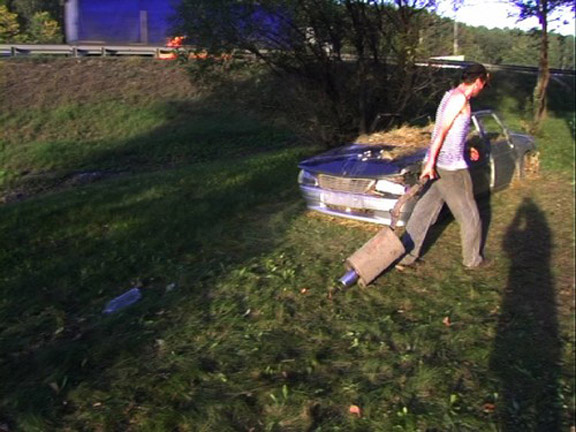 Dmitry Venkov "Crazy imitators", a random shot from the video
A common feature of these two works and a number of others is an appeal to the opinion of experts - even if they appear in an invented position, like Venkov, in their real role, but in an invented situation, like Markchenkova, or are commentators of the work itself, like Ekaterina Lazareva, who traveled along the Radishchev route and read his famous work “Travel from St. Petersburg”, trying to apply it to it. today. She turned to two experts - from St. Petersburg, Andrei Krotin from the Institute of Russian Literature, and to the Moscow historian, the artist and political activist Ilya Budraite. The course of reading the classics on the anger of the day is widespread, it is brilliantly applied in Mirzoev’s film “Boris Godunov” (2011), and the quotes of the great people of the past used in advertising newspapers “Moscow News” turned out to be so relevant for modern Russia that some advertising boards were ordered to be dismantled. However, as Budraitskis says in his comments on Lazareva’s work, “the discourse of the inescapable historical fate always fails us very much. In fact, it is dangerous in that it always opposes any real changes. ”
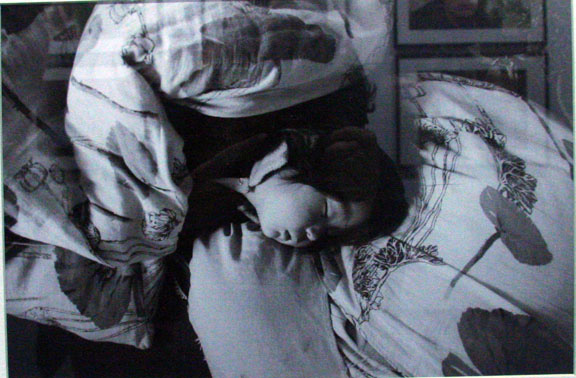 Stas Chekmayev, from the series "Introvert the Republic of Tuva"
The real person and his opinion in the center of artistic work are the exact opposite of the international style of “new boring” ones. Of course, the exhibition has a very different type of work. Photographs that gravitate towards a good journal report. The work of Alexandra Rudenko “Visual Dictionary of Russia”, in some places lyrical, as in a photo of a young military, thoughtfully hiding in spring greenery, and a patch on his hat seems to a flower, in places - bitter, as in a photo of intelligent adolescents who received a muzzle on the street of a night city and wiping blood. The work of Stas Chekmayev “Introvert the Tuva” could be on the pages of “Around the World”, and the Sayana Mongush series “Shaman-Office”, portraits of shamans with short stories about their professional career, or Galina Kamenskaya’s work “General desire” about the topography of modern cults, places where hundreds of strangers perform the same rituals, castles are hung Or tie ribbons - they could be published in Eskvire, for example.
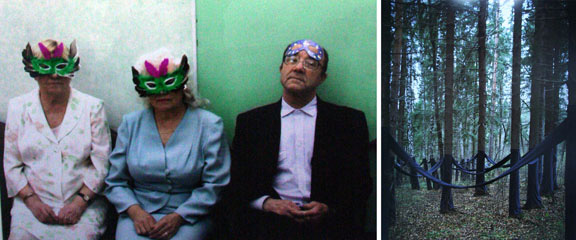 Photo by Alexandra Rudenko from the series "Visual Dictionary of Russia"; Natalia Tabakova, photo of the project "Forest"
Stas Chekmayev, from the series "Introvert the Republic of Tuva"
There are work in a conceptualist manner - for example, Sofya Gavrilova applies cartography to her memories. Photos of places of very unattractive gain the value for the viewer, accompanied by the schemes of the area with the marked point of the gaze of Sophia. So, "Children's music school named after Arkady Ostrovsky ”(zone 1) is surrounded by radial zones under the same number 2, continuing to infinity to the rest of the world-this is“ isoling of fear and shame, due to the impossibility of coordinating the movement of the hands during playing the piano and the need to open your mouth in choral classes. ” Subjective mapping, used by Moscow conceptualists to understand the mechanisms of human perception, continues in some confessional and emotional character, previously more accessible to literature, and is little represented in visual art.
Students of the School of Rodchenko know about all the technical means and types of modern artistic thinking, but they turn primarily to a person, and not to abstraction, specific territories, and problems at the same time eternal and pressing - so, Mikhail Maximov, for her work, “Mother gives birth to her husband’s father”, shoots on a 3D camera, still very primitive, people talking about children and motherhood. The camera is blind, and therefore people look like generalized mannequins, liquid terminators, they constantly lose some parts of the body, hands and fingers fly separately, bounces their noses from faces, the camera does not distinguish where one body ends and the other begins - and multi -headed and multi -armed monsters appear, talking with themselves. A clear background, very prosaic, then a bench in the country, then a cemetery, places that are visited by family - put under 3D shooting of figures in the computer. Sound is a cut from a recording of real conversations, from which only interjections, Ahi and Okhi are left. All this, mounted together, plunges into the touch of a young mother to an explained science, but at the same time a completely mystical process of continuing the genus, when consciousness for a while (and sometimes for the rest of his life) is turned off, and the miracle of the appearance of the child throws a woman into an unconscious, which can not be described in the language of primates.
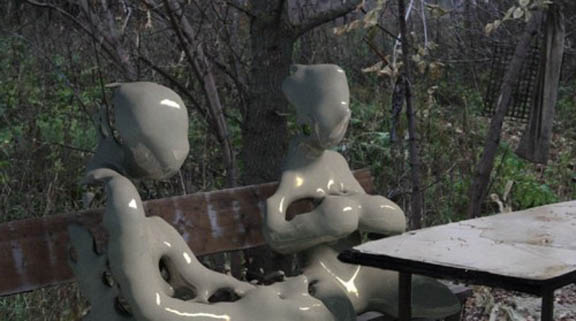 Mikhail Maksimov "Mother gives birth to her husband's father", a frame from the video
The exhibition “Show and Tell” ( until June 15, “EK Art Bureau” ) is the works of students of David Riff, art critic, theorist and teacher of the School Rodchenko. All of them are marked by the same interest in anthropology as the diplomas presented on “without exception”, although the will of the teacher is more felt here. The combination of the place and the overall exposition move work strongly.
The exhibition hall "E.K. Art Bureau ”is an apartment in a residential building. The curator Elena Kuprina, together with her comrade -in -arms, artist Alexander Danilova made a number of excellent exhibitions of Moscow conceptualism, also "E.K." Following the young authors who correspond to this tradition, and regularly makes their exhibitions. The space is amazing-the apartment has a secret character, like Soviet, or rather, anti-witch, apartment exhibitions, but there is no spirit of marginality inherent in home exhibitions of the 2000s, while the place is far from the mainstream. Just a point at which they are professionally engaged in art, which makes the meaning of existence. The apartment is partly used as an apartment-therefore, there is always a sense of personal space, penetration into someone’s life.
And the general exposition move is labels in the form of small screens on which artists talk about their works. This is also a kind of works in which artists are the subject of research for the viewer. An opportunity that is not always given to us, but it is very important - to find out what the author wanted to say.
The name of the exhibition is the same as that of the popular game in kindergartens of the English -language world, where you need to choose your favorite item and tell its story. Actually, this is the art - to see certain features of ordinary objects, not noticed by anyone else, to show the hidden mechanisms of their functioning. At the entrance - the video “Field” by Lena Koptyeva, in the plot, similar to fragments of a typical Russian series, only shot by a talented operator, with conversations of a married couple at breakfast, walks of new buildings in love with the ugly courtyards, but they say something terrible. It turns out that the text for actors is composed of advertising SMS.
Small lightboxes "My columbarium" Andrei Kacalyan are a photo of lush burials of pestilence. Manto from the couture for Yorkshire is, of course, a parable in a tongue, but a completely different story. We do not know what will happen to those Yorkshirs after their death-but perhaps they will not solemnly bury and wear flowers on the grave, because in such cases it is not so much a favorite as an escort service, mannequin to demonstrate luxury. Here, the artist reveals another story - that the popular tradition (or Soviet necessity) has now gone to live in a family together with several generations, and changed to the western one, when children leave their parents early for an independent life. The ancestors are longing and turning a dog or a cat who replaces the child to them, and buried with all the honors as a native child.
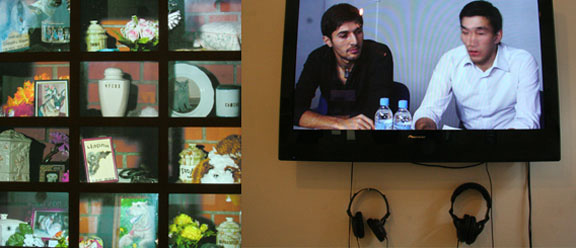 "My columbarium" Andrei Kachalyan; Elena Artemenko, "Round table"
Young artists freely “sprinkle” everything familiar, everything that seems to be, of course. “Letter”, and in general the epistolary genre, as the embodiment of tete-a-tete, and in this case, a love, that is, ideally, sincerity and immediacy of feelings, in the work of Evgeny Gorlshchikov, appears in a strange form-a letter from the point of view of the Litredactor rules the red ink of an elegant female hand. With a red manicure, and you already think that this is a manifestation of hysteria from a lady who received a letter, point out errors in the Russian language so as not to think about love mistakes (so often in social networks - in the comments people who disagree with the essence of the post, compensatory begin to brand the author for typos or illiteracy). But no - it turns out that the boy wrote a letter to his girlfriend, but was terribly nervous that he made mistakes, and gave a letter to his acquaintance to the editor. До чего ж мы докатились, если соответствие норме важнее искренности.
Сопоставление ненормальной правды и нормативной лжи есть во многих работах. Елена Артеменко взяла своим предметом «круглый стол» как явление. Эти столы, как правило, посвящаются актуальным вопросам современности, и среди них – проблема нелегальной иммиграции и ксенофобии. Художница взяла цитаты из различных публичных встреч на эту тему, а еще на них часто говорилось о том, что «жаль, что главные герои нашей беседы не присутствуют здесь» - и вложила эти слова в уста гастарбайтеров, нанятых актерами на этот круглый стол. И пусть они не всегда правильно говорят по-русски, и иногда читают по бумажке, но работу актера они выполнили прекрасно. Тут есть и ирония – очень часто круглые столы не желание высказаться и что-то изменить, но просто нудная работа по озвучиванию общепринятых мнений, имеющая материальную выгоду для участников. И вопрос – если уж что-то менять по теме этого круглого стола, то почему бы не попробовать дать гастарбайтерам иные вакансии, кроме дворников и строителей. Хорошими актерами они тут себя уже показали, и на посту местных чиновников были бы не хуже их - по крайней мере, у них было бы оправдание, почему просьбы населения не услышаны: «мы не знаем по-русски».
В этой выставке тоже есть работы, связанные не с социальным бытием, но с восприятием образов человеком. Софья Гаврилова показывает настенный паззл «Пейзаж с тремя лошадьми» - вместо элементов паззла, в которых мы собираем заданную картинку, здесь большинство деталей - просто белые и пустые, и мы вольны их соединять, как получится. Но местами на них есть текст, который замещает картинку – надписи «три лошади у одной звездочка на лбу», «река», «река», «река», «небо», «облако». Концептуалистское взаимодействие текста и картинки, вернее, замещение образа словами. Что именно думает художница о своей работе, я так и не узнала, потому что на видеоэтикетке она все сидит и сидит в лесу, но что поделаешь, художники не только на видео, но и в реальности бывают неразговорчивы и предоставляют исключительное право слова своему произведению. Приходится зрителю находить ресурсы понимания в собственной фантазии и базе знаний. Елена Куприна вспомнила в связи с этим работы Малевича – серию рисунков с сюжетными названиями, вроде «Кошелек вытащили в трамвае», но при этом на картинке есть только рамка, в которую вписаны слова. И как протоконцептуалист Малевич говорил, что если написать слово «деревня», любой представит ее себе четче и яснее, чем если бы она была нарисована.
Школа Родченко продолжает работу с плодотворными диссонансами. Не только между текстом и изображением, традицией от Малевича до концептуалистов, но между словом и делом в нашем мире, между материальной частной и коллективной собственностью и интеллектуальной общественностью.
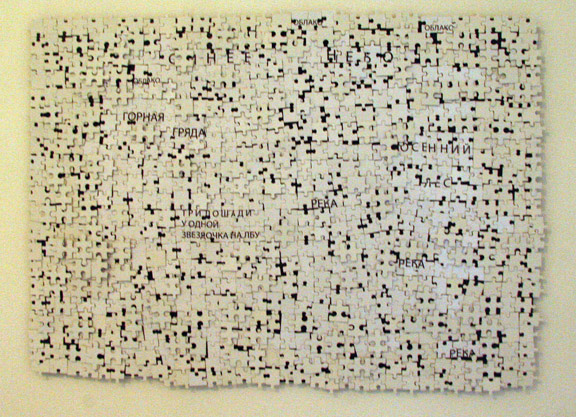 Софья Гаврилова, «Пейзаж с тремя лошадьми»