
Translated material
Dollars, euro? Better pound and franc
How to protect yourself from a crisis
Dollar or euro? Better Frank and pound! The fall of the ruble, as usual, forced Russian citizens to rush into exchangers. During the first decade of June, the national currency was restored, then fell again, thereby confusing everyone even more: how to preserve their savings and in what financial instruments to invest. How the population reacts to an unexpectedly cheaper ruble and a course of confusion and what experts advise - found the New Times 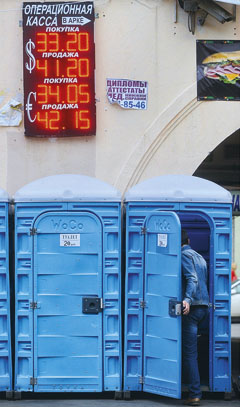
Following us, the father of the family comes to the exchanger. His wife and little daughter stand at the entrance, guarding a small bunch of suitcases and backpacks. “We are going abroad, but we saw that the course has grown sharply, we decided to change more,” the lady explained.
Many banks were clearly not ready for the influx of those who wanted to buy currency in the wave of an unexpected sharp reduced ruble.
In the period between May 31 and June 4, a shortage of dollars was observed in many exchange points. “We need to order in advance,” they told the correspondent in the office of Rosbank on Tverskaya, citing a sharp increase in demand.
An employee of the exchange point near the Baumanskaya metro station reported that people are actively interested not only in dollars, but also to the euro. Although the European currency ended at the box office the day before. The cashier admitted that she advises customers to purchase dollars: “Take bucks, you will not lose. They grow very quickly. ”
Run to the dollar
The central bank of currency excitement is not seen. “Our statistics do not show that the profile of demand for foreign currency has changed,” said Sergey Shvetsov, deputy chairman of the Bank of Russia, deputy chairman of the Bank of Russia. “The population behaves absolutely normal, there are no special queues in exchange points.” "
It’s too late to run into an exchanger with a bag of rubles to be overstated in dollars: the market has already shook, and when and in which direction the next fluctuation will not know, even experts do not know
”On June 5, when the ruble began to slowly play the ruble on the exchange, in the previous days, in exchange offices, on the observation of The New Times, they did not fuss and change the price tags back.“ Listen, back in mid -May, I had a dollar for 31 rubles, and the euro is 34 and 43, The exchange point of the Uniastrum Bank on Tverskaya.
Most of The New Times surveyed by banks recognize that in the last 2-3 weeks there has been a tendency to a faster increase in currency deposits than ruble (official data of the Central Bank should appear only in early July).
Another consequence of the weakening of the national currency, according to tradition, is a surge in consumer activity, which is accompanied by an increase in demand for loans. “There is a category of customers who planned to make an expensive acquisition, saved up for the purchase, but now, seeing how import prices are growing against the background of the weakening of the ruble, they are trying to make it as quickly as possible,” explains Mark Rubinstein, director of the IFC Metropol IFC. “In this situation, people are in a hurry to take loans - at least for a small amount and term.”
According to experts, the growth of demand for consumer goods, in particular, bought on credit, has already begun. “May became a record for us: loans to individuals were issued by more than 4 billion rubles with an ordinary average monthly volume of less than 1 billion,” says Vladimir Verkhoshinsky, a member of the Moscow Bank Bank. “Consumer expectations were played by the last role regarding the change in the exchange rate.”
“Our partners-retailers note the growth of demand for expensive household appliances or furniture,” says Andrei Sokolsky, senior vice president of Alfa Bank. In his opinion, this is primarily due to the desire to turn their funds into real goods in the context of financial instability.
What to wait
An increase in the dollar and euro in relation to the ruble will wrap up the increase in prices for imported goods in Russia by 5-15%, said Pavel Shapkin, chairman of the National Union of Protection of Consumer Rights: “It is unlikely that many Russian markets are largely dependent on importing.”
According to the expert, the price spiral will most likely be spinning in mid -June. “By this moment, commodity residues will be sold, which are now being implemented at old prices,” said Shapkin. “But prices can also increase on them on the eve of more expensive deliveries.”
According to experts surveyed by The New Times, such imported goods as household appliances and electronics, clothes and medicines, as well as cars, can rise in price. Growth will also affect domestic goods produced from imported raw materials or components. In the meantime, bankers record a noticeable increase in demand for car loans *** according to PWC estimates, in 2011, with the involvement of credit funds, 44% of all new cars were purchased .. “We have a demand for car loans in May 30%: most likely, this is due to the concern of citizens with the possible increase in prices for imported cars of all brands,” says Elmira, deputy chairman Tikhonchev. And many tour operators, in connection with a decrease in the ruble exchange rate, raised the cost of their services by an average of 10%.
What to invest *
Unity in the understanding of where the course will swing in the near future, even analysts do not have. The majority believe that the ruble will smoothly fall smoothly under the supervision of the Central Bank by the end of the year. “In the near future, the dollar may reach 35 rubles if the situation in Greece will develop according to the worst scenario,” said Dmitry Alexandrov, head of the university analytical service.
35–36 rubles per dollar - the head of the analytical department of the Tserich group Nikolai Podlevsky, who founds his forecast for the confidence in the fact that oil will be cheaper, is sees on such a prospect. But BCS Express analysts believe that after reaching 34.5 rubles, the dollar is adjusted to 31.5–32 rubles. Anna Bodrova, an investkaf analyst, is equally optimistic, who believes that in the near future the dollar in Russia will cost 31.7–32.8 rubles. By the end of the year, the expert predicts a “fork” of 31–33.5 rubles.
So what to do with their rubles to ordinary people who do not study the movement of markets professionally? “Nothing,” the chairman of the Board of Directors of the Bank of the Bank Oleg Vyugin is convinced. “This is basically wrong: trying to win in a game whose rules are unknown to you.” The banker believes that it was too late to run into an exchanger with a bag of rubles, to overstate dollars: the market has already shook, and when and in which direction the next fluctuation will not know even experts. At the same time, the expert advises to be guided by common sense: “If you are going to rest abroad, it is reasonable to quickly get the currency of the country where you are going. But if you receive income in rubles and are going to spend money in Russia, think firmly whether it makes sense to distill the rubles you have in dollars, and vice versa - the only fee for exchange points will eat all the profit from such an operation. ”
Well, to those who still scratch their hands to play with some currency, experts advise paying attention not to the usual dollar and euros, but to less promoted Swiss franc and a British pound. If Russia has an outflow of capital, then in Switzerland, on the contrary, an influx. And the British currency behaves better than the dollar, and the euro, and the yen. Not to mention the ruble. The indicators of the British economy are surprisingly stable, despite the crisis.
Reply to relate to all overwhelm