
Translated material
Spring in Marrakesh
Spring under control. In late May - early June, tens of thousands of Moroccans, for the fifth time since the beginning of the year, took to the streets of the largest city in Morocco - Casablanca, demanding social reforms. But even this protest, like all the previous ones, did not result in a protracted confrontation with the authorities, as in Tunisia, Egypt, Libya, Syria ... that extinguishes protests in Morocco - The New Times found out in Marrakesh 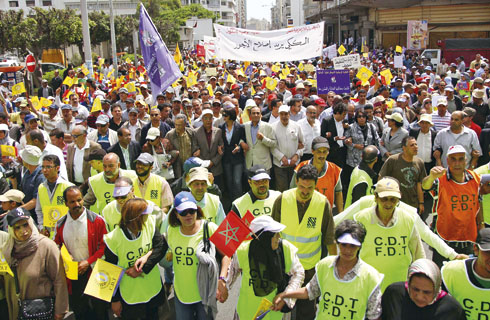
“Actually, we are obliged to keep an accounting book, here it is with me,” explains to the New Times Abdell, the owner of the leather shop on one of the narrow dark streets in Medina (Old City) Marrakesh. - Every year, on the basis of these records, we submit a declaration, but only officials do not believe in our papers. They usually double, or even triple the tax amount - you have to go to the tax inspectorate and agree. ” When you enter Medina, it seems that I got into a fairy tale about Khoju Nasrreddin. Time stopped here several centuries ago: in numerous shops they sell copper and ceramic dishes, leather grandmothers (slippers with sharp ends without asses) are made using centuries, fashion has not changed since the Prophet Muhammad. Unless sometimes a bench with Chinese fake Adidas or Louis Witton will come across. A foreign tourist in this maze is easy to get lost. And only after spending several days here, you begin to understand that the city is divided into artisans, as in medieval Europe: they sell takny, here - gold, and around the corner there is a real bird yard.
Taxes by eye
Trade is the second of the two cornerstones of the Red City economy (the so -called Marrakesh for the predominant color of the houses) after tourism. It accounts for about a third of the city GDP, which is € 500 million. However, these are the numbers are official, it is almost impossible to calculate the turnover: there are no cash registers in any store, and taxes, as Abdella already explained, are paid a glare. When asked how it is possible to agree, Abdell slyly shrugs: "We know how to bargain in the East." According to the Minister of Information Morocco Mustafi Halfi, the volume of corruption money in the country is € 1.5 billion, but these figures are far from those presented in the World Bank, which estimated the level of corruption and loss of tax failure in 2010 at € 70.5 billion, that is, in 4% of Morocco GDP.
“Ah-ah, no one really wants to fight corruption,” Hamid, the owner of one of the rare luxury boutiques in Marrakesh, is dismissed, “our economy has always been built on Bakshish, bribes are taken from the prime minister to the last inspector.”
For example, in Marrakesh, Hamid confidentially reports, everyone knows that has only bought hash from the police: “Drug merchants pay them“ goods ”so that they are not touched, it’s clear: it is not possible that the police are not slipped. Do you want, by the way, a "record"? " 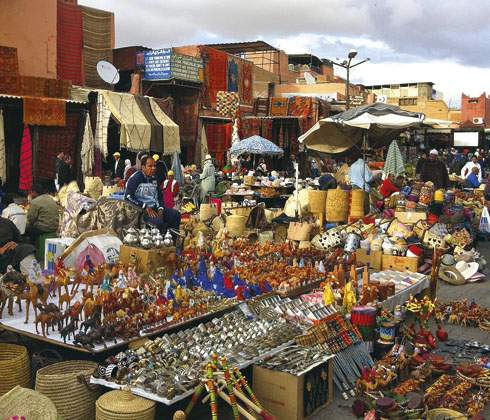
On mass actions against corruption, Hamid is convinced, people come out to whom no one gives; Put them on a bread place, they will immediately forget about the rallies: “The main thing for me is that the trading goes briskly, and whoever is enriched there does not care - he will then spend their money in my store.”
In prison with a diploma
The authorities seemed to adopt Hamid's philosophy: frightened by the "Arab spring", they decided to stop protests with financial injections. Unemployment in Morocco is not so great - in 2012 only 9.9%, and in rural areas, are 4.8%even. In Marrakesh, the tourist flagship of the country, the situation is even more favorable: the unemployment rate is only 5.8%: a city visits 2 million people with a population of 1 million per year.
The main headache of the authorities was university graduates who did not want to work in the shops and on the farms of parents: the unemployment rate among youth under 34 years old is 31%. It is they who every now and then go to the streets of Rabat, Casablanca and other cities. In order to reassure them, more than € 4.5 billion for social expenses, including € 2.5 billion, for the creation of jobs, were laid in the 2012 budget.
“My wife’s brother is an engineer,” says Hamid, “lives in Marrakesh, but went to Rabat and Casablanca for all demonstrations. After the government began to create new jobs this spring, he found a job as a watchman in prison. The diploma had to be put in the pantry, but it is better than without work. ” "
The backbone of the protest movement in Morocco - diplomated young specialists - too small. In Morocco, only 11% of the population has higher education, while in Tunisia, for example, 31%
“Yes, there are many positions of watchmen, guards, supervisors, controllers on the balance of the budget, but there was no real economic needs behind this altruistic impulse of the authorities,” notes Jean-Niel Ferier, director of the research program in the branch of the French National Center for Scientific Research in Morocco.-we are talking about temporary measures that are about temporary measures that are about temporary measures that are about temporary measures. The problem of the protest movement in Morocco will not pour out in the full -scale reforms that his bone is diplomated young specialists - only in Morocco only 11% of the population has a higher education, while in Tunisia, for example, 31%. ”
Until recently, the 27-year-old Hafiz also went to the demonstration, who graduated from the University of Casablanca and returned home to Marrakesh, to get a job in a call center for a franco-speaking audience. This is one of the rapidly developing business segments in Morocco, for example, the French clients of Microsoft are forwarding to the call center in Casablanca. “I just started working and therefore I get 3 thousand dirham per month (€ 300),” says Hafiz. “After a couple of years, the salary should increase to 5 thousand dirham, and it will already be possible to put it off a little to marry: my parents will find the bride, they will pay for everything-a wedding and all that, but then you still have to feed the family.” It is supposed to live with parents: according to the good old tradition, a man leads his wife to his house. It is almost impossible to buy something of your own: salaries are too small, religion prohibits mortgage and other loans, and Muslim banks in Morocco are still a curiosity, and their services are too expensive.
"The King of the Poor"
Going out of any Ryyad, you will certainly see the portrait of King Morocco Mohammed VI. It is to him that he is largely attributed to the fact that the revolution here has not gained momentum. The king in Morocco is not just a political figure, but also the leader of believers, a direct descendant of Ali, a cousin and successor to the Prophet Muhammad. “The monarchy in Morocco is absolutely legitimate,” explains Jean-Noel Ferier, “is associated with the awareness of the independence of the country, national pride, this institution is not yet subject to discussion. Yes, and Mohammed VI himself is very popular. He personifies all the merits of the monarch and at the same time does not cause such fear as his father Hassan II. In addition, he actually proved his readiness not just for reform, but to share power. ” 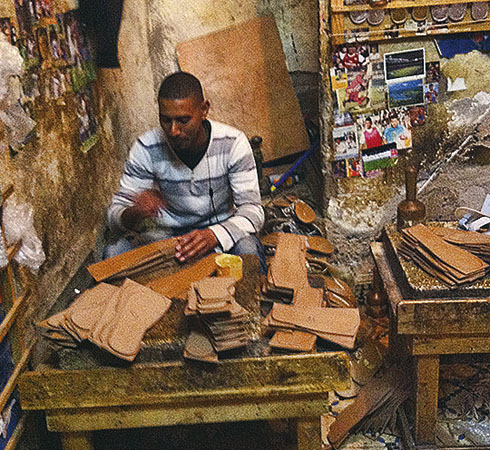
According to the new Constitution of Morocco, adopted at the referendum in July 2011, the government was created in the country, de jure independent of the king: the Prime Minister is no longer appointed by the monarch, but is selected from the party that won the election. Parliament can express distrust of the government, and the Prime Minister can dissolve the parliament without the consent of the king. “It is unlikely that the confrontation between the prime minister and the king should be expected, but this government cannot be called puppet,” says Jean-Noel Ferier, “the Moroccan elite stands behind his monarch, but there is also a people to whom he constantly shows that he takes care of his good, it is not for nothing that he is called the“ King of the Poor ”. "
The monarchy in Morocco is absolutely legitimate, the awareness of the independence of the country, national pride is associated with it, this institution is not yet subject to discussion
“Muhammad VI himself is difficult to call the poor. His personal condition is estimated at € 384 million, but this amount does not include real estate belonging to the royal family in Morocco, and thousands of hectares of agricultural lands, income from taxes. In 2000, immediately after the accession of Muhammad VI to the throne, the religious leader Sheikh Yassin called him “Attrack the sins of your father” and pay the 14-milliardous external debt of Morocco from his own money. 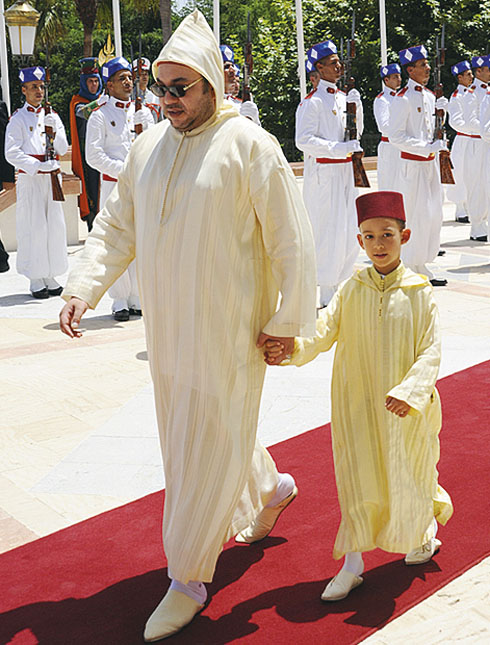
The adoration of the monarch is also transferred to the heir to the throne, Milia, the future king of Hassan III. The influential local magazine Telquel, usually very critical in its materials, in articles about the royal family demonstrates an idyllic image of a nine -year -old dofin, who loves football and riding and is not at all embarrassed when the elderly ministers approach the pen at official ceremonies. However, rumors about young favorites - it is the favorites, not the favorites - his father does not pass the little Mulay, and the order at court perfectly characterizes the story of how the boy, playing football, fell and broke his leg. For an hour, the child shouted, rolling across the football field, but his educators were afraid to believe in the worst and persuaded Hassan to get up and go.
They say that the future guarantor of the Constitution showed stiffness, demanding to dismiss everyone who was on the football field that day, while the Moroccan revolution seemed to break both legs, tripping over the assignments and promises of his father.
Private House (Riyad) in Morocco -
This is a rectangular two -story building without a single window outside: the light penetrates here through the courtyard, covered with polyethylene in winter, so that the Marrakesites spend most of the year in the twilight. Foreigners buying rijes (about 40 thousand foreign citizens are registered in Marrakesh), small pools are building in the yards, and terraces on the roofs; Local residents are far from aesthetics: a chicken coop may be in the yard, and an unchanged satellite plate on the roof.
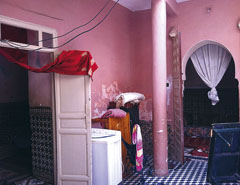 | 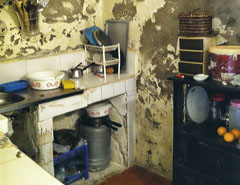 |
It is almost impossible to get into the holy holy Moroccan family: guests are not accepted here. In Riyad, as a rule, three families live plus an elderly uncle - a local patriarch and, it seems, a tyrant. When an uncle is at home, not a single extra sound violates his peace, even infants do not cry. However, this is all one family: three brothers with their wives and a myriad of children who scatter at the sight of strangers, continuing to look out of the corners with curiosity. Each pair has its own room in size about 7x2 m and its own kitchen is slightly smaller than the room. When asked why it is impossible to make one kitchen for everyone, they usually answer like this: “Women should not come across, otherwise there will be no rest in the family.” At the same time, there are only one bathroom on all the inhabitants of Ryyad and there are no doors in any opening: the curtains hang instead. In winter, when the temperature in Marrakesh can drop to five degrees, it is not so easy to heat the Riyad. Electricity is very expensive - an account can reach € 200–250 per month, and in winter even more. But only no one pays for him. It is enough to simply stretch the wire bypassing the counter - and burn yourself as much as you want. To the question of a resident of Marrakesh: What, no one controls? - In response, a familiar cunning smile is usually followed: East.