
Translated material
The motor stalled
Brik is no longer a locomotive of the world economy
The motor stalled. The collapse of oil quotes and the fall of world stock indices in the early days of June were caused, among other things, bad news from developing markets. China, India and Brazil, which regularly worked as “locomotives” in 2009-2010, today may not draw global economic growth. The New Times studied the latest statistics of Russia partners in BRIC
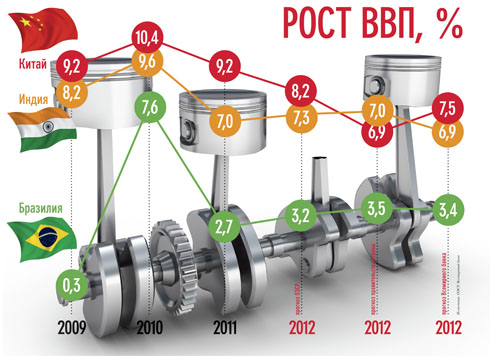
In recent years, the BRIC countries have become a world of economic growth. According to the calculations of the authors of this abbreviation, the Goldman Sachs investment bank, the share of the Four in the increase in global GDP increased from 23% in the 1990s to 45% in the 2000s. But now the engine is "at the limit." Not only Russia - each of the countries BRIK is experiencing serious economic problems. What is not surprising: they are all very integrated into world trade and financial system. Now, the demand for the import of goods and services in developed countries is not growing, and due to the financial crisis, investors from the USA and Europe are striving to place funds in the safest assets that the BRIC countries do not yet belong. 
According to statistics published on the last day of May, the Indian economy for the first quarter showed an increase of only 5.3% (in annual calculus). For other European countries, such an indicator could be considered excellent, but for India it is a failure: its economy has grown 8% or more in recent years. 5.3% is a 10-year minimum, and it is clear that investors were shocked.
The quarterly indicators of Indian companies do not add positive emotions. So, the profit of the largest developer DLF in January-March fell by 39%. The leading airline Kingfisher generally suffered a net loss, having lost $ 205 million. The GMR powerful construction company said that due to too high loan rates, it is suspended work on infrastructure projects in different parts of the country.
The result of this pile of gloomy news was the acceleration of the fall of the rupee course. It fell to the historical minimum, and in just the last year it collapsed to the dollar by more than 20%. Weak Rupa should sprinkle inflation, which has already exceeded 9%.
In Indian ruling and business circles, they have already begun to look for the guilty. The government led by the Indian National Congress believes that the opposition connects them on hand and foot, demanding even more mitigation of fiscal policy. Meanwhile, the budget deficit is already approaching 6% of GDP, so there is nowhere to take money to increase expenses.
At the same time, the government itself demonstrates that his attempts to manage the financial system have failed as strictly and carefully as possible. The Central Bank refinancing rate lasted almost a year at the level of 8.5% per annum (back in 2010 it was half as much), which made borrowed money very expensive. Now the bet is reduced, but you have to wait for this measure to take at least some result.
The budget is a traditionally big problem for the country. According to OECD * * Organization of economic cooperation and development. The average deficit for 2009-2012 will be 8.3% of GDP, and no prerequisites for its reduction are visible. Some relief of India can bring a decrease in oil prices: the country has the largest gasoline subsidies in the world. Moreover, any attempts by the state to reduce their size lead to mass strikes. Recently, such an action took place in 28 states of India - state offices, schools and shops were closed.
The quality of state regulation in India can be a view on the idea actively discussed in a bombing now in Bombay to force all adults who want to drink, to buy a license for alcohol consumption. This needs to be done with each use - a license for a day costs 5 rupees, and a lifelong - 1 thousand rupees ($ 18). According to the law of 1949, a fine for a drink without a license is $ 900.
To everything else, it is necessary to add corruption scandals shaking the country. Not so long ago, licenses of a number of telecommunication companies were withdrawn: it turned out that they simply bought these permits. As a result, the Norwegian Telenor has already sued India, demanding billions of dollars of compensation. Next in line is a similar scandal in connection with the privatization of coal mines: there it also passed with numerous violations.
The problem of India is a bad investment climate, the lack of trust between business and power and high corruption, which interferes with the implementation of infrastructure projects, says Credit Agricole Strategist in Hong Kong Darius Kovalchuk. Indian politicians made a lot of errors, and the country is becoming less attractive to investment, the well -known financier, creator of Templeton Mark Mobius, echoes. It is no coincidence that Standard & Poor's recently changed the forecast of the Indian rating to negative. Do not be surprised if the result is a crisis like Greek, the local economist Rajiv Malik warns. It is clear that world investors shakes from such forecasts. 
Economic growth slows down in China: in the II quarter, it may be lower than 7.5% (in annual calculus), Darius Kovalchuk believes (this will be a three -year minimum). Well, China, China, was reduced from 8% to 7.5% in the spring. In the pessimistic version of the forecast, growth can fall below 7%. The decline is most obvious in export. In 2011, it grew by only 8.8% after an increase of almost 28% in 2010. And this year, according to the forecast of the OECD, it will be only 5.8%. In Europe, the demand for Made in CHINA has fallen strongly, and Chinese goods are becoming more and more expensive due to the growth of salaries, the economists of the Japanese Bank Mizuho noted.
In May, the PMI index, which measures business activity in industry, sank to the annual minimum. Unlike 2008-2009, this time the Chinese authorities are not going to stimulate the growth of budget investment (then they amounted to $ 635 billion). The country's banks are already overloaded with “bad loans”, and regional budgets are debts. Budget anti -crisis injections of four years ago led to speculation in the shares market and the formation of a “bubble” in the real estate market, an increase in inflation and corruption, says Andy XSI, a former economist Morgan Stanley: “China would not want to repeat this experience again.” Then, in just a year, housing prices doubled, inflation reached a three -year maximum, and regions debts - $ 1.6 trillion.
In these conditions, the Chinese financial industry lobbies at least a decrease in banking rates. “In order to avoid the ongoing slowdown in the economy, you need to immediately reduce bets,” the official Exchange Bulletin of China Securities Journal wrote in the editorial article last week. The Council was heard. On June 7, for the first time in four years, the People’s Bank of China lowered the interest rate by 0.25%. "
Until the situation in developed countries is being improved, the BRIK will not be able to return to the previous pace of state growth: the world economy motor was stalled
“Taled with the experience of 2008-2011, the Chinese authorities are now not trying to improve the economic situation due to cash pumping, but develop more subtle stimulating mechanisms. The authorities reduced the time necessary for the approval of investment projects, try to accelerate privatization and offered subsidies to customers of equipment that allows saving energy. 
In the first quarter of this year, the Brazilian GDP grew taking into account seasonality by a miserable 0.2% (less than 1% in annual terms). And this is after a recent triple slowdown in growth-from 7.6% in 2010 to 2.7% in 2011. The country's stock market at the minimum level in eight months, since March it fell by 22%, and this can cause a mass outflow of funds of foreign investors, warns Carlo Alonso, a trader from Interaacciones.
The country is trying to return to a stable annual four percent growth, says President Dilma Rusef. So far, it does not work out. The Minister of Finance Guido Mantega reduced the forecast of economic growth for this year from 4.5% to 3-4%, but now this result looks unattainable.
The country is uncompetitive, and until the necessary reforms will be carried out, growth will not accelerate, says Susum Honda, president of the local supermarket association. First of all, business asks to simplify tax legislation.
The government is trying to accelerate economic growth by lowering taxes and credit subsidies for individual industries (recently, car 1 billion benefits were received in 2011, which in 2011 went out in 3rd place in the world after China and the USA). But so far this approach to success has not led.
To stimulate the economy, the Brazilian National Bank once again lowered the interest rate - from 9% to 8.5%. Back in August 2011, the rate was at 12.5%. In general, bank rates in Brazil recordly high. This is a legacy of hyperinflation of the border of the 1990–2000s: then the National Bank rate reached 45%. But now it is dangerous to lower the rates even lower, since the inflation last year increased from 5% to 6.6%, and a little more - and banks will be forced to work at a loss.
Each of the partners of Russia in the BRIC has its own problems, each of them is associated with the world economy uniquely (China is primarily by the economy of the order by industrial export, India - the service sector, and Brazil - the agrarian complex). But each of the large developing countries depends tightly on the demand for goods and services, on loans and investments from the USA and Europe. And therefore, until the situation in developed countries is being improved, the BRIK state will not be able to return to the previous pace of growth: the world economy motor was stalled. It is hoped that temporarily.