
Translated material
Drahma under a gun
Do the Bolsheviks win Greece?
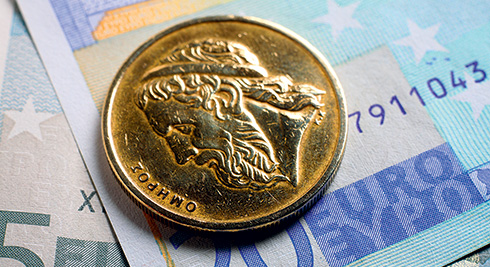
Drahma under a gun. On June 17, Greece repeatedly chose the parliament - in the hope of finally creating a capable coalition government, which will be saved by the national economy under the control of the EU. However, only the most desperate optimists believe in this prospect. According to rumors, the Greek Central Bank did not wait for the election results and had already begun to print drams - under the quiet applause of the rising star of the Greek politics of Alexis Tsipras and his party Siriz, who sought to take the majority of places in parliament. What awaits Greece in the coming months - the answer was looking for The New Times
The leaders of Greek banks are assured by the diplomatic sources of the magazine, the seals with the sign of the Greek currency were sent: the exact date of Greece left the eurozone is still unknown, but it was decided that it would be Friday evening, immediately after the closure of banks. Within two weekends, all ATMs in the country will be disconnected, and bank clerks will begin to hastily put prints on the euro bills, turning them into drachms. The authorities are afraid of serious riots, so the command of the Greek army has already been warned: it may be necessary to bring troops into Athens, Thessalonics and other large cities and declare a commandant hour there.
Red Greece
A partner in an international law firm who did not want to reveal his name shared an interesting detail with The New Times: earlier, when concluding gas supplies from Russia, conditions were stipulated in the case of the country's entry into the euro zone. Now the conditions were added to them in case of leaving this zone. “In the business world, Greece’s output is a resolved issue, but we also prescribe it with other countries, because you can’t be insured from anything,” the interlocutor of the magazine explained. - The situation would not be so catastrophic if there were people who were ready to work in Athens. But the governments are not even expected, but with these Bolsheviks it is impossible to negotiate. ”
The Greek “Bolsheviks” who frightened Europe are the Party of Siris, who rose on the crest of the crisis (translated from the Greek abbreviation means the coalition of radical left), led by 37-year-old Alexis Tsiprase. He came to politics in his youth: in the late 80s, when the Berlin Wall collapsed in the West, and in the east he lived the last days of the USSR, Tsipras joined the youth ranks of the Communist Party of Greece (KPG). Having joined the reformal wing of the KKH, he became one of the initiators of her split, advocating for the preservation of the “Stalinist beginning” in the party. Tsipras quickly rises at the head of the youth communist movement, takes an active part in the student struggle. He, however, remains unknown until 2006, when he exhibits his candidacy in the elections of the mayor of Athens. 10% of the vote and the third place were a surprise for many, including the left. He was only 32 years old at that moment - the youngest political leader in Greece. Two years later, Tsipras accepts the “command” by the party of Siriz.
Today he is still the youngest. The passion for football and the motorcade, performances on the side of the manifestants in 2008, when Greece exploded after the death of a 15-year-old teenager in clashes with the police, all this impresses the youth who has become its main electorate. Siriza confidently takes the first place among voters under 25 years old, 50% of which are now sitting without work and seeing hope for a better life in Tsipras. 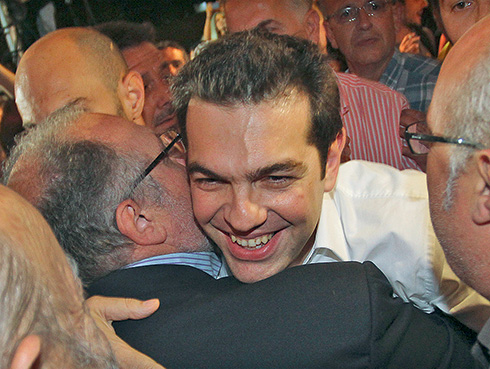
For euro against the EU
The popularity of Siriza is explained not only by the fact that Alexis Tsipras does not wear a tie: the main point of its program is the revision of agreements between Athens and the Troika * * the European Commission, the European Central Bank and the International Monetary Fund. providing for Greece assistance in the amount of € 240 billion in exchange for strict savings. However, according to the City of Greece, the execution of Brussels should not mean a rejection of the euro at all: in early June, he tried to calm the European community, saying that Dragma would not return. “This is a vivid example of left -wing populism,” notes Kostas Lavdas, a Greek political scientist, a professor of Cretan University, “in Brussels Tsipras says one thing in Athens - the other, the votes in the elections for him are the main thing, and how to fulfill his promises, he does not think yet.” Tsipras is convinced that Greece is too important for Europe and the euro zones, and therefore the Greeks can do anything - Germany will still pay on their bills. “Tsipras is brutally mistaken - the patience of Europe is coming to an end: even if political leaders would like to preserve Greece in the eurozone, voters who do not want to pay for it remain,” Lavdas summarizes.
The Siriza program is quite consistent with the moods of the Greeks: 75% of the population against saving measures, while 80% want to stay in the eurozone. “It is impossible to say that this is the pursuit of the chimera,” says Jacques Sapir, the French economist, director of the Center for Research of the Problems of Industrialization of the French Higher School of Social Sciences, “in principle, the EU has been aware of the understanding that excessive economy kills the Greek economy without solving the problem of debt. The memorandum between the Troika and Greece could have been revised, for example, in terms of interest on duty. They now make up 6% of the country's GDP, or three quarters of the budget deficit. ” But the revision will not take place, because there is a psychological barrier who is not ready to cross Angel Merkel. “She is not lonely, it is supported by public opinion in this matter: 70% of the Germans believe that Greeks should be forced to pay.”
"
The Siriza program is quite consistent with the moods of the Greeks: 75% of the population against hard savings, while 80% want to stay in the eurozone
"
Not just elections
Before the elections of June 17, European leaders called on the Greeks to make a conscious choice, clearly making it clear: without fulfilling the conditions of previously signed agreements, the country's membership in the euro zone will become the subject of discussion. However, there are more sensitive measures: the 20-milliard tranche from the EU and the IMF, which Athens should receive before the end of June. “The Greeks should understand: we are not just discussing the composition of the parliament, but the future of the country,” said Simos Kedikoglu, the Russian -Right Democracy, the shadow minister of information from the New Democracy Party, in an interview with The New Times. - Tsipras can promise anything, but we will very soon end with money not only to pay debts, but even for salaries and pensions. Then he will become the first to be thrown out of the parliament. ” With or without Cityce, the Greek treasury is empty: according to the sources of The New Times, Greek state employees will stop receiving a salary in June.
On the agenda today, like a month ago, is the formation of a coalition government. At the same time, no one guarantees that this will finally be able to do this: the positions of the right and left on fundamental issues of budget policy and relations with the EU remained unchanged. “In our country, there is simply no necessary political culture,” explains Kostas Lavdas, “for 30 years in Greece there were majority governments, no one has experience in creating coalitions.”
“You cannot exclude the Belgian scenario * * in 2010–2011. Belgium lived without a government for 535 days. - thinks Julien Theron, French political scientist, professor of Versailles University. “True, in Belgium there is no such economic crisis and it can afford to exist for a long time without a government, and in Greece it will be difficult for the population to explain the need to hold elections in a third or even fourth circle.”
Kostas Lavdas agrees with his French colleague only in one thing: “It is impossible to hold another election, the patience of the Greeks has dried up.” However, the Belgian scenario, in his opinion, is unlikely: “Neither Siriza, nor PACOK * * Party“ Left Socialist Movement ”. , neither the "new democracy" will not be patience of the electorate-within a week or two they will come to an agreement. "
However, according to a number of economists, the presence and composition of the government is not such an important thing in the assessment of Greek prospects. “In any case, by October, Greece will switch to drachma,” Jacques Sapir say with one hundred percent confidence. “But it was necessary to do this back in 2010-2011, then the EU would save a lot of money, which can now be forgotten.” Another consequence of a belated transition to Dragma can be a sharp deterioration in the domestic political situation in Greece. As the New Times told a source that is developing a strategy in one of the European banks, in its department they calculate the options for actions in the event of Greece to leave the European Union and the introduction of a military dictatorship in the country.
"Our bureaucracy is inherited from the Ottoman Empire" 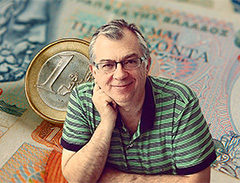
Europe, with bated breath, was waiting for the results of the Greek elections in order to finally understand whether Greece would carry out the reforms required by the European Troika or will leave the euro zone, and possibly even from the EU. In fact, these elections are not at all as important as they think about in Brussels. Whoever was sitting in the Greek parliament, any reform will be inhibited by a clumsy bureaucratic machine, which will even turn the Augish stables with minor steps.
Greece received its management system in the inheritance from the Ottoman Empire: they are accepted for work here not for professional qualities, but for family ties or friendship. Then we adopted some “achievements” of socialist countries, for example, the complete opacity of the activities of state structures, as well as a million different decrees and orders signed by a variety of officials - these papers often contradict each other, and sometimes existing legislation. For any occasion, there are several papers, and if there is no, then what happened for, you can still sign it. Based on such documents in Greece, two -thirds of the decisions are made, and only 2% are based on the legislation. So, tell me, what's the difference, how will the prime minister call? 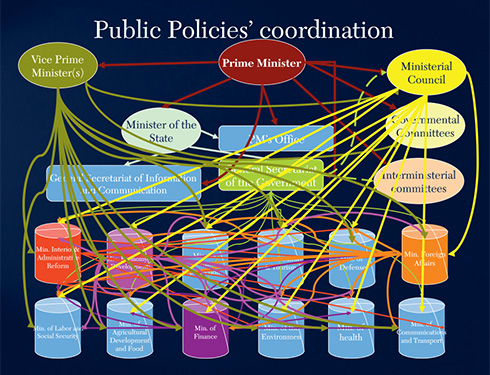
My favorite exercise: to draw a diagram of mutual subordination of the main ministries, drawing arrows between them. The scheme very quickly becomes like pasta, it is almost impossible to understand it: in such a government, everyone is responsible for everything and no one is responsible for anything, and most importantly, with mistakes and ask no one!
Usually, management experts believe that if an administrative unit consists of less than five people, then it has no right to exist and should be united with another. This allows not only to save on salaries, but also to increase the efficiency of employees. In Greece, only one person works in 20% of departments. The boss is his own, a subordinate to himself. Another 57% of departments are represented by two or three employees. These people most often receive a salary for nothing, or rather, for supporting this or that leader and on occasion they can wave the desired paper.
Prior to the crisis, Greece spent € 15.8 billion per year on officials, including € 6.5 billion for salaries and € 9.3 billion for operating expenses. Business damage from excessive bureaucratization is € 14 billion per year, that is, 6.8% of the country's GDP!
Of course, before the elections, the party competed in populism, but no one presented specific measures. So, for example, only the lazy did not promise to fight the bureaucracy and defend small business. But not in any program there were no proposals to simplify the procedure for creating a company. In other European countries, this process takes from one day to a week, in Greece you will spend 37 days, visiting 107 different departments.
In Brussels, they know about all this, but they prefer to close their eyes: no one is ready to play the role of Hercules.