Translated material
On the Vilkovsky Yereks
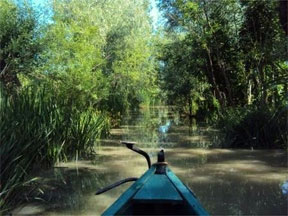
Having left the hospitable Kilia, the participants in the Literary Expedition I and Dmitry Iskovich, they decided to visit the famous city of Vilkovo on the Danube floods. On the one hand, the place is legendary, and on the other, it’s just a shame to come to Budzhak and not visit Vilkovo.
The city was founded by the Old Believers in the 18th century. In the Delta of the Great European River by capturing the reed fields manually and arranging man -made islands directly on a horseman river base. This is now cut for export, partially the old (manually tarpans), and partially with combines. Buys, they say, Holland, it is fashionable to make reeds there.
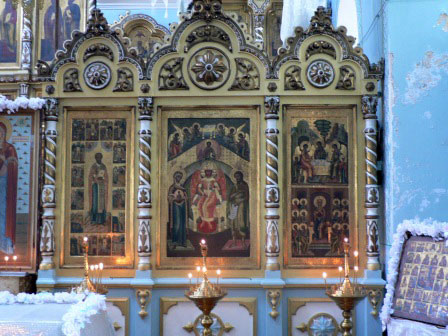
The path from Kiliya to Vilkovo lies along a broken asphalt road through the village of Mirny and Primorsky. That is, they are now, since 1956, so called. The peaceful was called Karika, and the Primorsky - Zhebriyan. These are the Old Believers' villages, and the high bells of the rural churches can be seen from afar on a flat Besarob plain. In Karika -Mirny in the church - an amazing old iconostasis, and in Primorsky - a whole Black Sea. The water there is salty, as it should be at sea, it is fresh - when it brings from Europe. From Primorsky-Zhebriyan to Vilkovo-Euroress in memory of Vilkov’s visit by the former President Kuchma.
Vilkovo is the most extreme point of the Danube trajectory from German Passau through Vienna, Bratislava, Ishmael and other cities. That is, the city is almost European. It contains not only water from Europe, but the construction of the city is also quite European. He was called "Soviet Venice", and now - Ukrainian. Although, in fact. This is more like Luzhitsky Schrevald in Germany. In Venice, the scope will still be more. They say that the city from the air looks like a fork - because of this and the name. In fact, in the documents of the 19th century. Its name is Volkovo, but the Vilkovites do not believe this and they say to everyone about the “fork”.
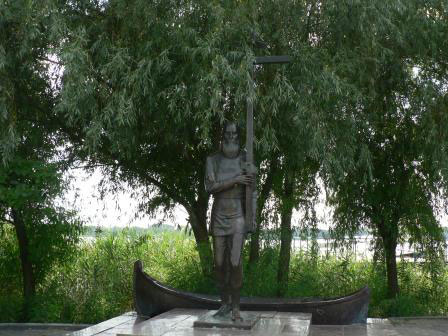
Old Believers in the 19th century They built a city, started gardens and caught fish, which in these places the real breakthrough. Now, they say, less. On the Vilkovo pier there is even a monument to the Old Believers-fish with a beard and in a boat. The current beards, for the most part, were shaved, which causes the usual remarks of the local Old Believer Father, Father Sergius. In their black boats with motors of different stripes, they maneuvetrate according to the system of the Yereks, who were captivating back in 1962 by the young Bulat Okudzhava, who recalled Vilkovo after 20 years:
How I would like to suddenly find myself in Vilkovo now!
There are channels, there are gondolas, gondoliers.
Complete, get forgotten, laugh from sorrows:
My life is poisoned without measure.
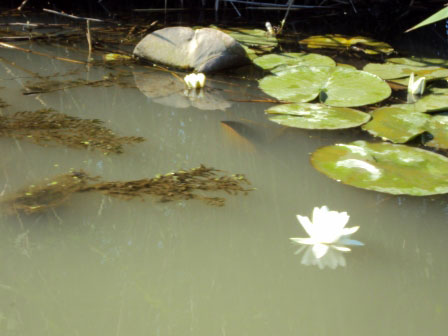
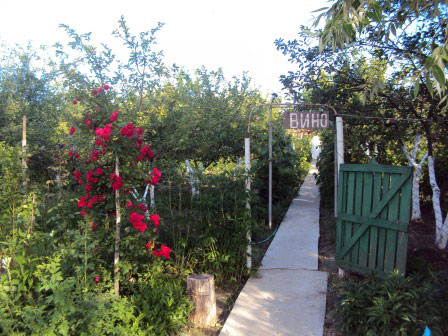
We thought not to catch anyone on the Trinity, but Lipovan Alexander immediately approached us at the pier and offered to drive with him in a boat on the Yeres. Taking dried fish in a local shop, we got into a boat and set off on a trip in time and space. From time to time, the boat made stops: to see an interesting house, then moor on the gate with the inscription "wine", then show us the fields of water lilies, which open the luminary in the morning, and closed by the evening.
On the way, Alexander told us about local life. The Vilkovites everyone seeks to get a marine education and go sail. It is impossible to make money in the city itself. The fish plant has been closed for 15 years, it remains to dilute potatoes and tomatoes, and fish, fish, fish. In Vilkovo, a fish is a job, a hobby, and aesthetics, and a subject of conversation. "There is a fish - there is no fish." Like mushrooms in our north or beer in a stall in the 70s. Young guys are all engaged in the school of baidary rowing. Above the large channel you can hear the coach shouting at them in a matyugalnik. Row, guys, stronger! Many have popularity for the rowing simulator for the home.
Having examined the Yereki, we went to the border control - a small booth on the shore of the central channel. We gathered to the other side of the Danube, to the village of Ankudinovo. And there are already Romania in 300 meters, you need to formalize. In terms of spaciousness, I want to sing with delight and Lipan wine. Vilkovo can be seen on the other side with the high bell tower of the Nikolsky temple.
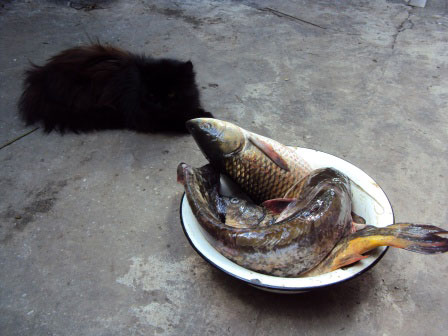
Ankudinovo is a channel, along the banks of which are fences, followed by houses. Here, on an ilbus soil, there are gardens. Miriads of “mouse” jump on the surface of the water, insects like our lifts are said to be eaten by catfish. On the shore there is a brand new wooden chapel - on a holiday like without a church? Seeing the familiar inscription "Wine", we wrap in the hospitable house to Alexei and his wife. It turns out that the Lipan gardener himself lives in Odessa in winter, and in the spring moves to Vilkovo Ankudinovo. Here is the garden, and fish, and the sky. “A neighbor a week ago caught Beluzhina, weighed 110 kilos”, half took the fish protection.
The order on the farm is almost perfect, some even German. Alexey works hard and successfully: a narrow area, 200 meters long, all planted with different crops. There are potatoes, and tomatoes, and strawberries, and grapes, and cherries, and much more. One misfortune - the wild boars got crazy, the heresies are crossed and the landings spoil. “I’m putting traps on them,” a little already came across, they froze a barbecue, ”the owner jokes.
Alexei worked before the pension by someone for a relatively large economic part, then he lived ten years in Portugal. He, of course, is a downshift, but with a strong habit of work. Holds simply and with dignity. His own wine in oak barrels ripens. “Here, this season they put three tons.” Alexei's wife is Mengrelka, took her out of Georgia during it. Like all Mengrels, she explains that they are actually Jews. Either from Solomon, or from Davyd-Tsar ... marvelous. Wine from the Vilkovo variety "Novak" with a special bitterness is easily drunk. But you need to know the honor.
We are returning to the Vilkovo harbor. The boat engine is hiding, the sun sits somewhere behind the Romanian shore. On the Nikolsky church, the bell calls to Vespers, the bell of the Vvedensky Church answers him. In the evening, there will be only old women in the church. Husbands and sons, who did not go on a flight, celebrate the Trinity at home. A tied boats swing near an empty pier.