
Translated material
Tsyrt. Transformation of tradition
Now there will be a little boring text, which I was going to write for a long time, and now, finally, gathered. Since we will not see each other for the next few days, for I am flying to the northern capital at the conference, I wanted to tell a little more before departure. So simple. Without complaints about scientific.
I had quite a lot of posts about the chicken, but they were, let's say, photographic ones. And I did not bother myself, in the explanations of what this kind of tsert is still. I correct my mistake, since the material is worth it.
So, the word "Tsyrt" (Cyrt, Cirt) is translated from Ossetian as a grave stone, a monument or grave. However, the very concept, hidden under the word, is much wider. I will not now go into the history of it, who will want to readthe article by Valery Tsagaraev about the Tsyras.
The classic Ossetian chick is a rectangular slab in a person’s height placed vertically and oriented to the cardinal points. A complex ornament reflecting the image of the deceased is carved on the front part of the plate. It happened that the chicken were not tombstones, but simply with memorable signs set in honor of certain events or people. However, with such chicks a completely different story, and we will touch it next time. In the meantime, we are only interested in tombstones. A direct ancestor of Ossetian chicks can be called Scythian tombstones. They were both anthropomorphic and ornamental.
. 
From Scythian culture, they migrated to Alan, and then to Ossetian.
Initially, the chicken was put only on male burials, and only women's chicks began to appear much later. Since the ornament on the chicken is a symbolic image of the deceased, it varied in male and female tombstones. 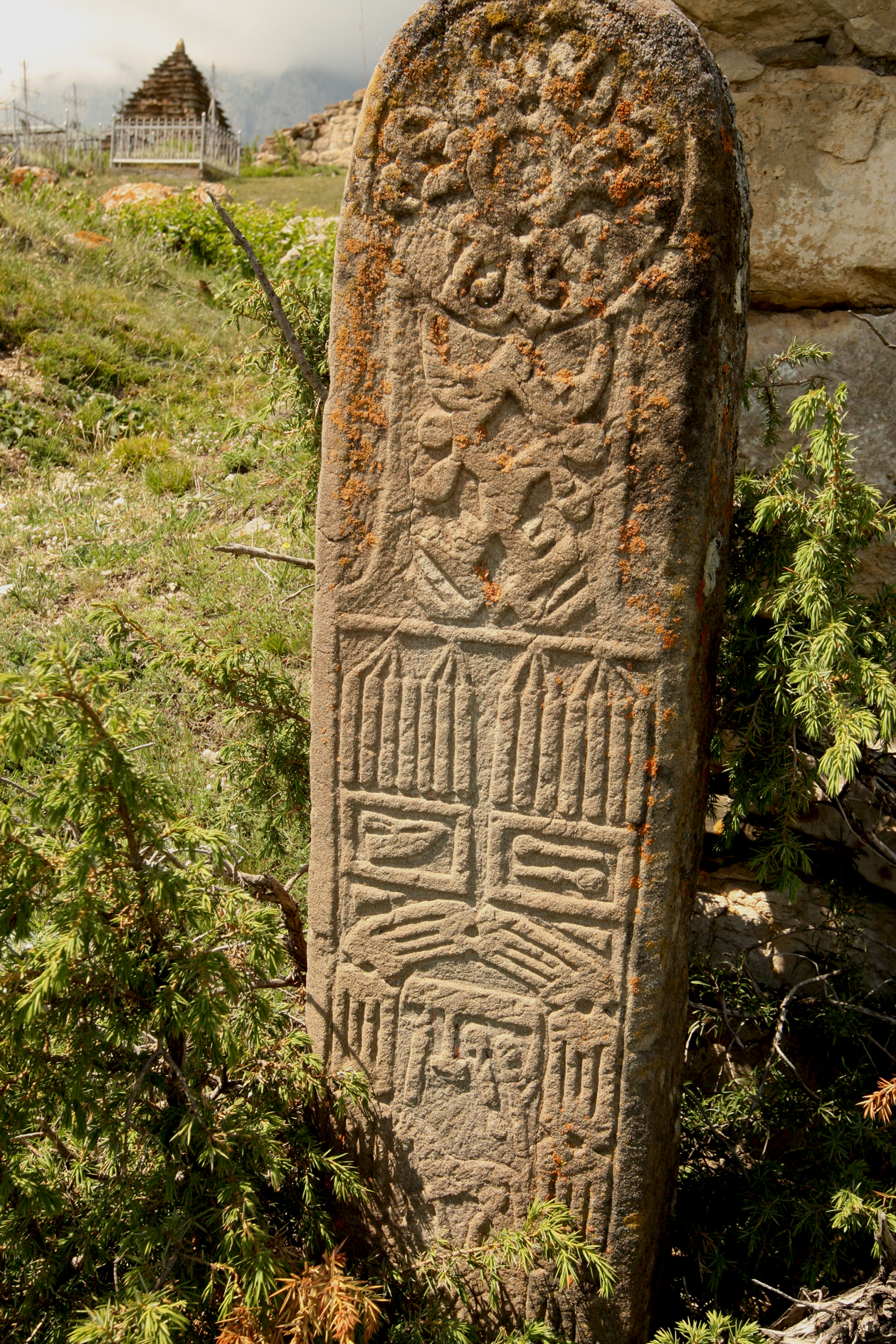
The male tombstone standing in the cemetery in the village of Verezniy Mizur.
Female tombstone. Upper Mizur.
Why am I saying so easily that this is male, but this is female. In fact, everything is very simple. Our eye quite often perceives these tombstones in its entirety as a continuous ligature of the ornament, but in fact it is not. If we look closely at the Upper Tsyrta, we will see that in the top we have an ornamental solar symbol, which replaces the face with a stylized figure, then there is a “neck”, then a shoulder outline and vertical stripes of gazyra, and then part of the “initiation”. We see the same thing in the second Tsyrta, where instead of gazyrs, there are transverse clasps of the dress, and just below the belt. Such a construction of a composition is absolutely typical of chicks until the end of the 19th century.
Now let's look at the structure of the ornament. He, as we have already revealed above, is divided into three zones.
Facial - the sun marks not only the symbolic image of the face of the deceased, but rather the upper part of the three -part world. The upper world. Solar symbolism is found not only on chicks, but sometimes on crypts in the form of an image of the sun setting over the horizon, or other solar characters.
The sunny face relies on the ornamental image of the world tree, as if growing from the actual stylized human figure. The lower part is the dedication of the deceased and the image of things that he will need in the afterlife.
For those who did not see anything, the picture below.
The image of a horse on the tsyras is an echo of the ancient ritual of initiation of the horse to the deceased, described in many sources and dating back to the Indo-Iranian roots. In the late Tsyrtes you can see more inscriptions, and, perhaps, this was the first deviation from tradition, despite the fact that the rest of the separation was preserved, I repeat, up to the 19th century.
However, having got into the vortex of the change of traditions, the tsyras have undergone significant changes. This segment was quite brief, lasted about 30-40 years, and fell on the years of the life of Soslanbek Oskiyev. It is unlikely that he was the first person who abandoned the ornamental tradition, rather he became the pinnacle of this transition. In any case, it was a transition to a completely anthropomorphic image, although the old tradition remained alive, even in this form.
S. Khanaz. The tombstone of the work of S. Daziev. Photo by Ruslan Tavasiev.
In full, these were no longer traditional curses. Rather, it is a transition from Tsyrt to the tombstones of a European species. They still kept attributes with the image of the deceased weapons and a horse. However, the solar symbolism has already been lost. Enziev is a topic for a completely separate conversation, and we will definitely talk about it. I think that it has become the last connecting thread between an ancient tradition, and modernity.
By the beginning of the 20th century, such tombstones were replaced by traditional chicks, and it has already become in fashion to put monuments of an absolutely European species.
Well, the modernity completely lost the connection with the past, although, sometimes, the past and show us ghosts, but we are no longer able to perceive them seriously.