
Translated material
The case of the murder of a royal family
Investigation in the eyelid
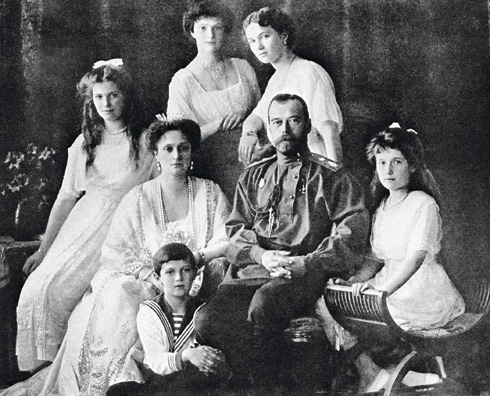
The royal family. The beginning of the 1910s.
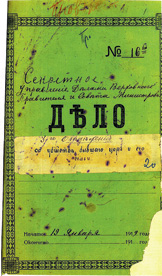 |
| The case "On the killing of the former king and his family", begun on January 19, 1919 |
In the exhibition hall of the State Archive of the Russian Federation, the exhibition “The death of the family of Emperor Nicholas II was opened. The investigation in the eyelid length. " Its exhibits talk not only about the last months, days and minutes of the life of the royal family, but also about subsequent many years of searching for the truth - what exactly happened on the night of July 16 to 17, 1918. Especially for The New Times, the exhibition was conducted by the senior investigator-criminalist of the Main Directorate of the Forensics of the Investigative Committee of the Russian Federation Vladimir Solovyov, who has conducted this criminal case since the 1990s
On the night of July 16 to 17, 1918, in the basement of the house of engineer Ipatiev in Yekaterinburg, the Bolsheviks shot the family and servants of the last Russian emperor Nicholas II. On July 25, the city was occupied by white. Leaflets were scattered around the city with a message about the execution of the former king. The officers entered the house of Ipatiev. A strange and terrible picture: trampled toys and medicines of Tsarevich Alexei, icons, without which the royal family did not even take steps, thrown into the trash. Washed traces of blood and traces of bullets. The killers tried to confuse traces, hide the murder of children and distributed rumors that only the king was shot, and the family was taken to a reliable place. Things talked about something else: a terrible tragedy occurred here.
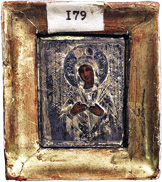 |
| The icon "Blessed Virgin Mary" Trushing "belonged to Empress Alexander Fedorovna |
Things
Things from Ipatiev’s house presented at the exhibition are witnesses of this tragedy. The most amazing thing is that something has been preserved at all.
After the admiral of the White movement came to power, the head of the White movement, from November 18 , 1918 to January 4, 1920 - the Supreme Ruler of Russia. The criminal case of the death of the royal family attached important political significance; Shelters have acquired historical value. The investigation began to oversee the prominent military leader, the former chief of staff of Brusilov, Lieutenant General Diterichs. Nikolai Sokolov was appointed the new trial, who was conducting the investigation until 1924, until his death. All the things found during the inspection of the houses of Ipatiev and Popov, in the study and search in the Ganina Yama area, during the excavation of the mine in the vicinity of Alapaevsk, where the Grand Duchess Elizaveta Fedorovna was dropped, in the rooms of the former regional council and in the postal and telegraph office, transferred to Omsk. Sokolov examined them, packed them - it turned out 50 boxes. The Bolsheviks advanced, in the confusion of the Civil War only 29 boxes reached Vladivostok. They were sent to England to the sister of Tsar Ksenia Alexandrovna. Here it was found that most of the things in the remaining boxes were replaced by garbage. Many things were ruined by sea water, and they were burned. In the spring of 1948, the Grand Duchess decided to transfer part of the relics of the royal family to the rector of the London parish Archpriest Mikhail Polish, who by this time was going to move to the United States, in San Francisco. Ksenia Aleksandrovna handed the rest in 1950 to Brussels, to the temple-monument of the ROCZ of the Holy Righteous Job, built in memory of the king of the martyr Nicholas II.
“When in 1991 the investigation of the death of the imperial family began,” says Vladimir Solovyov, “we thought that everything connected with the house of Ipatiev and the execution died. Today we are standing next to the icons, before which the king prayed, who saw how the royal family gathered on the last journey. Here, things found on Ganina Yama, and even bullets from the bodies of members of the royal family. ” 22 subjects transferred about. Mikhail Polish, now presented at the exhibition. These are the trousers of Nicholas II, the uniform and epaulettes of Tsarevich, a plate, several icons. All these objects kept in deep secret, and they did not leave the walls of the Holy Trinity Monastery in Jordanville, where they were transferred after the death of Fr. Michael. After the combination of churches in 2007, a show of unique things in Moscow became possible.
In the exposition - the inserting jaw of Dr. Botkin, found at the bottom of the mine in Ganina Yama. Soloviev points to the inconspicuous skirt of the princess of Anastasia. “It’s a pity,” he says, “that the skirt did not fall into the hands of the investigation in a timely manner. Experts around the world have hoarsely argued about how growth was in the summer of 1918 the youngest daughter of the king. Many were sure that she was small, which means that a girl from the burial could not be anastasia, too high. The skirt confirms: identified the remains correctly. "
"
All the Tinskiytsy pulled the blanket over himself, everyone said that he had fired the first shot, that it was he who killed the king. They wanted to get into history
"
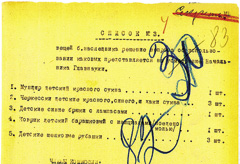 |
| The list of things of Tsarevich Alexei, "the use of which is at the discretion of the chief of Glavnauki" |
Papers
The main documents on the death of the royal family are stored in the State Archive of the Russian Federation. The beginning of the meeting was laid by the Tsareubian Yurovsky. Immediately after the execution, he brought royal papers and things from Ipatiev’s house to Moscow. Among them are many personal photographs from albums. All members of the royal family were fond of photography, and their personal albums are stored in the archive. The exposition presents terrible documents. The Chekists on behalf of the monarchist officer sent letters to the king and tried to stage the escape to kill the family when "trying to escape." The king, fearing that people could die during the “escape”, refused salvation.
According to Solovyov, the search for papers presented at the exhibition is unprecedented, this is a good detective story. The director of the State Archive Sergey Mironenko led the search as part of the work of the Government Commission in 1993-1998. Russian and world archives of Russia, private collections were examined. The so -called Liechtenstein collection was the most important acquisition. Having got out of Russia to France, Sokolov, hoping for help in the investigation, handed over the materials of the case to the former Russian Commander -in -Chief Grand Duke Nikolai Nikolaevich, and he, in turn, was a specially created committee. Sokolov hardly achieved admission to his materials and, fearing for their safety, replaced the most important genuine documents for copies in the volumes. After the death of Sokolov, these most important documents were among Prince Nikolai Orlov. In 1994, at the proposal of the search group at the Sotbis auction in London, this collection was about $ 500 thousand was acquired by Prince Liechtenstein Hans Adam II to exchange for the archive of the Principality of Liechtenstein, confiscated in 1939 at the direction of Hitler and exported in the USSR after the end of the war. To study the archive, Solovyov, Mironenko and the Ren TV television group at the head of Irena Lesnevskaya, specially went to Liechtenstein, and then sought (it was required the help of President Boris Yeltsin) so that there was an exchange. So documents from the archive of Nikolai Sokolov fell into the GA of the Russian Federation.
Today, all documents of Sokolov’s investigation are collected, and the materials of these cases are presented at the exhibition. Here, a genuine encrypted telegram from Yekaterinburg, where for the first time in the official document the bodies of Soviet power recognized the fact of the shooting of all members of the royal family. Nearby is a requirement to issue 170 liters of sulfuric acid to destroy corpses, written to the Ural supply commissar Voikov. Nearby is the famous “note” of the organizer of the execution of Yakov Yurovsky, the record of his story made by historian Mikhail Pokrovsky approximately in 1920, and the true map of the surroundings of Yekaterinburg, made by military topographers General Diterichs. On the basis of these documents, the film scorer Geliy Ryabov and the geologist Alexander Avdonin, who engaged in illegal search for the remains of the king, in 1979 found a secret burial. Avdonin and Ryabov are also at the exhibition “field documents”. There are documents of the modern investigation - materials of examinations that proved the belonging of the remains of 11 people to the royal family and servants.
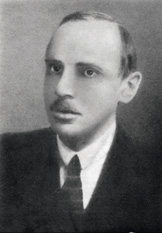 |
| Nikolai Sokolov, the first criminal investigator about the murder of the family of Emperor Nicholas II. 1920s |
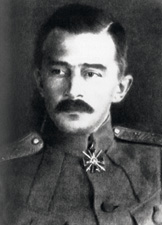 |
| Lieutenant General Mikhail Diterichs, appointed by Admiral Kolchak to oversee the investigation |
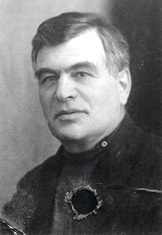 |
| Yakov Yurovsky, organizer of the execution of the imperial family. 1930s |
People
At the end of the exposition - ordinary headphones. Visitors put them on, listen, their faces are changing. In the headphones - the votes of the queens who recall their young years. Without regretting, sometimes chuckling, Nikulin, Rodzinsky and Kabanov tell how the royal children were killed and the corpses were burned. Nobody should have heard their secret words. The notes were on special storage in the archive of the CPSU Central Committee.
The fact is that in 1964, one of the tsareubians, Mikhail Medvedev, turned to the first secretary of the Central Committee of the CPSU Khrushchev with resentment: they say, he does not receive a personal pension. Soon after the appeal, Medvedev died, and his son wrote a letter to Khrushchev with a request to provide his mother, i.e. Zhenya Medvedev, a place in the sanatorium. This document is in the exposition: “Dying, dad asked you to congratulate you on the day of your 70th birthday, to wish you good health and personally convey to you on your behalf the historical relic of our family-a pistol of the Browning system, from which the father shot the last Russian Tsar Nicholas II and his family.” The son also conveyed the historical memoirs of his father “On the liquidation of the Romanov dynasty”, which immediately - probably for excessive naturalism - were classified.
Khrushchev then ordered to organize a commission and find out how it was. They found other participants in the execution, they were asked, they were invited to the radio studio, recorded detailed memories: how Nikolai did not manage to understand anything how they had to finish off the victims in the basement of the house, how they reunited a small dog with the owners, the corpses were hidden, how the human bodies were unpleasant - they tried to destroy the corpses in order to prevent “counter -revolutionary activity” (“you would know that you know, from that of They would make their relics from them. The only drawback of these memories - everyone pulled the blanket over himself, everyone said that it was he who killed the king. They wanted to get into history: the end of the dynasty, the last shot. No one considered it a crime. Party authorities always justified and approved this. In the documents in the neighborhood - portraits of other tsareubians. Yurovsky, who shot the young Tsarevich and came home, where he was met by a son of the same age. Before his death, he wrote to Stalin and unsuccessfully tried to help his daughter out of prison. Goloshchein, who has been in a year in the Turukhansky Territory along with Stalin and Sverdlov, and then sent by Stalin for execution. Safarov, who left with Lenin in a “sealous car” from Switzerland to Petrograd, and then shot as a traitor to the homeland. The executioner Ermakov died his death. At the stand - a bayonet from the American rifle, which Medvedev finished off children, a gun from which the king was killed.
When asked if people who made a decision on execution and killed the royal family, criminals are recognized, investigator Soloviev answers as follows: “No. At first, they were recognized by the killers, but after the decision of the Presidium of the Supreme Court of Russia of October 1, 2008, they were “rehabilitated” on rehabilitation - like members of the royal family. Collective responsibility - there are no guilty at all. And I, it turns out, was engaged in repression against specific figures - Yurovsky and others, unfairly accused them of murder. ”
The first criminal case that Nikolai Sokolov, like people, had his own fate. Together with Sokolov, it passed along the fronts of the Civil War, almost lost the investigator himself when the chieftain Semenov in Chita wanted to shoot Sokolov. Then this case went on to the French General Zhanen, who gave Kolchak to slaughter red. Having drove through China and Japan, it turned out to be in France. With part of the documents submitted, Sokolov traveled to the United States to the famous owner of Henry Ford car factories. Part of the documents by Sokolov was kidnapped in Germany, they hit the USSR and are now united with the main volumes at the exhibition. One of the secrets remained unsolved. General Diterichs made copies of Sokolov’s investigation, and after the death of the general, relatives handed them to the Jordanville Museum. It is not clear how one volume from the Archive of Diterichs - this volume is presented at the exhibition - ended up in the archive of the Reich Scanning Committee, was taken to Moscow and eventually ended up in the archive of the CPSU Central Committee.
The original of the criminal case during World War II was in one of the French banks. Hitler’s closest comrade -in -arms Rosenberg proposed using the “tsarist business” as the next reason for the persecution of Jews. He was guided by the fact that some authors tried to portray the murder of the king as a “Jewish-Masonic Conspiracy”. On February 18, 1943, the Nazis took documents and material evidence to Germany. Anti -Semites did not find signs of “ritual murder”, but now many Russian sites violently defend ideas rejected by the Nazis. In 1946, analyzing the archives of the Reich Scanning Committee, the Chekists and employees of the military prosecutor's office discovered eight volumes of Sokolov’s investigation. In the end, volumes settled in the Russian archives * * Four volumes, including belonging to General Diterichs - in the RGASPI, four in the Russian Gosarchy. In the GA of the Russian Federation there are also documents taken out by Yurovsky from Yekaterinburg in 1918, official party and state documents related to Nicholas II, as well as “Liechtenstein” documents. . So the “paper turn” ended Sokolovsky.
"
Anti -Semites did not find signs of “ritual murder”, but now many Russian sites violently defend ideas rejected by the Nazis
"
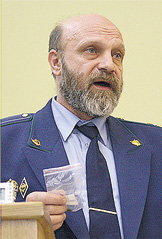 |
| Criminal investigator Vladimir Soloviev continued the case, begun by Nikolai Sokolov |
Bones
One of the important issues is the fate of the remains of two people found near Yekaterinburg in 2007. “The exhibition lacks the two most important exhibits - the remains of Tsarevich Alexei and his sister Mary, three years ago identified as a result of the most difficult modern examinations. Their ashes are still not rested, and formally they are units of storage of one state organization to which I transferred them, ”says investigator Soloviev. - They are still listed as material evidence in the case. I believe that the decision on burial cannot be made without the participation of the Russian Orthodox Church. ”
The state is waiting for the church to remember its saints. The church is silent or expresses its doubts about the reliability of the examination. Meanwhile, the head of the Russian Orthodox Church of Abroad, Metropolitan Hilarion, not only provided exhibits for the exhibition, but also carefully studied all the materials of expert research. “It is a pity, our compatriots, representatives of the Russian Orthodox Church, will not find time to resolve the question of the holy children of the Russian king,” says Solovyov. “The coffins stand immodest, and the church is silent.”