
Translated material
Henry Reznik: "They began to take less often, but in a large way"
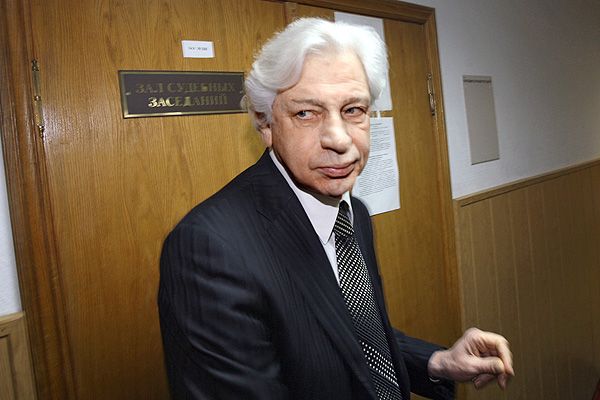 Photo: Sergey Mikheev/Kommersant
- Now they often talk about the absence of competition in the courts. Do you agree that she is not?
Well, firstly, what is the lack of adversarial process? I say to the lawyers: "Here you exist in this justice - so beat, fight and do not give up." And I must say that there are such things in which the protection wins the process. Everything is not absolutely, do not smear with one paint. Another question is that our presumption of innocence in the courts is not in demand. The presumption of innocence is you know when the unproven guilt is equated with proven innocence. Of course, we do not have this.
Our presumption of innocence is replaced by the accuracy of the materials of the preliminary investigation, and, in essence, in order to win the case, the lawyer needs to completely ruin the indictment. But for the most part, this is impossible, because negative facts are not amenable at all, with rare exceptions, positive proof. You can prove that the person did something, but try to prove that he did not do something.
- You are a lawyer since 1985, before that have been an investigator. How did the system change?
Here was the period: 1986-88, when it was the famous December Terebilov resolution (Vladimir Terebilov-chairman of the Supreme Court of the USSR in 1984-89-PP). Then they told me right from above to apply the presumption of innocence - justification sentences went. Our courts are controlled. But then quickly everything entered the same shores. But in comparison with 1966-86, it is better now. Then there were no acquittals at all. Now at least 1.5%.
-And something has changed since the Moscow City Court led Olga Egorova? Many believe that with her arrival the situation was fundamentally worsened.
Absolutely not. In criminal cases - nothing. Everything was already like this under Zoe Ivanovna Korneva (Chairman of the Moscow City Court from 1986 to 1999 - PP). In professional courts, we never had acquittals in the amount in which they should be.
- In an interview with Publicpost, the former judge of the Dorogomilovsky court, Alexander Melikov, said that with the advent of Olga Egorova, the personnel policy has changed, and now they do not take lawyers ...
And under the Soviet regime, no lawyer never became a judge. The system has reproduced itself. At one time, the only exception was the chairman of the Moscow Bar Association, the famous Vasily Samsonov. He was made a member of the Supreme Court, and it was an event. Never, I repeat, never came to the judges from lawyers. This was not under the Soviet regime. Lawyers were absolute class enemies. He could not become a judge Jew, could not become a non -partisan judge, which was often combined.
- And now?
Now is another problem. In general, they would take a lawyer - and take separate ones. But the best lawyers should go to judges. The judge is a special position. And now Vyacheslav Mikhailovich Lebedev (Chairman of the Supreme Court of the Russian Federation since 1989 - PP) has announced numbers at the last meeting of judges: 144 applications from lawyers. And this is all over the country! Of these, 45 passed exams. And why, in fact, do not go? In Moscow, for example?
Let's imagine: the judge receives about 60-70 thousand rubles. And how much is a lawyer with practice? Actually, we have a stratification in the bar: many lawyers live poorly, you know, they interrupt literally. And on the periphery in general! In some Vyatka, where the insolvent population. On the periphery, lawyers consider 10 thousand a month for decent earnings. And in Moscow-who should go to the judge? A lawyer, if he is a specialist, a connoisseur of law - such a lawyer, you know, is in demand. In any case, he will earn 200 thousand in Moscow. Of course, 70 thousand rubles on the periphery are good money, unlike Moscow, but it is precisely representatives of the lawyer elite, especially corporate law specialists - they will earn such money on the periphery. Arbitration courts would love to accept lawyers, but experienced civilists and connoisseurs of corporate law simply won’t go.
- If the lawyer elite does not go to the judge, so who judges? How has the quality of judicial personnel changed?
We will be able to judge this when we have transparency, a data bank and when all court decisions will be available in electronic form. For example, in arbitration courts, all decisions are already available, and, by the way, at the level of higher courts - courts of regions, edges, republics. And I can tell you that in principle, most of the judges are qualified people. Yes, and difficult things - I do not take arbitration, there are really difficult things - there are not so many difficult things in the total mass. What are mostly cases in the courts? Of the 20 million cases, approximately 1 million criminal. What are these things? 50% of cases are considered in a special order - this is when the accused pleads guilty. Most of these things are thefts, robberies, hooliganism. Basically, the problem there is that in doubtful cases when the guilt is not proved, the judges find the defendant guilty. We have the most acute problem - these are custom -made business, as the Khodorkovsky case, and so on.
- And what can a lawyer do if the case is ordered? If the end is already clear to everyone?
And at what level was ordered? In the court of first instance, for the most part, the judge understands everything, there are few such villains. He was told to pronounce a conviction - he would soften the punishment. But life is long: further cassation, time will pass, the situation is changing. And then supervision: supervision in the city court, then in the regional, then in the Supreme Court. There are two instances, there are two instances. I won a lot of custom -made works in supervision. The situation has changed. And in supervisory order, the courts, which are still more independent, made such decisions that completely surprised everyone ...
Well, for example, the case of Vadim Poil (the journalist of the Moscow Komsomol member Vadim Poal in 1995 was accused of insulting the Minister of Defense Pavel Grachev in the article "Pasha-Mercedes"-PP). The district court condemned him, and then the Supreme - fully justified. Or the case of a journalist and a deputy from Belgorod Olga Kitova (the author of anti -corruption articles and investigations, in 2001 was subjected to judicial persecution, she was accused of being beaten by a group of police officers - PP). She was convicted of five articles! When filed a cassation, it was possible to withdraw three articles, and after supervision, it was completely rehabilitated. And the case of Oleg Orlov and Ramzan Kadyrov (in 2011, the head of Chechnya, Ramzan Kadyrov, accused the human rights activist Oleg Orlov, who announced the involvement of the head of Chechnya in the murder of journalist and human rights activist Natalia Estemirova, PP). They already lost in the civil process, another lawyer was doing the case. And in a criminal case there is an acquittal. Well, who could believe?
I can say that I was lucky: a conscientious judge was considering the case. And I, in general, created such a situation in which it was very, very difficult to make a conviction. I managed to convince the judge of his innocence.
Therefore, to lawyers who do not want to leave the profession, I can only advise you to beat my head against the wall. It is more likely that only cones, but never - absolutely - absolutely, 100% - to exclude the likelihood that it will be possible to succeed. Therefore, I am in the profession.
- Former Deputy Chairman of the Volgograd Regional Court, Sergei Zlobin , who filed a resign in 2011, in an interview with Publicpost, said that "the court became a business." Do you agree?
Rumors about the corruption of our judicial system have always been greatly exaggerated. In the courts of general jurisdiction, the insolvent population is mainly suited: in criminal and civil matters. Part of a certain case - of course, yes, money is taking place there, but I think that the peak of corruption has been passed in our courts. They began to take less often, but in a large way. I do not touch the arbitration courts, where, as it seems to me, there is also money, but there the peak of corruption has passed.
- That is, nevertheless, lawyers bring?
Part of the lawyers - I call them, by the way, not even "postmen", but "colleges". Do we have "collectors"? Yes, of course, of course. There is such a part, but the fact is that if you need to bring it, suppose, they are most often brought to investigators, prosecutors and operatives, because there is an opportunity to influence the outcome of the case. And in the courts what? One percentage of excuses.
“ Why is there so little?”
This is just raising certain questions. This just says that the presumption of innocence does not work.
In the 19th century, lawyer Lord Eldon said that the colossal mistake is that people divide things into black and white, while most of the things are gray. As in a joke: "Again damned doubts." It is necessary to understand what evidence is in the courts. By 95%, this is the readings of people - hence doubts. Here in the same meaning of the presumption of innocence, she says in such cases: interpret in favor of the accused - which the jury is done, which the judge gives such an instruction (she would try not to give such an instruction). In jury ships-15-20% of excuses. These "gray cases" say: "There is no reliable evidence of guilt." And professional judges are initially suitable with their indictment. They drive all doubts away: the investigation was presented, the prosecutor supports - well, and crazy.