
Translated material
Know marketing
In recent years, we have had such a profession - a cultural manager. Contemporary art has become fashionable, and managers are suitable for it from the commercial side - to find an unusual product and convince people that they need it and they can not do without it. When the viewer asks what to read about contemporary art, he is most often recommended “how to sell Don Thompson for $ 12 million dollars”, after which a person finally gets the impression that all this is a grand fraud created only to make a profit.
This popular book tells a lot about the market, and almost nothing about art in its actual meaning of the generator of meanings, a public instrument. If something cultural managers should work in Russia at the moment, then this is to destroy their own newly -minted profession. To eliminate the false situation in which art is a certain incomprehensible thing, which must be able to foil the client, and make people themselves understand it, to enjoy what they see and understand, then even the market should be improved by itself. First, value, and then, based on it, is the price.
The Center for Modern Culture "Garage", which made contemporary art fashionable, and the publishing house of AD Marginem, which made the intellectual literature of the popular, combined their experience in a joint publishing program. The founder of the Iris Foundation and the Center for Modern Culture "Garage" Daria Zhukova mean the purpose of the program: “To make up for a gap in the modern cultural landscape of Russia. In recent years, a new cultural community has been formed in Russia - artists, curators and lovers of contemporary art, but there are almost no books that would help to better understand this new culture in Russian. ”
 Gilles Delez, "Kino", Ad Marginem, 2012, Cover
Until the end of this year, it is planned to publish 12-14 books, among which both the archive and modernity, theory and fiction, written about art or art critics will be presented. What was published, but the circulation has long been dispersed; What has become a classic in the West, a necessary basis for further research, but we have not yet been translated, and works of recent years. The immediate plans are Rolan Bart and two books by Suzan Umbar, for the rights to the publication of which had to fight seriously, the “brief history of curators” by Hans-Ulrich Obreist, the “grammar of the sets” of Paolo Virno, the author’s collection of Boris Groys “Politics of Poetics”, the Book of the Buker Laureate John Berzhder Bento.
Burger has a bright biography, one of the famous episodes of which is that in 1972 half of the Bokerovsky Prize of the Buker Prize received by him for the novel “G”, he gave the Black Panther ultralery, and now, at his 86 years, he did not lose radicalism. Notebook Bento is somewhat reminiscent of the 4-serial Ways of Seeing film, made by BBC Berger, the script of which was published after a book. There - about the ideology hidden in visual images, here is the fruit of the writer's thoughts about what could be in the notebook of the philosopher Benedict Spinoza. This is, as it were, the notebook restored by the writer, along with the sketches of the philosopher who had the talent of the drawer. In general, this is a demonstration of the meaning of drawing.
As Börger said in an interview with Anna Aslannyan on the Radio “Freedom”, when you draw, you will identify yourself with the depicted object, and then you begin to feel the connection between everything that exists in the world, with the past experience of mankind. And this is not some kind of spiritual practice, distracting from the present-on the contrary, a way to understand better what is happening now. The writer calls the current situation "economic fascism." If industrial capitalism knew what time was, then financial capitalism is a blisor, and cuts time on short unrelated pieces of speedy profit. The time and unity of all things that are given to us to know in the process of drawing reveals this shortsightedness of capitalism.
Simultaneously with the first edition in English, in 2012, the book of Jonathan Littlela “Triptychih. Three sketches about Francis Bacon. " AD Marginem has already shook the audience, promptly published the novel of the “favor” of the same author who received the Goncurov Prize. In addition, it will be interesting to combine the impressions of Littlel’s book with the only appeal of the French philosopher Zhilus, Deleuz to fine art - the work of Francis Bacon. Logic of sensation ”(St. Petersburg: Machina, 2011). In relation to the Russian artistic situation, where in art they are looking for commercial grounds all the time, and painting is so considered the most corrupt form of art, acquaintance with these works dedicated to the work of the painter can act very sobering. Yes, Bacon's works are expensive, but it is worth it. This is not a rehabilitation of painting, but a rehabilitation course for those who are sick with faith in the exceptional strength of marketing.
From the fiction - the novel “UTC” Bruce Chatwin, an impressionism expert at the Sotheby's Auction House, the observer of the Sandy Times, an avid traveler. His novel “The Viceroy of Ouidah” (1987) about the slave trade in West Africa was filmed by Werner Herzog. The novel “UTC” is about the Czech collector of porcelain trinkets, a detective story, which is the shadows of Rabbi Lev, Kafka, Mayric, and Chinese alchemists. It was already published in the magazine Foreign Literature, but went unnoticed, even despite such an important fact that Bruce Chartwin was the most famous user of Molekin, and they say that it was he who invented this name for him.
At the presentation of the Publishing Program "Garage" and AD Marginem as part of the 7th Moscow International Open Book Festival, the first two books of the series were presented - Nobrow. Marketing culture. Culture marketing ”John Sibruk and“ Cinema ”Gilles of Deleuz. Separately, Mikhail Kotomin, representing the publishing house, noted that they are proud of the design of books. And not in vain. They do not try to give a sense of significance and attractiveness to the publication with the help of a firm binding with a bright picture, selective lamination, coated with paper, as in Russia, unfortunately, it is customary. In this series, such significant texts are published that there is no need for decorative tonses, and therefore even a huge Tom Delez in a soft cover and on modest paper weighs almost nothing. It can be carried with you, read in the subway, and make notes with a pencil. Well, it’s not at all without Kunshtukov-just Sapienti Sat, and therefore Sibruk’s book is hinted at a barcode, which is now on almost all books as a product, only here it is moved to the front side of the cover with the back, and the black cover with somewhat blurry “titers” is responsible for the “cinema”.
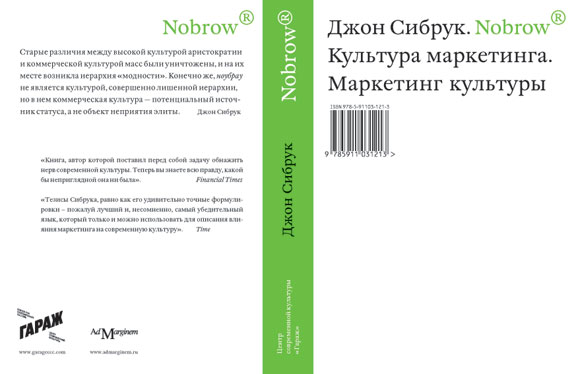 John Sibruk, "Nobrow. Culture of Marketing. Culture Marketing", Ad Marginem, 2012, cover
John Sibruk was invited to the presentation, the discussion with which was held by Mikhail Idov, the editor-in-chief of the GQ magazine, a person speaking the same language with the author of the book-not in the sense of English, but in the sense of immersion in the same New York party. Sibruk AD Marginem already published this book in 2005, but then, according to Kotomin, it was perceived as a “note in a bottle”, the general public was not clear what to apply it to. At the same time, in many foreign universities, she enters the program, and as Maria Steinman reported from the hall after the discussion, the associate professor of the Department of Theory and Practice of Public Relations of the Russian State University, this book since its first publication has become part of its course on advertising and mass culture, ten dissertations have already been protected on this material. That is, for scientific work, she was good in 2005, but now she, one must think, will find a much wider audience - because since then self -education, including cultural, has become very popular.
In short, Sibruk introduced the concept of nobrow as something new in relation to the previous division into the culture of the elite - Highbrow (approximately “high -luminous”) and Lowbrow (“narrow -minded”). At some point, the borders between them began to erode. As Sibrock emphasized, in America there was never a class difference, such as in the UK, there were cultural classes, and now they disappeared. High culture standards like The New Yorker stopped dictating the style and nature of hobbies and began to follow the information noise (Buzz), listening to what people discuss.
In Russia, the initial situation is different. As noted during the discussion, we rather have mass culture, and elitist - exotic. The Soviet art underground, probably, should be considered a variety of elitist culture-but Moscow conceptualists, social artists, and later currents programmatically included mass culture in their works.
The Nobrow Culture Sibruk divides the Big Grid and Small Grid to the “Big Grid” (Big Grid). The large erases geographical and national differences - as an example of such a phenomenon, he leads Hollywood blockbusters who are watching around the world. A small network, communities, fan clubs - what makes you special, the moment of clear identification is what is “yours”.
These networks, such as YouTube, are much wider than Hollywood, but the audience becomes very fragmented. In the 80s, cable channels appeared, where there were 100-200 specialized topics, such as “animals”, “women”, “cooking”. Now these topics are much more - thousands. According to Sibruk, "large networks feel something authentic in small communities and bring them to the top of the wave." His favorite example of this kind is Marginal Kurt Cobain, who has become a star for everyone. From this marginality they have already learned to extract commercial benefits - pay attention to YouTube advertising.
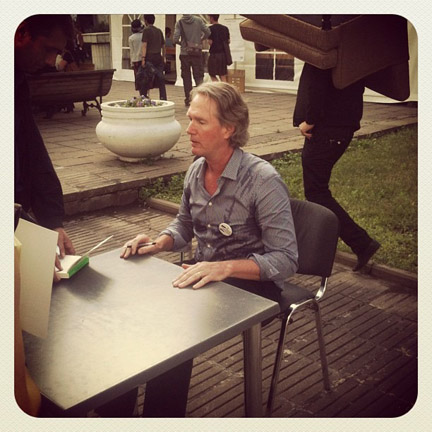 John Sibruk gives autographs at the 7th Moscow International Open Book Festival at the Central House of Artists. Photo: falanster.livejournal.com
Sibruk spoke of the mixing of cultures as something very democratic-well, look, before the hairdresser was a servant, and now he is a respected person, the creator of the style. The elite can be your subculture, but this does not mean that you are higher than some other subcultures. In response to Kotomin’s question, but if the large network is losing this multivariation, Sibruk said that everything is in order: a large network exists at the Hollywood level and becomes stronger than ever - we do not lose the point of contact. And an extremely original and strange circle of interests that separates you from others, such as addictions to the YouTube channel, which, in addition to you, has only a couple of dozens of fans - that allows you to identify yourself as a person.
From what has been said, it turns out that both the formation of a person and the feeling of oneself part of the society are the result of someone's cultural marketing. Nobrow democracy can be called into question - the choice of objects for hobbies is so wide that the result of choice has no social importance and is a purely private business. This is just the notorious global supermarket in which any needs can be satisfied. One must think that at universities the book is studied by those who want to learn how to make the most successful cultural goods. In the framework of this series, it is more likely to establish a “large network” again, but based not on Hollywood blockbusters, but on serious texts fundamentally important for understanding culture.