
Translated material
Revolution in a coma
After the elections - again Tahrir
Revolution in a coma. The Egyptian as an election commander had transferred an indefinite period for the results of the presidential election. At the time of delivery of the number, the winner was not known, but both candidates were Ahmed Shafik, former Minister of Hosnie Mubarak, a protege of the Supreme Council of the Armed Forces (VSVS), and Mohammed Mursi, supported by Muslim Brothers, ”said their victory. Mursi's supporters also occupied Tahrir Square, making it clear that they were ready to defend their candidate to the end. How the confrontation between the army and Islamists will end - the New Times found out 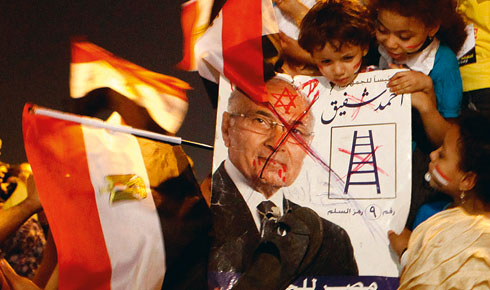
The generals promised to transfer power to the newly elected president no earlier than July 1, but they did everything to de facto preserve the reins of government in their hands. The day before the election on June 16-17, the Constitutional Court, formed under Hosni Mubaraka, dismissed the parliament chosen four months ago and, accordingly, the Constitutional Commission, which developed the basic law of the country. The official explanation: they say, the existing elected legislation violated the principle of equal conditions for all candidates.
Deterioration rate
“In fact, the reason is that 60% of the places in the parliament were received by the“ Muslim brothers ”, the Salafites and other Islamic parties,” explains The New Times, the editor-in-chief of Oumma.Som Said Branin, “which means that the places were also distributed in the Constitutional Commission. But this, of course, did not suit the military junta at all. ”
The military came to power in Egypt 60 years ago, when General Mohammed Zavti, along with young colonels Gamal Abdel Naser and Anvar Sadat, overthrew King Faruk ** Mohammed Shipa-President of Egypt in 1953–1954, Gamal Abdel Nasher-in 1956–1970, Anvar al-Sadatat-in 1956–1970. 1970–1981 .. Over the years, the essence and methods of managing the country have not changed: all the presidents of Egypt were immigrants from the army, which influenced the adoption of basic decisions. “The army in Egypt is not just a million people and huge financial opportunities,” says Pierre Pichinin, a Belgian analyst, a specialist in the Arab world, is a pillar of the country's political life. The interests of the generals were closely intertwined with the interests of the Egyptian bourgeoisie, the whole establishment of the Mubarak era, its administration, ministers, large businessmen, close to the regime. All of them are afraid of the “Muslim brothers”-and not because they are scared by the Islamization of the country, they simply do not want investigations and trials. ”
The struggle for power in Egypt has turned into a struggle for existence, Said Branin agrees, but now "it is dangerous that the military clearly relies on confrontation and deterioration of the situation." The expert is more than sure that Ahmed Shafik will be declared president, despite the fact that Mursi actually won the elections. ” And then? People will go out onto the streets, the country will transfer to martial law, blood will again pour - and in the end the army will again take control of the situation, thereby saying: “They played enough into democracy? Enough! Now we will put things in order. "
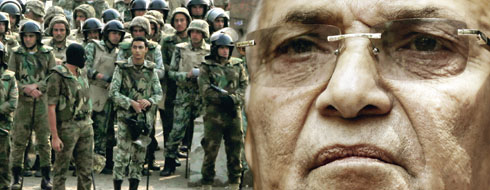 Former Minister of Mubarak Ahmed Shafik (1) relies on the army ...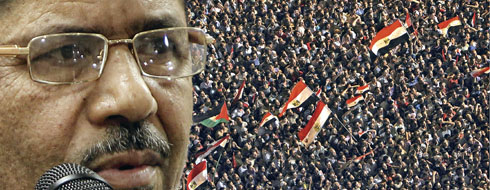
Billionth argument
The Egyptian army has a serious trump card that unties her hands - the US political and financial support. The annual volume of assistance - $ 3 billion. With this money, the military manage at their discretion, neither the parliament, nor the president has the right to even ask what they were spent on: the military budget is a state secret. “In Egypt, the interests of several international players are now faced,” says Said Branin. - On the one hand, Washington and Jerusalem are behind the military. But the “Muslim brothers” and the Salafites also receive quite massive financial support: the first from Qatar, the latter from Saudi Arabia. These two countries recently fight for the role of the main player in the region, which, of course, is explained by the personal ambitions of Emir Katar Al Tanya. The question is whether the United States, Qatar and Saudi Arabia are ready to supply each of its partners in Egypt not only with money, but also with weapons in case of military clash. Judging by Libya and Syria, it is quite possible that they are ready. ”
Friends against *
The world community was confused by the relative calm, with which the “Muslim brothers” perceived the news about the dissolution of the parliament and the restriction of the power of the not yet elected president. “At first, several dozen, not even hundreds, young people went to Tahrir, but it didn’t work out a mass performance,” the professor of the American University in Cairo, a member of the advisory council for working with the army of Monaram-Ebeid, tells The New Times, “and although the situation is heating up, the explosion has not yet smells of explosion.” "
All that the Egyptians achieved by brewing this porridge - a gray mediocre reincarnation of the same authoritarian regime
”Experts believe that there is one explanation:“ Muslim brothers ”did not take people to the streets not out of love for public order.“ Secret negotiations on the banal division of power are underway, ”Pimerinin is sure that the generals understand that the“ brothers ”are a street. Moreover, not only Cairo and Alexandria can rebel, but also the province, where dissatisfaction grows, where dissatisfaction grows The Islamists are spurred by the economic instance that they are behind the army and in the case of an armed collision, they will lose the main question for both sides: what to do with the Salafis that make up the real competition of the brothers and leading a much greater fear of the army - it is much more difficult to agree with them. The Salafites would take about 25% of the seats, was dissolved with the knowledge and consent of the Muslim Brothers, who, together with the military, will do everything in order to simply prevent the Salafites before the elections in the future. ”
Turkish version
Jean-Noel Ferier, director of the research program in the branch of the French National Center for Scientific Research in Morocco, also believes that a lively bargaining bargaining between the two main players on the Egyptian political scene: “The army does not need to seize power, it is already in her hands. Even less generals want to rule the country and, accordingly, bear responsibility for what is happening in it, find solutions for economic and social problems. ” The military simply needs some control of what is happening in the country, and most importantly, the belief that their status will remain untouched: “They are interested in guarantees of their financial stability, personal integrity and some inappropriateness, as well as the ability to intervene in the political life of Egypt, if there is something directly contrary to their interests,” continues Ferier. The preservation of this privileged position following the example of Turkey has become the subject of bargaining, the expert is convinced. According to him, in any case, the process of becoming power in Egypt will now drag on for a long time: "It is unlikely that we will see the elected parliament and the new constitution until the spring of 2013, if not later." 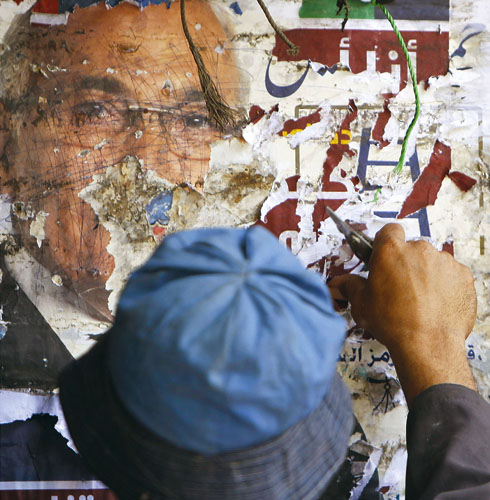
Pierre Pichinin has no doubt that the military and Islamists will eventually find a compromise. At the same time, the expert urges "to honestly admit: the Egyptian revolution has long lost." This happened exactly on the day when the Egyptians were pleased with the resignation of Mubarak and left the electoral process in the hands of the associates of the overthrown leader. Today, the ex-president is in a coma, but also the revolution: “You look at the candidate from the army! When I was in Cairo immediately after the resignation of Mubarak, the youth in Tahrir Square wore t -shirts with crossed out photos of Ahmed Shafy! All that the Egyptians achieved by brewing this porridge - a gray mediocre reincarnation of the same authoritarian regime. ”