
Translated material
Where is the stock market rolling
Tied with a triple knot. The Russian stock market is going through difficult times. The capitalization of shares of domestic companies circulating on the exchange fell by a third over the past 15 months. And since the beginning of the year, the RTS stock index has been shown by almost the worst dynamics among all exchange indicators of developed and developing markets. What will happen to the stock quotes further - the New Times found out
“We waited for the collapse on June 18, like what happened in September 2008,” a familiar exchange trader told The New Times. “But it seems to have passed.” It was about the day when the results of the Greek parliamentary elections were published, behind which, having lurked his breath, not only politicians, but also the exchanges of the whole world, followed. If the victory were won by the forces tuned to the exit of Greece from the eurozone, the stock indices would have collapsed, despite all the assurances of the financiers that are ready for this outcome. However, in Greece, pro-European forces took the top, and although events in this country can still develop differently, the markets have the opportunity to take a breath.
The worst of all
In the event of the implementation of the negative Greek script, the Russian stock market would have waited for a collapse, the trader of the “region” Evgeny Pishchulin believes: “If the RTS index struck the level of 1200 points above which it was, the road to 550-600 points would be open to him.” And so the index even rose somewhat from June 18. However, this does not cancel the fact that over the past 15 months, the capitalization of Russian public companies has decreased by almost a third. The total cost of shares that are applied on the combined exchange of the MICEC-TRTS exchange has decreased over this period from 33.1 trillion to 23.5 trillion rubles, the BDO audit and consulting group said in a study. The retreat in the market took place in all positions: the number of ordinary and privileged shares of Russian companies applying on the exchange, in five months of the year, it decreased from 419 to 407, and only in the last month the total decrease in their value amounted to 2.8 trillion rubles, or 10.5%. 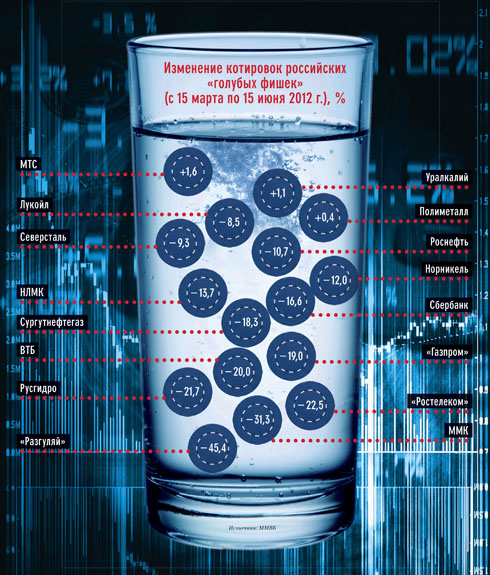
Well, from the beginning of the year, Russian stock indices have fallen much stronger than their European and American “brothers” ** Read more - in The New Times No. 20 of June 11, 2012 .. Moreover, if you compare the domestic RTS index (it is nominated in dollars) with leading American ones, then the picture is dramatic: Dow Jones has grown by 1.44%, 1.44%. NASDAQ - by 8.53%, S&P500 - by 4.19%, and the RTS fell by more than 10%. Unless the Indian stock index is close in terms of falling to ours - it has lost 28%since the beginning of the year.
Experts interviewed by The New Times explain such deplorable results by the fact that the Russian market is tied with a triple knot: firstly, world risks are fully affected, secondly, its own Russian political and economic problems, thirdly, it depends on the world's oil prices. Now all these three factors are formed in a fairly negative puzzle, which determines the fall of domestic indices and a decrease in the capitalization of Russian public companies. “Throughout all 5 months of this year, for the most part, the pessimistic mood reigned in the markets, supported by a disappointing situation with debt problems in the eurozone,” says Artemyeva, head of the analytical department of the national rating agency, Karina Artemyev. The conversations that seriously came out about the withdrawal of Greece from the currency union, a decrease in the ratings of Spanish, Italian, French banks, not impressive macrostatistics from the world's largest financial centers - all this gave rise to the mass flight of investors from risky assets, which include Russian papers.
Purely internal economic factors affected the cost of domestic “blue chips”, added by Ivan Manenko, the head of the analytical department of the Veles Capital IK . In particular, the growth of debt load of leading domestic companies and a gradual increase in inflation in Russia. However, the main of the internal reasons-the stormy outflow of capital from the country, Karina Artemyeva notes: at the beginning of June, he already amounted to $ 46.5 billion, and a serious reason for his return from abroad is not visible.
Finally, exchange practice shows: our exchange indices willingly hesitate after the price of oil. And since since the beginning of the year, black gold has become noticeably in its own way (the price of a barrel has fallen from $ 125 to $ 100), sank the entire stock market: after all, most of its “blue chips” are enterprises of the raw material sector. “If global markets grow, Russian indices will follow in line with the general trend, but will lag behind competitors,” concludes Alexander Kovalev, an analyst in the capital Bank. “If the fall around the world continues, Russian papers will again be among outsiders.”
Movement of ideas *
The dynamics of the quotes of Russian “blue chips” since the beginning of the year is an almost continuous fall curve. From the overall picture, except for the “polymetall” shares stand out. During the May sales, they practically did not fall, and in June they completely updated the maximum. It is quite obvious that this "golden" asset plays a kind of protective role in the Russian market. Similar dynamics and the papers of the Fertilizer Fertilizer manufacturer, and the MTS mobile operator, whose papers managed to play all their losses by June.
The main outsiders were shares of the largest Russian agricultural holding "Rainty", which lost about 50% of their value due to negative dynamics in the food market. Councils of shares of electric power companies also rolled up to the minimum values - in the wake of corruption scandals that shocked the industry at the beginning of the year.
Despite the fact that the Russian stock market as a whole looks much like a weaker than competing markets, this does not mean that it is impossible to earn on it, representatives of investment companies note. Even in the current circumstances, there are quite a lot of market ideas related to the prospects of a particular industry, either with individual companies, or with shares that are regarded by investors with “quiet harbors”, where it is more handful to survive the crisis. In particular, investors carefully monitor how the privatization program approved by the government will advance, which involves the sale of state shares in the largest Russian companies: RusHydro, Inter RAO, FSK, Rosneft, Sberbank, VTB and others. The very news that the state is ready to reduce its share in the economy caused the local growth of shares of most of the above companies: at prices “above the market”, the transneft and FSK shares are traded in June. "
Despite the fact that the Russian stock market as a whole looks much like a weaker than competing markets, this does not mean that it is impossible to earn on it
“Critically configured investors, however, see the problem that government plans for privatization are changing too often to perceive them seriously. It was originally planned to finish the privatization by 2013, but as oil prices, the motivation of the government, the chief economist of the BNP Paribas in Russia and the CIS Julia Trichyeva , noted. The goals and terms of privatization, which seriously inhibits the process.
With the price of a barrel, of course, quotes of shares of oil companies are closely adjusted. So far, among them, the LUKOIL shares most attractive thanks to the plans voiced in the last days of May to hold the public placement of shares on the exchange in Hong Kong next year. However, analysts are noted if oil collapses up to $ 60 per barrel, no placement in Hong Kong, if it takes place at all, will not save Lukoil’s paper from the fall. The same is the same with the Russian banking sector. No matter how favorably investors take the recent absorption of the Turkish Denizbank by the Cberbank, the quotes of shares of the largest Russian retail state bank will collapse in the event of serious problems with the world financial sector.
Nervous ending
Speaking about the second half of the year, most analysts converge that the situation in the financial markets will remain extremely tense. Even if European problems are somewhat faded into the background, another round of speculation on the topic of giant American public debt (104% of GDP) is expected by the fall. The “extinguish” the threat of the crisis with new and new measures to stimulate the economy (that is, pumping money) is unlikely to be able to easily - the previous experience shows that such decisions are fraught with stormy discussions in the congress, which themselves can be pretty shaking the market.
For the Russian stock market, the situation is aggravated by the fact that the outflow of capital from the country continues, as well as the fact that, according to most analytical forecasts, oil will certainly be cheaper by the end of the year. In such layouts, there are few reasons for optimism for exchange players. But pessimism is also an incentive for action. According to Trader Evgeny Pishchulin, many of the exchange players began to think about "was it time to take advantage of the moment and start buying pretty depreciated shares of Russian companies that are traditionally considered one of the most underestimated papers in the world."