
Translated material
The simulator of the image of the world
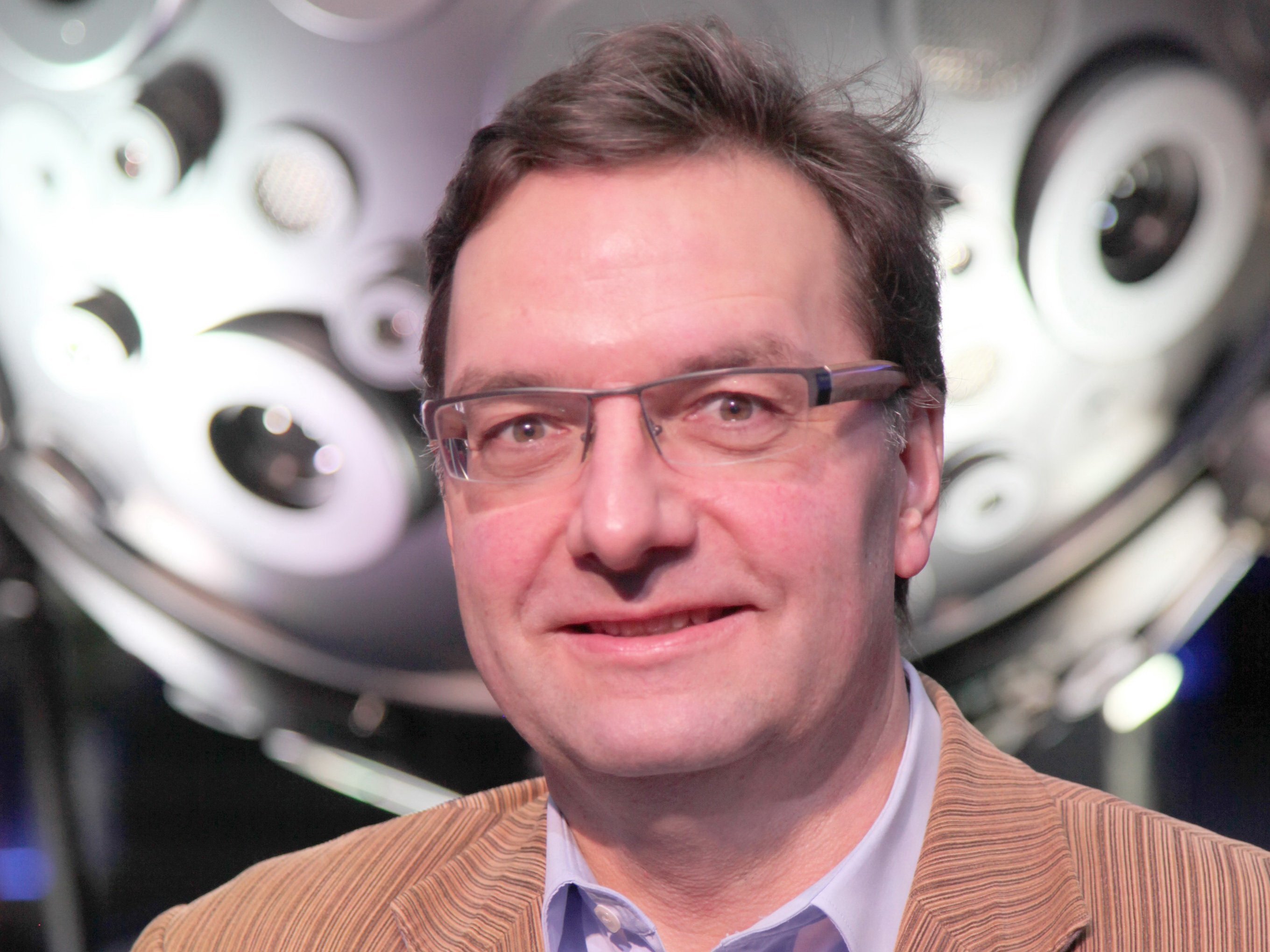
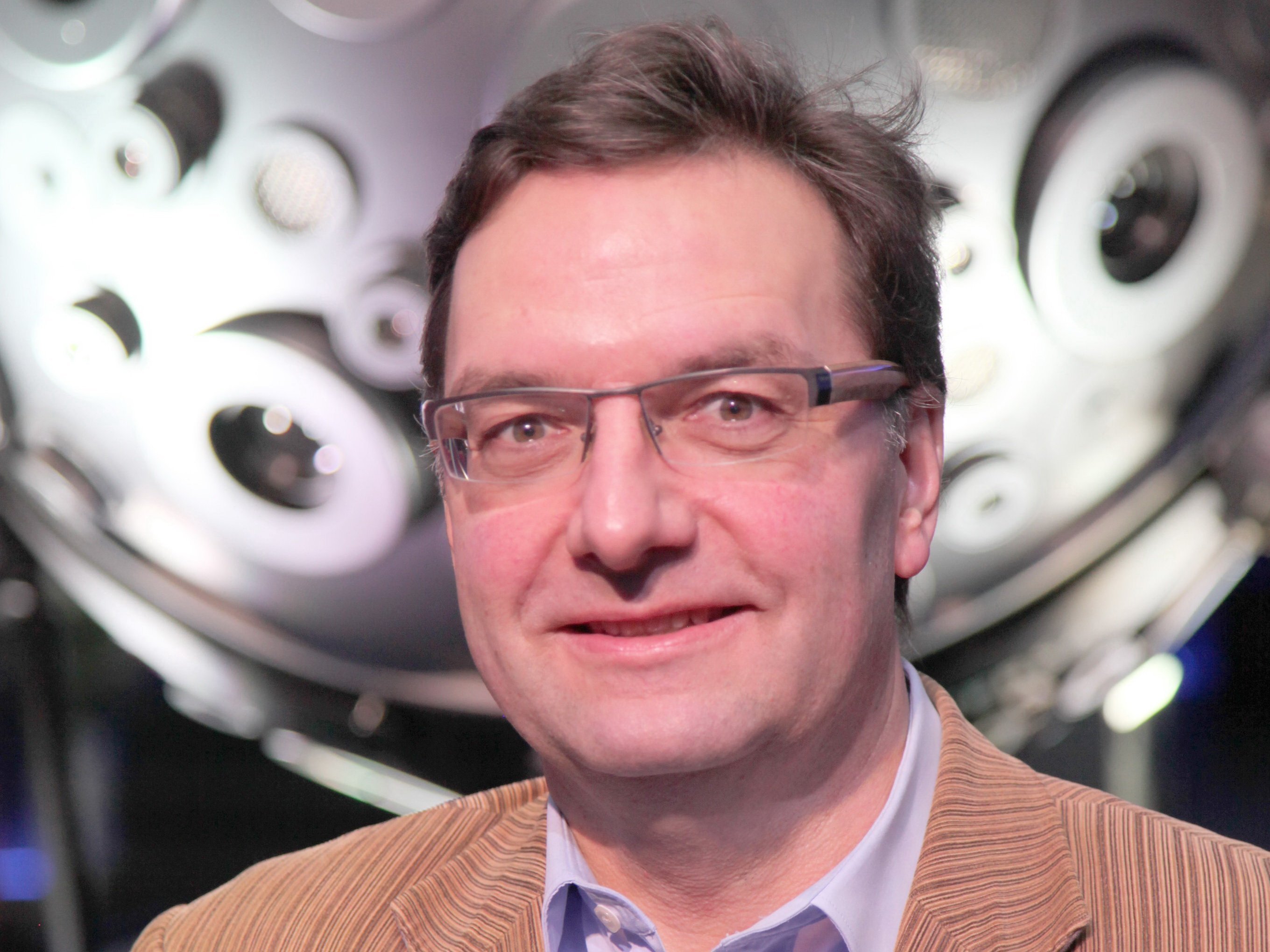 Thomas Kroup. Photo fragment from the planetarium site
We continue the publication of the materials of the Forum "Funds and Museums as a popularizers of scientific knowledge", which took place as part of the Popular Science project. The director of the Hamburg Planetarium Thomas Croupe is talking about his experience.
First, let me thank you for the invitation here, to your beautiful city. I was recently in Yaroslavl and looked there a planetarium. It exists for a year, and I really liked what is happening in Russia in terms of planetarians. This is the first picture of the sky that we know at all. This was done in the carer, this picture was found in 2000 in Germany during archaeological excavations. This is a new illustration of the heavenly sphere, a new picture. This is a picture of the world. Our cosmology is not where our cosmological performances are located - they are in our head. Cosmos is in our brain . We show space with the help of paintings that arise in our brain. These are our senses that interact with the universe. This is not a reality, this is a reflection of reality, the interaction of reality with our senses, with our brain, with our ideas about this, about space.
The planetarium projects ideas about space - from the head outside, into space. Maybe push a little curtain? The space is dark and we need less light here so that it does not bother us. The planetarium is not just a reflection of the starry sky.
The planetarium was created as a simulator of the image of the world.
The first planetarium arose from the founding of the German Museum in Munich. This was considered as a miracle. The space of the room turns into space. That is, furniture is not noticeable, there are no chairs, and you are, as it were, in the middle of the starry sky. The planetarium looked like a circus animal, as a source of the sky for observers on Earth. A circus animal of technical origin - like an elephant in a circus that dances in the arena by the racket of a trainer and begins to move suddenly - so the planetarium is approximately.
The Universe - our image of the world was completely different than now. He corresponded to the fact that we see with our own eyes in the sky. What we perceive with our own eyes, like a starry sky. A strong impulse of the planetarium received during the years of competition in the development of space between Russia and America from 1960 to 2000 approximately. This left its mark on the entire methodology of the story about the world, space in the planetarium. It was a space flight theater, one might say. In the 1970s, a revolution took place, which first occurred in the cinema. Large design of films, films in large format. In 1983, this revolution passed to the planetarium. The first digital domed cinema was created-Digistar-1. You seemed to be freed from the plane of the Earth and were able to show completely different images, completely different pictures.
But the challenge was that a huge stream of information began to come to us from the sky. A new generation of instruments, telescopes in space, which terabytes of information began to be sent to Earth. Our audience needed accompanied, in explanation at these flights in space. Cosmos increased in volume, became more exotic, it was necessary to explain all this to the public. The beginning of this revolution of the planetarians was when in the American Museum of Natural History, natural nature in 2000, such a center for Earth and Space was opened. It was a center of virtual reality, one might say, the world's first completely digitized planetarium. For 4 years I participated in the development of the concept and technical training of this planetarium.
For those who do not know details, a little background information - what elements such a modern planetarium consists of. In principle, this is the video generator, this is a whole stack, you can so to speak, computers that create images, images, computers cluster, a database of galaxy, about the universe, a huge amount of information about the universe is processed and produced here. In principle, this is the world's largest 3D model, which is hidden in this computer - there are no gears there, there are no mechanical details there, like in the old planetarium, and this is a digital planetarium, a completely digital model of the Universe, which is hidden in this computer center. All this is projected, reflected on the dome using video projectors that are under the dome and cover the entire dome with pieces of images-6-7 fields that completely close the entire dome. There is a general picture of individual pieces, a single image is obtained.
The digital planetarium is a new experience, it makes it possible to carry out virtual space flights throughout the cosmos, and, of course, it reflects the real data in 3D format that was obtained as part of the study - there is no Hollywood effect, unlike visual elements. This is a visualization of science, we can in this way achieve - thanks to this technique - visualization of science. What potential does the planetarium have in the framework of educational sciences, and how does it engage in the popularization of science? What is the role, the task belongs to the planetarium? From my point of view, it is clear that
The planetarium makes it possible to change the perspective, gives a new angle of view for people. The planetarium expands our imagination - this is the central task of the planetarium from our point of view.
And - besides science, this is a place where people receive an aesthetic education, and the planetarium has an artistic component, artistic space, art component.
So, what place does the planetarium occupy in the 21st century? The planetarium is more than just a telescope. This is a microscope and a time machine at the same time, all together. And, in addition, the planetarium makes the unimaginable imaginary. Moreover, this happens: in space, in time, in sensations. In space - we can achieve any point in the universe. From the point of view of time - we can travel in time. As for the sensations - these discoveries become possible, open to our sensations: our hearts, our sensations and our brain are all included in this process. This, in fact, is an authentic expedition that we carry out into science. In principle, this is a cruise liner for our sensations, it is a cruise into space: into a microcosm, in a biocomos, and a macrocosm. This is both a cruise liner for our head, for our imagination, for the power of imagination, in order to comprehend nature. Thus, in this case, we are talking about imagination and inspiration - these are two basic concepts that belong to the planetarium, and in the focus of the planetarium attention, there is an important content, and the quality of the content is also important for people of the future.
And, in addition, we must remember that we can know the world with the help of the senses, ears, eyes.
We see not with the eyes, but in reality our brain, as you understand. We see how the brain interprets the world.
And it is important for us how our brain functions when we talk about scientific communication and do scientific communication. And this is very important just. When we talk about the space that gives us a review of 360 degrees, this means that we are talking about the human side and human dimension: what does what I see for me as a person? Planetariums tell history . We are the narrators, we are storytellers. If we are engaged in scientific communication, popularize science, then in the planetarium we tell the greatest history in the world. We talk about how the world appeared, about how the world arose, we are talking about the beginning of the cosmos, about the first stars and how the earth arose. We associate people with what they cannot achieve, touch.
There is excellent aphorism belonging to Friedrich Nietzsche, a great German philosopher: if the senses allowed us, we would perceive the motionless resting rocks as a dancing chaos. Our feelings make it possible not only to understand and find out what geological processes are on Earth, but also those processes that go in heaven, in space can be comprehended if we observe them, armed with the telescope. And just in the planetarium, in our simulator of space processes, we can do all this. Perhaps you will ask yourself: what topics are of interest to people? What is the focus of our attention to?
In fact, there are three main questions that excite everyone. The first question: where are we in space, the second - where did we come from, and the third - where are we going?
And in the end, in fact, the planetarium is a theater that tells us about the past, connecting it with the future.
The planetarium in Hamburg is a planetarium that is most long exploited around the world, i.e. The oldest planetarium in the world. We make an affordable universe for people, and it becomes accessible to both the mind and the heart. Do you know the words of Woody Allen, he said: “I am amazing people who want to comprehend the universe, because sometimes they cannot navigate in the Chinese quarter.” It is not easy for people to embrace this field, understand this gigantic cosmos, but it is possible, thanks to the senses and due to the fact that each of us has a heart. We need to combine our heart and our brain - and these organs to comprehend space, and we do it, and I would like to briefly show you at the end what we do through various programs - we are still talking about astronautics. Moreover, Russian astronautics plays an important role. Yuri Gagarin, and Leonov, and Valentina Tereshkova and so many astronauts are very important for us, and, of course, we also present musical and artistic ideas.
I consider it very important that cultural figures are not only scientists, and cultural figures also deal with science issues, and reflect science from an artistic point of view. And we consider it very important to include them in this scientific context, I also consider it a very important area of the planetarium. The planetarium has a large number of partners, we work with NASA, and thus we are trying to comprehend and own information about what exists in space in addition to our land, how this space exists, how they are connected with each other. Then archeoastronomy is another joint project, here we talk about the heavenly consciousness of people from antiquity, but, in fact, I must say that the technology is now available in order to demonstrate stereoscopic projections in 3D format. And our planetarium in Hamburg during the last year already uses stereoscopic methods to present you unusual plots to show what interesting objects there are already, and they literally swim in front of you when you look at this stereoscopic picture.
I can’t remember exactly, but it is very important in mass communication, we talked about this-social networks, connections with the audience, what is happening in the field of culture and art ... We have many programs in which we hold meetings with artists, you may know Jean-Michel Feature.
We are also engaged in media art because the capabilities of cultural figures expand so much, and thus we orient people for the future, and it seems to me that it would be important for technical museums - to invite cultural figures.
And here, in Russia, there are a large number of different samples, areas of art - they appeared in Russia. And therefore, I admire Russia in which there are so many different arts, and thus we can attract many young visitors to our planetarium and our museums, we carry out cultural programs and artistic art programs with various artists and other artists, use various devices. But, unfortunately, I can’t tell about them now. We have an interface for the iPhone, where 200 people can simultaneously affect what is shown on the dome.
Thus, we offer various formats of events that our planetarium has recently seen. And the planetarium, therefore, is a completely new means of information for various fields of knowledge, culture and art. And at the end of my performance I would like to summarize a small result. I was preparing to speak for half an hour, and now I'm trying to meet the time allotted to me and say what seems interesting to me - that
The planetarium must constantly update its activities.
Moreover, I am talking not only about the replacement of exhibits, but, of course, these are data banks that come from various fields of science that should be updated and are also the physical object of our museum. Physical object data banks - rather, a virtual object, and we now have the opportunity within the framework of all kinds of media, through TV and social networks, to make communication and carry out communication.
Thus, the following steps of the digital planetarium are a new content, new content, image improvement, stereoscopic image. In addition, we want our visitors to be part of our team, so that our visitors are not just passive spectators. With the help of their smartphones, they can join what is happening, we are working on this, and there are already the first successes. And I hope that in the future these planetaries will be united with each other, and we will have an online connection with theaters. For example, an astronaut from Russia can manage some processes. And all people in the planetarium can be these pilots and play these pilots. And it seems to me that visitors, thus, will not be passive spectators, but will be active participants in the process.
The planetarium of the future for me is the area of unification of the sensations that you perceive, a high level of communication, a high level of how we can perceive and process the information with the help of our means with the help of our feelings. At the end of my speech, I want on behalf of the International Association of Planetarians, the chairman of which I am, to invite Russian planetaries to a large conference at the end of July, because they are also part of this international organization, and their significance is growing because we see how culture and science are united here. And I am very happy about our cooperation in the future, and I hope that I could give you several impulses for your subsequent activities so that you formulate new questions. I want to invite you to our planetarium in Hamburg, which has been working continuously for 80 years and has been engaged in educational activities and delights people. Thank you very much.
Lyubov Strelnikova : Thank you, Thomas, very interesting. Do we have clarifying questions?
Question from the audience : The first question is clarifying: this may be the inaccuracy of the translation. It was sounded that the Hamburg planetarium is a planetarium that works for the longest planetaries in the world. The first planetarium in Jena, and, of course, it works for the longest. This is a clarifying question.
Thomas Kroup : I did not say that our oldest. The first planetarium arose in Deutsches Museum in 1925, and Ian is not the oldest planetarium. At first in Munich there was a planetarium. But during the war, all this was destroyed. An exception is a planetarium in Jena and Hamburg, which have been preserved and were not destroyed by the war. No, in Hamburg there was generally the only planetarium, not destroyed by the war. And if you are folding years from 1930 to the present, then we have the longest operation of the planetarium around the world. Our planetarium as an apparatus worked for the longest.
Lyubov Strelnikova : Thank you. Question.
Question from the audience : Thank you, Thomas. Did I understand correctly - you talked about the history of the planetarium. And the complex that you have, in general, is not a planetarium. It was possible to come to him, designing today something such without the history of the planetarium? This is not a planetarium at that then - it could be called a sphere , or a certain complex with powerful computer support, with a spherical screen that gives all the gigantic opportunities that you said. Do I understand you correctly?
Thomas Croupe : This is an ancient discussion: what is a planetarium and what is not a planetarium. I can only say that we are still a planetarium - I say. Throughout the world there are a thousand planetarians approximately; In New York, they first used this digital technique, and the Moscow planetarium-really a planetarium-the same technique is used here. The projection of the cosmos on the dome - to show space in all its dimensions. This task is to show the starry sky, the whole universe, the whole universe - I believe that this is the most important thing in the planetarium.
Lyubov Strelnikova : Thank you. Another question?
Andre Vegener : Andre Vegener from the Society of Max Planck. Can you say anything about the structure of financing? Is this state, private money? How is your planetarium financed?
Thomas Kroup : the Hamburg planetarium is funded by the culture department of the city of Hamburg, but in the past years we were so successful in our activities that the subsidy we receive was reduced to almost zero. 90% of the money that we needed, and even more we earn at the expense of input tickets. 150,000 euros are our subsidies, and our turnover is 2.7 million euros, or a budget. At the expense of our income, we pay all salaries, i.e. In fact, we finance ourselves. Но мы хотим, чтобы все-таки город нас поддерживал, в городском ведении мы хотим сохраняться, и чтобы город как бы сохранял свою ответственность за культуру, и чтобы мы оставались одним из важнейших культурных учреждений города.
Любовь Стрельникова : Томас, скажите, сколько сотрудников может позволить себе самоокупаемый планетарий сегодня?
Томас Краупе : У нас 12 постоянных сотрудников и примерно 25 свободных сотрудников. Это техники, кассиры, на телефонах сидят, уборка и т.д. Но 12 постоянных сотрудников у нас есть, штатных.
See also: Опыт "Экспериментаниума"
  Контраст музеев
  Модернизация Политехнического Technological Museum in the era of the technological revolution