
Translated material
From a secular Informburo
Why the intra -church business - to take the same Pussy Riot - is not subject to state justice
The Pussy Riot incident, on which many non -immutable (primarily political) meanings have been laid, is difficult to judge because we ourselves have to judge - people inevitably sensitive to the border of the sacred and profane logic, which determines its scandalous violation/confirmation
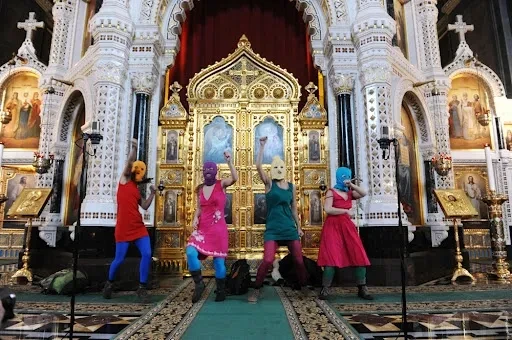
In science, it has long been recognized that the essence of religious feelings is not faith in the gods, but the division of the world into a sacred (sacred) and profane (worldly). There are people, animals, objects, substances, places and periods of time, etc. sacred or profane, etc. The sacred differs from the profane with its prohibition: it is not that it is impossible to contact him at all - it is possible, but not everyone, not always, in compliance with special ritual ceremonies. A unceremonious, unauthorized violation of the border between profane and sacred is experienced as a scandal - desecration, sacrilege, blasphemy, or yet, using a special term, “transgression”.
The difficulty is that for the normal functioning of society, it is necessary to violate prohibitions from time to time: on holidays, carnavles, often in art ...
The separation of sacred and profane is arbitrary; It can be motivated by divine will, but only this will is known exclusively from traditions and legends, it cannot be tested, it differs in different religious traditions and therefore, of course, looks conditional. God Himself never intervenes - or is extremely rare, also only in legends - in human deeds, and therefore people have to take on the maintenance of the border of the sacred and worldly. It is not determined by the nature of things, but drawn by society; People themselves guard it, they themselves approximately punish its violators - it is then that, thanks to such sanctions, the forbidden line remains obvious to everyone. So, for the strength of the border, violators and punishable are required, who at the cost of their own suffering demonstrate the inviolability of order to society. This is reminiscent of terrible, if you think about it, gospel words: "It is impossible not to come to the temptations, but woe to the one who they come." In the Greek text of the Gospel, the “temptation” corresponds to the word Skandalon, from which our “scandal” comes; And this maxim expresses the tragic contradiction between the inevitability of the “scandal” (transgression) and the pattern of punishment “to the one through whom it comes”. There is no justice in this square: it falls on a person, despite the fact that his sin was necessary for world order. In a broader sense, here we are talking about ancient sacrificial logic - the logic of atonement, not responsibility. For the sacrifice is actually not “for what”, but “for what”, not as a punishment for sins (they may not be), but for the sake of compliance with the border, to restore and maintain cohesion and consent in society. Thus, the largest social thinkers of the XX century explain the victim from Emil Durkheim to Rene Girar.
All this must be borne in mind, understanding the current scandal around the sensational hipphening in the Moscow church. It is difficult to understand it, because it has many different aspects, and in one of them public consent is possible today, by others - practically no. There is no hope, for example, to come to a consensus about the artistic side of what happened: the concepts of art adopted by us do not even cover even less provocative performances, and if in a narrow circle of supporters of “contemporary art” they can still seriously discuss the creative achievements or disadvantages of this action, then beyond its borders such reasoning will only meet perplexity, if not indignation: “What else is“ art ”? What other “artists”? ”
It is easier - although state power is opposed to this with its apparatus of violence and propaganda - to agree on the legal assessment of the deed. It is clear to each unbiased person that young women who were dancing on a symbol in the temple did not violate public order, but only a church order. Our social morality does not include the prohibition to rise on a salt (or baptize a poker, or remember the Lord in vain); Most of the members of our society and the words do not know this-"Sale". And since this is an intra -church business, it is not subject to state justice, like violations of the party charter or the rules of the sports game.
To sing or droop on a solar - the same as playing in football with a hand: yes, it is not supposed to, but the police are not called on this subject.
By the way, the analogy of the stadium with the temple is quite legal: in developed modern societies, sport causes experiences comparable in strength to religious and largely replacing them.
You can find consent of the political component of the incident (is it permissible to pray for the expulsion of the bad ruler? Yes, why not?), For its ethical component (is it decent to call the elderly hierarch to call? No, not very decent, but only he himself accurately fought in the word and deed - unfortunately, the elders also do not always behave decent). The most difficult thing is to explain and justify this from the actual religious point of view. That is why many people-and not only believers, which is once again proved, that the sense of sacred is deeper and primary of faith in the gods-advocating the liberation of the accused from prison, they make a reservation: “Actually, I do not approve of them ...” Indeed, the participants of the action themselves asked to become victims: they did not commit anything criminal from the point of view of ordinary, professional legitimization, but violated the sacred prohibition - They climbed into the place, reserved for the laity, and arranged there, even for a few seconds, purely symbolically, the action unacceptable according to church canons. If they insulted someone's religious feelings (and thereby, paradoxically, they woke up, forced to abruptly survive them), then only with this-scandalously crossing the line of the sacred.
So what is “woe to those through whom the temptation comes”? Do we agree, modern secular society, so that, due to carnival action in the temple, they if they did not bear criminal punishment (which are actually already carrying), then at least they were morally condemned in the name of unknown commandment-without justice, not for our guilt, but for our sacrificial enthusiasm? Without causing real harm to anyone, they are a shock effect - so painful there are some experiences in the theater or cinema - confirmed for everyone the sharpness of the gap between the sacred and worldly; And having set his experiment consciously, with deliberate minimalism (transgression is spectacular, but minimal in scale), they also require us to realize the conditional, relative nature of the gap, to stop considering it granted from the nature of things. According to the already mentioned by Rene, Girard, one of the most influential religion theorists today, the similar meaning had the voluntary self -sacrifice of Jesus - he also sought to overcome the dark sacrificial logic, bring it to the world of reason.
It’s not that the corporators from the group with the mischievous name were like him, but we can assume that, voluntarily going to severe persecution, they tried - consciously or not, successfully or not - to imitate Him, and the imitation of Christ is considered to be a good deed.
The Pussy Riot incident, on which a lot of non -immutable (primarily political) meanings has been laid, is difficult to judge because we ourselves have to judge
- People inevitably sensitive to the border of the sacred and profane and to the sacrificial logic that determines its scandalous violation/confirmation. This feeling lives in us like an indestructible hereditary virus; Perhaps without him we would not have been able to live like public animals at all - this temptation cannot but come ... We will try to at least take it critically and keep it under the control of the mind. The temptation is for that and the temptation so that he can’t give in.
Sergey Zenkin