
Translated material
How much does the sea cost in Sochi
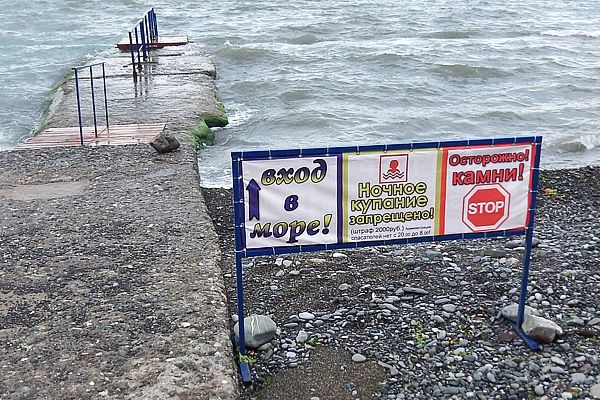 Photo: Wanda Avramenko/Publicpost
 Sochi, if you look at it from an airplane porthole or through the Google Maps grid, looks like a long narrow strip stretching along the coast. The future Olympic capital is the largest resort city of Russia and almost the longest in the world: 148 kilometers from the Shepsi River in the north to the PSOU River in the south. Locals always with pleasure say that only Sochiko is longer than Sochi, but visitors from the north correct them, that there is also Norilsk, throw kilometers between hills and mines and take “pure 180 km from the“ Taimyr ”to Snezhozhorsk. When such disputes begin, it is better to get up and silently go out from the table.
Of the 148 kilometers of Sochi, about 100 are beaches: bulk, natural, pebble, sandy, adapted for bathing and not very. The sun and greenish sea water are perhaps the only invaluable assets of the resort. It is for this that tourists continue to go here, despite the cement dust of the Olympic construction projects, endless car traffic jams, conditionally friendly service and quite Moscow prices for traditional local products - cherries, strawberries and a mulberry. It is difficult to say why tourists are still going here: against the backdrop of an impeccably debugged resort machine of Turkish hotels with "All Inclusive", the Russian coast is significantly pale. If they love here, if they love, it is a very peculiar love - changeable, windy, unstable. The specifics of Sochi is such that in winter the tourist is idolized here, in the spring they are waiting stronger than the closest friend, but by the fall of the guests they begin to tirely get tired. And from mid -May to the end of August, tourist is intensively milk.
Almost everything was monetized in Sochi: from the hydrogen sulfide of Matsestin sources to the limestone labyrinths of the Tiso-Samshit grove. In the forests and on the tracks, inconspicuous, like forest perfumes, in the shadows of the trunks there are tanned men who collect "contributions" for the needs of the Caucasian biosphere reserve. These amounts, at first glance, are not critical - from 150 to 300 rubles. For tourists, "Friends of the Forest" always cause stable associations with Ostap Bender, collecting money from Pyatigorsk failure, "so as not to fail."
Sochi beaches were no exception. 100 kilometers of pebbles and surfs only from a height seem like an indivisible whole. If you bring the optics closer, it will become clear that the coastal strip is not a monolith, but rather a pie or a roll, cut by uneven pieces: exits to the sea are clearly divided between sanatoriums, rest houses and boarding houses. The fence is in contact with the fence, the edges of the grill opened deep into the sea are seated with roughly welded peaks and pins and covered with fuel oil - "so as not to climb."
The problem with the free sea, like almost all the indigenous Sochi residents, worried little: the local sea does not appreciate, go to the water once or twice per season. Somehow it was implied that you can always find a wild beach, and on occasion-and climb over the fence. I left Sochi for a long time, but I have been here almost every year. This time he came with his wife and son. For the standard two weeks of vacation from the beach vacation, I wanted to squeeze to the maximum. Usually we bathed on the beach of the Central Military Sanatorium - there is relatively clean and there is no deafening music from the radio room. Why exactly on the beach of the CVS? Because there are almost no free beaches in our area. Usually we calmly passed through the turntable at the entrance - I always remembered that there is a certain order of the city authorities, allowing residents of nearby areas to use sanatorium beaches for free.
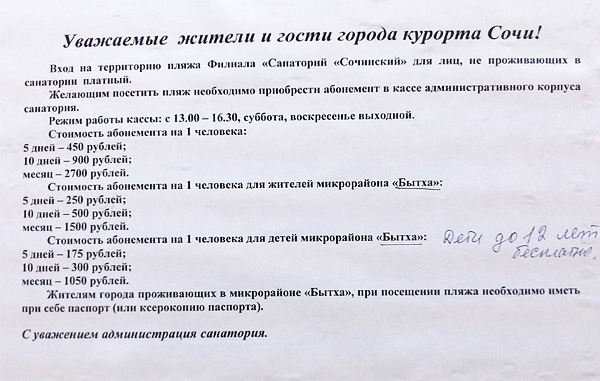
This time, the awareness of one’s own rightness did not help-where the underpass the transition emerges from under the railway track, resting against the sanatorium turnstile, two people stood in the uniform shirts of the choke and with radio in the palms. One of them immediately explained that there used to be a mess on the beach, and now there would be order. The second pointed to the price list hanging on the wall. The inhabitants of the house, closest to the sanatorium of the microdistrict, in comparison with the visitors, really had benefits: now, in order to get to the sea, they will have to pay only one and a half thousand rubles a month. Residents of the rest of Russia, who want to go to the sea, will fork out already 2700 rubles a month. A similar situation was repeated on a neighboring sanatorium beach. In the end, I just wanted to understand where in Sochi you can swim in the sea for free.
At first I decided to check my memory and find out whether this phantom order of the mayor really existed. The city administration explained to me that such an order really was, but it concerned last year, and this year the department, which belong to the sanatoriums, was protested in the courts. The text of the document is also very flowing. In particular, it is said that "the installation of the fencing of a medical beach belonging to the sanatorium on the right of lease is legitimate and does not violate the rights and interests of others protected by law." The leadership of the sanatoriums is mildly recommended "individually, to consider the issue of registration of passes on the territory of the health resort for residents of microdistricts located next to the beaches." "To do this, you should apply with the appropriate statement addressed to the head of the sanatorium with photocopy documents (passport, birth certificate)," the document says.
The order did not clarify anything. I asked the press service of the city administration to provide me with a list of free municipal beaches and soon received it. I must say right away that only the Central and Khostinsky districts were interested in me - that is, the places where the main spa life is concentrated: theaters, restaurants, cafes, concert halls, parks and shops. Go to the Lazarevsky district through many hours of traffic jams, and then looping along the serpentine in order to swim and sunbathe, it is unlikely that anyone will come to mind. Soon they sent me a resolution of the city administration of March 2, 2012, signed by the head of the resort department and tourism Grachev. According to the document, there are six free beaches in the Central District, but there are only two of them in the city center - Mayak beach and Maurice Torez beach.
The oldest public beach of the city, Riviere, for some reason did not get on the list. But I wouldn’t swim there even for money - the beach is in the Sochi River Delta: during the rain, when river water takes out streams of sewage in the sea, water brown and remains so for weeks. In addition, next to the water area, the seaport crews with winches of lifting cranes, sometimes supplementing the resort tan spots or fuel oil.
On the south side of the seaport, the free beach looks like this.
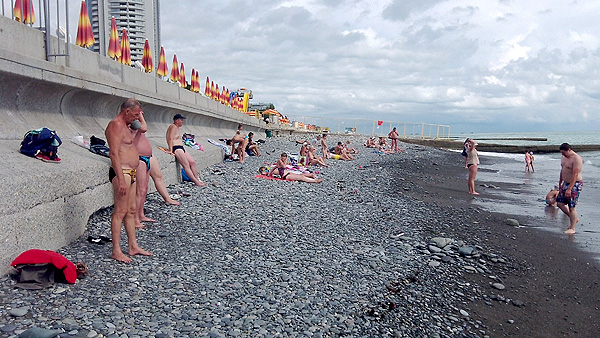
The beach "Mayak" begins with a fence, behind which the artificial palm trees of the Malibu disco bar and the decorative huts of the Koton cafe. Formally, the path to the sea is free, but in reality you will have to go past the bar racks and tables.
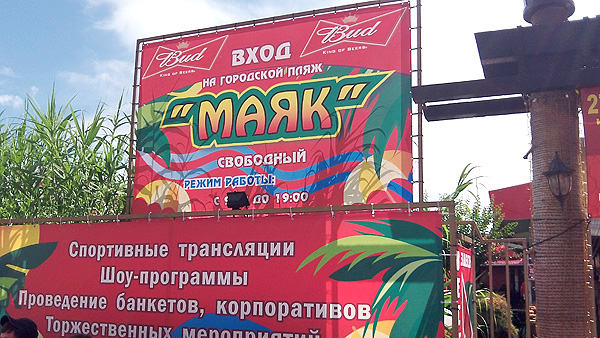
Plastic pipes of the water park sticking out behind the cafe. You can go to the sea here by paying 800 rubles. For a child from three to seven years, you will pay half as much. On the other hand, the water park reliably covers the “Flister” cafe - the sea from the embankment is almost not visible.
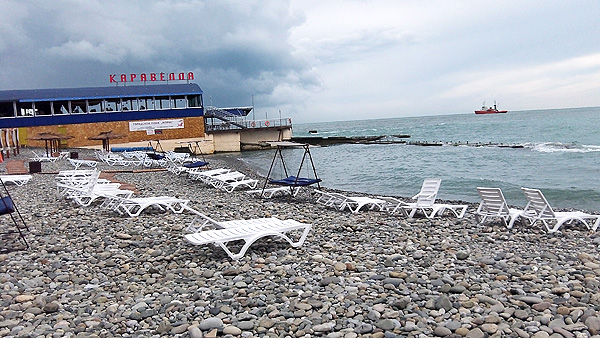
Then there is a strip of a free beach, but even here it does not do without small tricks: pebbles are almost completely busy with wooden platforms and sunbeds, for which 150 rubles will be taken from you, if the sunbed is in the sun, and 200 if it is located in the shadows. The service is indicated on the signs assigned everywhere as "free+services".
In the area of the Tinkoff restaurant a few meters from the shore for three years, the Araz-1 broken in two dry cargo is rotted. Fuel from his tanks has long been pumped out. You can sunbathe on the rusted deck of the vessel for free.

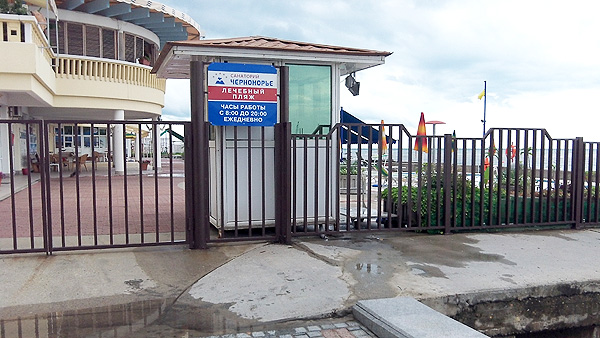
Soon the path of the Chernomorye sanatorium blocks the path. The health resort belongs to Russian Railways, she has five stars, so it costs 300 rubles to go to the sea. This cost generously includes an umbrella and a deck chair.
Next, the embankment rests on the fence of the Pearl Hotel. The guests of the Kinotaur have already left, so you can get to the beach for a symbolic fee of 1750 rubles a month from a local and 3,500 rubles from a visiting one.

Behind the "pearl" begins the beach "Solnechny", bubbled by a certain "VIP zone": the sunbed here costs 500 rubles, and a cozy, hidden with a canopy of three people-3000 rubles.
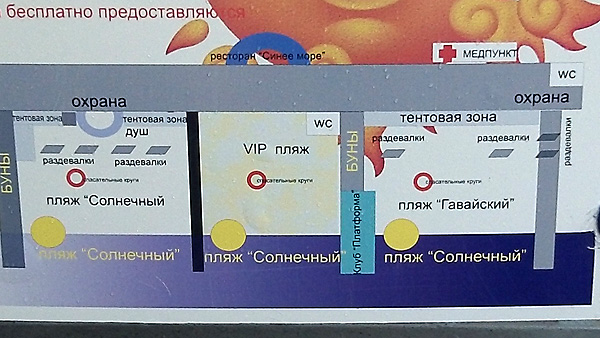
Through a small interval, occupied by the slurred "Hawaiian beach" (the same "free+services"), there is a "recreational zone". Swiming here is somehow unpleasant.
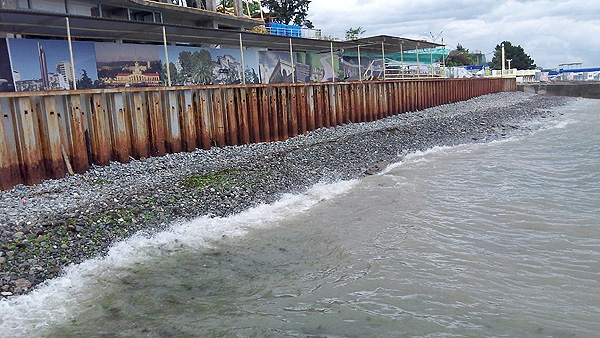
Next - the boarding house "Eden". Here, 150 rubles are taken for the entrance to the beach. Local you or visiting - does not play a special role.
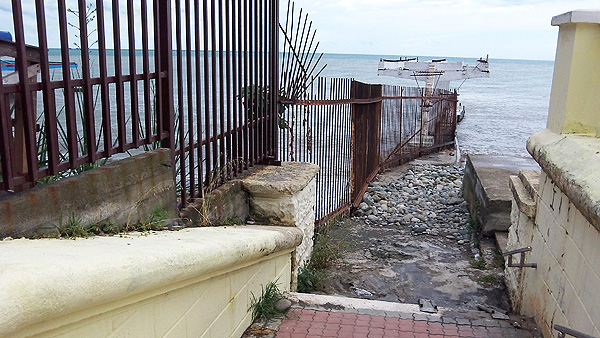
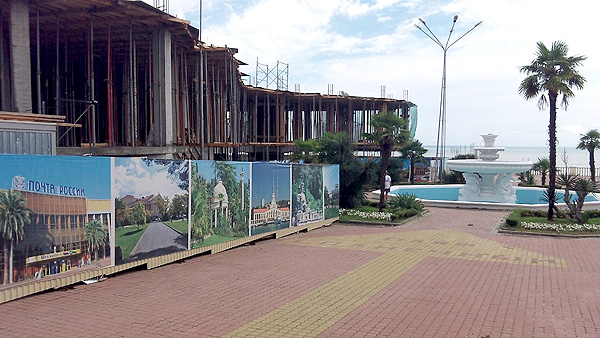
Fences of construction begins behind the "Edem", but what exactly is being built - local residents do not know.
The shore in front of the central stadium is occupied by the beach of the Frunze sanatorium. The health resort, which has traditionally been a recreation for the detachment of Soviet astronauts, is completely isolated, you will not even get here for money.
The shore near the sailing center - a small segment of land - was considered a wild beach until two an excavator landscape appeared on it. After their work, swimming on the beach became practically nowhere.
If you go along the pedestrian trail further, then behind the Sanatorium Metallurg can be stumbled upon a fence dotted with video camera, like autumn stump - mushrooms and a vertical shaft of the elevator. Do not be her - one would think that this is private possession. Locals claim that behind the fence there is a "sanatorium for scouts", so there are no signs.
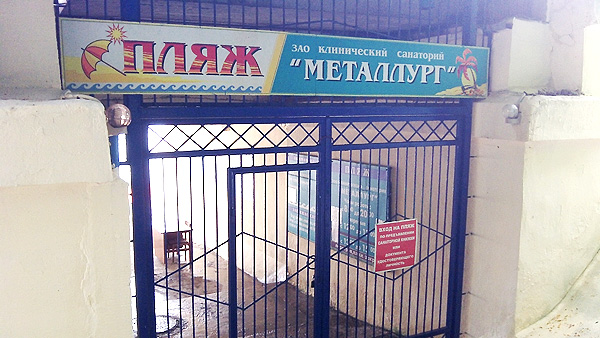
In Metallurg, the dear Tatyana Aleksandrovna leads the beach. “Come with a copy of the passport with a local residence permit - and the whole beach is at your disposal,” she told me. “We have only paid sunbathers.” From a visiting one for an exit to the sea, they will take 60 rubles.
The Central Military Sanatorium is on the balance of the Ministry of Defense. Prices, as I said, are as follows: 1,500 rubles a month from a local resident and 2700 from a visiting one. The administration of the sanatorium was impersonally explained to me that the sanatorium was not controlled by the city authorities, but is directly subordinate to the Minister of Defense Serdyukov.
The Sanatorium named after Ordzhonikidze (closed for repairs with the beach; locals assure that the former Palace of miners and oil workers bought Putin to give it to Alina Kabaeva after the reconstruction), the Pravda sanatorium (the Service of Foreign Intelligence, you can’t even get a fee), the Primorye sanatorium (the beach is closed for reconstruction) and the sanatorium) and the sanatorium) and the sanatorium) "Actor" (170 rubles per day). The Radisson SAS Lazunaya Hotel is completing our route. One day of stay on it will cost one and a half thousand rubles.
If you are stupid and go further, towards the host, then in the area of the Sputnik Center, behind the railway and the Sochi - Adler Highway, you will find another wild beach. In the list of the administration, it is designated as the "Technical Zone" Sputnik. "Technical zone" for many years-the traditional resting place for local nudists and sex minorities. You can swim here completely for free.