
Translated material
Isn't it time to carry out real reform?
Questions
All of you know that the reform of the state and municipal order called the Federal Contract System is approaching Russia . Like the fact that a serious struggle of the Ministry of Economic Development of Russia and the Federal Antimonopoly Service flared up around it . They argue about powers , about procedures , much more . However, I want to raise the question of what problems actually exist and what could be and could be real reform in this area . I'll start with questions .
- Why in Russia is the state order register the Ministry of Economic Development , and not the Ministry of Finance ?
- Why is the main controller the Federal Executive Committee of the FAS Russia, and not the bodies of judicial and representative power ?
- Why does the regions and municipalities completely lack the authority to regulate procurement at the expense of their budgets ?
- How could a situation turn out when the purchase of ships and parliaments controls the executive branch?
- Does at least one Russian department have an objective analyst in what is happening in the state and municipal order ?
And many and many others . Most of which relate not even to the technologies of the order , but how the powers are distributed between those who are engaged in its regulation and control .
Separation of the authority
One of the News of 94-FZ adopted by 2005, and subsequent by-laws, was a strict division of powers between the Ministry of Economic Development of Russia and the FAS Russia . At that time, these two departments still acted in agreement, and most of the official events on the topic of public procurement were filled with their speeches about the great changes that 94-ФЗ brought in terms of openness and competition. I will not dwell on issues of openness now , I will talk about something else . The mutual interest of these departments was not accidental . For the first time in Russia , and maybe in the world , two executive bodies received the maximum of powers to regulate not only the procurement of the federal executive branch , but also the state and municipal order of all branches and levels of power .
It was really a historical document, and all the more strange that the authors of the law did not pay attention to the 1st Constitution article, which mentioned that Russia is a federation , or the rest, where the independence of the authorities and their division is declared . In the Federal Law of 94-FZ, this all passed , let's say , imperceptibly . The powers of the Federal Antimonopoly Service and the Ministry of Economic Development were simply declared without comment , this topic was not raised by deputies and senators , and Cloarish conversations about independent procurement systems of a number of constituent entities of the Federation did not leave the sidelines .
At that moment, if not obvious, then a hidden argument in favor of such regulation was the construction of a “vertical of power” And the fight against corruption in the field . Another argument was attempts to join Russia to the WTO and the OECD and other international obligations regarding the regulation of procurement .
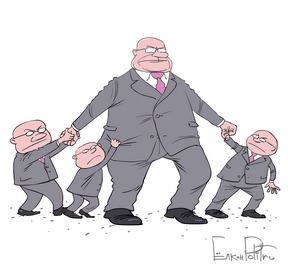
What did we get in the end. As a result of the law, we now have a situation where actually the executive branch concentrated all the powers in the field of state and municipal order . In fact, the FAS controls not only the purchases of the federal executive branch , but also the purchases of the Federal Assembly , the prosecutor's office and the entire judicial system , that is, those bodies of state power, which should just control their activities and the activities of the executive branch to the target .
A similar situation arose with a state order in the constituent entities of the Federation and a municipal order . The federal executive branch represented by the FAS Russia received a strong tool for influence on regional and local authorities and , in fact , took them all the powers to regulate and control the procurement even from their own budget .
I’m not talking about municipalities, whose formal independence from state power is constantly in doubt and even if you can find justification for the regulation of the entire state order , then the intervention of federal government in municipal affairs in the form of forced , and not voluntary regulation - this is the indicator of their non -howl and orientation of those people whom we choose in mayors and local councils, not to create an environment for a harmonious life of citizens , but for compliance with federal requirements .
As a result, we became slightly less federation and a little more by a unitary state. With all the ensuing consequences in the form of ineffectiveness and the transformation of the country's space into a single experimental platform for the development of laws on public procurement .
Experimental Russia
If the principles of separation of powers and restrictions on the strengthening of some branches of power over others can be attributed to politics , that is, simpler economic reasons for the fact that the practice of supercontacence among federal departments is vicious . These reasons are that different Russian regions are in different economic and social situations .
Different Russian regions have different experience in managing , regulating the economy , lack of budget deficiency, tax collectors , have different economies and many other social and economic differences . These differences do not always characterize problems , they also make it possible to choose their own policy in regulation in accordance with their own practices . However, federal laws have the peculiarity that they apply to all at once. This is not an information system, the pilot of which can be carried out in a separate region . Federal law is uniform rules of the game . And if the law contains an erroneous or impenetrable norm , then everyone suffers from it at once . At the same time, if a significant part of the powers to regulate the state order in terms of our own budgets would have remained with the authorities of the subjects of the Federation, we would have received a lively mechanism for developing the best practices , we would cease to wait with horror to wait for each new amendments and their consequences .
Perhaps the situation would not have been so bad if the decisions of federal officials would be backed up by the analytical work and justified. Alas , in most cases they act blindly or guided by conjunctural and tactical considerations .
"Blind moles"
The peculiarity of Russian regulation and control over the state order is that those bodies that are engaged in all this do not have an objective picture of what is happening in the area regulated by them . In part, this comes from their own misunderstanding why this is necessary, partly from the lack of an appropriate request for analytics from the first persons and Russian lawmakers and , not least , because the key information is focused on state information systems uncontrolled .
Thus, the register of contracts, until recently, led the Federal Treasury , information on legal entities and entrepreneurs is in the bases of the Unified State Register of Legal Entities and the Unified State Register of Legal Entities , real estate data , including according to the results of state contracts , in the register of dews and so on . The presence of all this information allows you to find out about what is happening in the state order much more than our officials have ever represented. I will give only a few examples.
One of the features of the state order in Russia is that public companies account for about 25 % of all money under contracts , but most of the funds go to the company in the form of an LLC and CJSC . Moreover, raising information on the statutory capital of these companies allows us to find out that many of the companies in the form of an LLC win multimillion -dollar contracts with charter capital of 10 thousand rubles and being registered , for example , a month before the purchase procedure .
Another example . Many of the contracts that indicate the details, TIN / checkpoints, banks are actually contracts with individual entrepreneurs , but , for some reason , instead of the TIN of the person, the TIN of the structure is indicated in which the person has the account , hence the statistics of the banking sector .
Another example. D about 40 % of the annual cost of state order is only a few hundred enterprises , most of which are registered in Moscow .
And finally , in Russia there are state orders and GRBSI, which conclude a significant part of state contracts with state commercial structures, including those subordinated to themselves . All these facts are only the tip of the iceberg, raising many questions about whether one-day companies can participate in the state order, whether we understand the structure of our economy and what goals and indicators the federal government should set ourselves, reforming the budget sector .
However, all of them are now unkind . The analytics on the state order is now almost completely in the hands of commercial and public organizations. The Rosgostata project I created ( www.rosspending.ru ) for the Institute of Modern Development in 2010 is one of these projects . In which , of course , not all of what is possible is implemented , but those examples are given that could make representatives of the Ministry of Economic Development and the FAS Russia about whether everything is in order in the area that they are trying to regulate and control, not having the opportunity to cover entirely and understand what is happening in our country in our country.
This problem of understanding leads to the question of whether the FCS really solves the problems that have accumulated over all these years of application of 94-FZ, or creates a new layer of problems .
Can FCS help?
The federal contract system, which we hear about so much, all this time could solve at least part of the accumulated problems . However , unfortunately , not everything decides . There are no clearly spelled out rules for the separation of powers between all branches and levels of power . There are no clear indicators of measuring what is happening in the state order in Russia . The issues of analytics and its goals are not sufficiently developed .
The poet , despite many other correct provisions , the rejection of such a form of mass state violence as electronic auctions , the FCS is not a panacea . As well as public discussions of large purchases, this is nothing more than another brick in a deliberately incorrect configuration. Whatever citizens are discussing now , it will still pass through the executive power filter represented by the FAS Russia . Is this the path that we want for our country ? Isn't it time to tell the “stop” to the expansion of the powers of the executive branch, under whatever the plausible pretext they are submitted ?
On this I want to take stock and express those sentences that have long been risen .
Offers
- The powers to regulate and control the state order should be redistributed between branches and levels of power , as well as extremely clearly , clearly and comprehensively spelled out in this or next version of the FCS .
- The authority to control, if not completely , then to a large extent, must be transferred to the judicial and representative authorities in the form of the Accounts Chamber of the Russian Federation , control and accounting chambers in the constituent entities of the Federation and arbitration courts .
- The powers for regulation should be divided between the authorized ministry , administrations of the constituent entities of the Federation and , in terms of industry regulation , relevant ministries .
- The norms of the state order that Russia must comply with international obligations should be clearly systematized .
- The remaining measures of regulation , including the mechanisms of public discussion and folk control, should be considered in a different configuration of regulators and controllers .
Post Scriptum
Outside of this article, many other issues remained, such as folk control , a system of “civil witnesses” , regulation and disclosure of subcontracts , forced video monitoring of all construction sites , strengthening control of the results of contracts and many technical issues of state control in this area. All these are no less relevant topics, and their turn will come .
The author of the article is Ivan Begin, the director of the non -profit partnership " Information Culture " , the founder of the projects "Rosgoszatrata" and "State and its information"

