
Translated material
Plus 96% of the universe
In the experiments of Tserna, a particle was found, corresponding in its parameters to the previously predicted boson of Higgs. The next step will be the definition of the nature of the particle and its significance for our understanding of the universe
In the experiments of Tserna, a particle was found, corresponding in its parameters to the previously predicted boson of Higgs. The next step will be the definition of the nature of the particle and its significance for our understanding of the universe
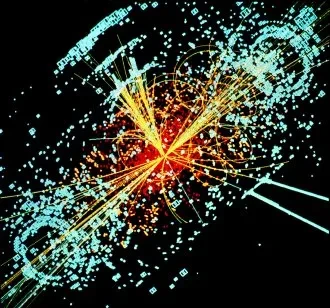
On July 4, 2012, in Geneva, at a seminar at the European Organization of Nuclear Research (CERN), the latest preliminary results of Atlas and CMS experiments on the search for a previously predicted elementary particle, the Higgs boson. In both experiments, a particle with a mass of 125-126 GEV was observed.
“We observe in our data with the reliability level of 5 Sigma clear indications of a new particle with a mass in the region of 126 GEV. The excellent work of the Great Adron Collider and the Atlas program, as well as the titanic efforts of a large number of people led us to this exciting stage, ”said the representative of Atlas Fabiola Dzhanotti. “We will need some more time to prepare these results for publication.”
“These results are preliminary, but the signal we observed in the region of 125 GEV, obtained with a reliability of 5 sigma, we regard as a dramatic event. This is a really new particle. We know that this is a boson, and this is the most severe boson of those that have ever managed to find, ”said the representative of the CMS experiment Joe Inkander. “This discovery has very serious consequences, and that is why we should be very careful in all our studies and cross checks.”
“It is difficult not to be shocked by these results,” said the director of research in Cerna Sergio Betrokelucci. -Last year, we stated that in 2012 we will either find a new particle similar to Higgs-Bozon, or exclude the existence of the Higgs boson, alleged by the standard model. It seems to me that we are at the decisive point: the observation of the new particle indicates the path to the future, to a more detailed understanding of what we see in the data. ”
The presented results are considered preliminary. They are based on data collected in 2011 and 2012, despite the fact that 2012 data are still analyzed. The publication of today's analysis is planned for the end of July. A more detailed picture of today's observations will arise this year, but after the Big Adrone Collider provides more data.
The next step will be the exact definition of the nature of the particle and its significance for our understanding of the Universe. Do its properties correspond to the long -predicted boson of Higgs, the last missing element in the standard model of particles physics? Or is it something more exotic? The standard model describes elementary particles, from which we and the entire observed universe, as well as the forces of interaction between particles. However, the observed matter is no more than 4% of all matter. A more exotic version of the Higgs boson can explain the remaining 96% of the universe.
“We have reached the most important milestone in our understanding of nature,” says General Director Cern Rolf Hoyer. - The discovery of a particle corresponding to the Higgs Boson's properties opens the way to more detailed studies, with a large number of statistical data, which will allow you to find out the features of the new particle and probably shed light on other puzzles of nature. ”
The accurate clarification of the characteristics of the new particle will take a significant time and require additional data. But whatever the Higgs particle, we will make a great jump forward in our understanding of the fundamental device of matter.
CERN, press release from 07.07.2012
Translated by Alexander Pankchin