
Translated material
Faith. Religion. Church.
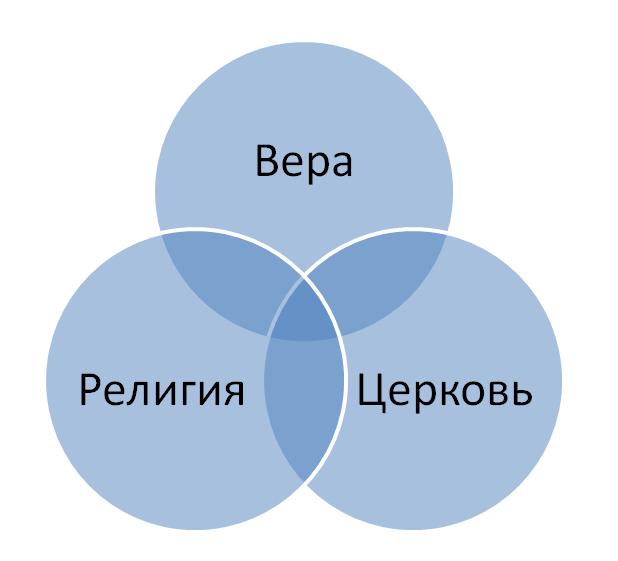
I have long been distinguishing the church, religion and faith in three completely different things.
(from blogs)
How is social reality arranged around such concepts as “faith”, “religion”, “church”? What do people mainly mean when these words are pronounced? What are the expressions associated with, but with what - no? In what social landscape are these concepts?
The response to this can give a cognitectricular, which allows you to build a cognitive map obtained when comparing hundreds and thousands of statements. In the compared statements, general and different, comparison is distinguished, the most common connections of elements are selected, more stable, and the resulting cognitive structures are presented in the form of schemes. This is a phased formalization of statements, produced on the basis of non -vegetative methods.
About 1,500 statements on blogs found according to the keywords “ Vera”, “Religion”, “Church ” (B-R-C) were considered. After a multi -stage classification of statements and filtration, a diagram of relations is obtained, which connects concepts. This is not the result of the author’s personal theorizing, but the totality of observations: what concepts in our society are associated with religion, what common in conversations of hundreds of different people on this subject.
The scheme turned out to be very difficult, these three concepts are associated with many other concepts, and the map of public opinion in this place is very rich. But if you extremely simplify the situation, ruthlessly throw out all the not very frequent meanings and leave only the most important relationships, we will get a diagram of relations around B-R-c.
Landscape of thoughts around the trinity of the concepts of "about faith"
There is a road, traffic rules and traffic cops.
There is faith, religion and church!
Blogger's speeches
Here is a map of the relationship inside the B-R-c. According to blogs. You can use it, as in a children's game: walk from circles and squares to nearby, adjacent to them. So this is a map of the ways that think of what is happening between faith, religion and the church.
The picture looks very complicated, but in fact these are three bush of the relationship , its bush from each node: faith, religion, church. In rectangles - what is thought of as social institutions, in ovals - concepts denoting emotions, thoughts, actions. This is not a too important division, so you can first not pay special attention to the shape of the cells.
In the center of the picture is a circle of concepts connecting c-r . Faith (as a public business of individuals) leads to the formation of the communities of believers , they are united in some corporations , which is called the Church. The concrete, meaningful nature of faith in relation to this form does not matter:
Faith can be communism, and corporations are party members.This is conceived by speaking as a process of creating a church-organization-secular, commercial, ideological-any.
According to the statements of bloggers, faith in the theoretical aspect, as a system of dogmas , “forms” religion, so that religion turns out to be a kind of theory for the practice of individual faith.Religion draws up and modifies some general provisions, creating religions that serve as the unification and separation of churches (teams of believers).
Now consider a bush of concepts near the “Faith” node. Faith, since this is a personal matter, a way of self -realization of personalities, is adjacent to many concepts of the inner world, methods of improvement. As roads, these methods of personal self -building lead to the idea of eternal life, truth, love, supernatural and to God .
A group of concepts near the Mug “Church” describes the existence of this corporation about spiritual affairs. Here everything that is connected with the cult , rites , priests and rules of behavior . Next to the “Church” there are the concepts of opponents, that is, atheists: this includes “ deception ”, “ fiction of priests ” and other swear words that non -religious people prefer to explain the life of the church.
A group of concepts near the “Religion” circle has several very important connections. First of all, in connection with religion, a system of values of man and society is formed, morality and lifestyle arise, ideas about the holy and sinful . It is here that the veneration of the Motherland , the land of fathers, parents ...
In addition to the system of values , in connection with religion, a public ideal is formed, which, developing, turns out to be a type of structure of society - liberalism, democracy, communism and anything else.
The third important connection of the concept of “religion” is unique: this is an antagonistic connection. In the whole scheme, it is one, indicated by a fat black mutual arrow. This is a powerful, vivid contrast of religion and science . Science is connected with the mind , evidence and useful activities, technologies . Religion - through faith - is associated with the truth and other values of the inner world. Apparently, in this arrangement of concepts in the statements of bloggers reflects the long -standing war of religion and science. It turns out a very painful rupture of truth (this is a concept, which is outside science) and evidence -based knowledge , reason .
Finally, another group of concepts related to the church . This is an old, “half -rack” conflict, which has become a double -built connection: the relationship of the church and the state . Once it was a real war. The history of Europe was written by wars about the relationship of these concepts. Now in modern Russia this is no longer a real conflict, but a bilateral connection (a white double -edged arrow). Through the concepts of power , society, these clouds of meanings are connected with the people . Other ties go from religion to the same semantic center: different words are pronounced like a civilizational paradigm , the soul of culture , such as rationality . There is only one meaning here: it is through religion that an extremely important category of national culture , that adhesion that ensures the unity of the people , is established. For society and the state, this is an extremely important knot.
Consent and collisions of platforms
"It is ridiculous, that's why I believe!" - said Thomas Aquinas
And you are unlikely to say better than him.
Blogger's speeches
Most of the concepts around each unit node is relatively conflicting. There are believers differently and in different things, but the people who are differently argue not so often that it falls into our sample, disputes about faith are apparently quite rare. The inner scan of the "world of faith" is conflicting. One believes that the main thing is love , the other is that truth , the third speaks more about God or fate . These are not fundamental conflicts. Such areas of meanings can be called “consent plateau” - there the conflicts are relatively local and relatively easily resolved.
But there are fundamental conflicts. For example, a hot conflict between religion and science tears the whole sphere of meanings in two - duplicate concepts like the pair “Spy” and “Scout” appear. There is truth and evidence -based knowledge , there is rationality and higher mind , holy faith and ideology .
But there are many more conflicts. Black stars on the scheme indicate arising conflicts associated with violence against faith . Believers in this case can be at least Catholics, even atheists. These are people who do not want to tolerate that rituals of religion alien to them without their consent. They forcibly forced children at school to teach someone else's catechism or shown sinful images on TV.
One such conflict is in the field of church and the state . The authorities , based on national culture , can impose a certain religion, faith , to prevent the manifestations of another faith, to deploy religious conflicts.
Another conflict unfolds in everyday life, at the level of collision of personal worldviews - in the left side of the scheme, near the value system - the same conflict in nature.
So, in general terms, the social landscape around the c-r. In this relief of meanings there are areas of relative calm (“this is your business”, “does not concern me”) and very dangerous zones in which ideological battles are being conducted all the time.
"Holes": what they are not talking about, because they do not think
Religion has nothing to do with faith in God
Blogger's speeches
You should add to this scheme an idea of what is not in it. This will be an indication of the “holes” of public consciousness: it is painted on the diagram, how and what they talk about in connection with the c-ts, but it is not visible that they are not talking about. As this is inconsistent, a separate question can be identified, this must be described in detail the methodology of compiling cognitive maps. Let's try to do without it, just indicating where the holes gap.
Do not talk about good and evil. It is interesting that there is talk about the system of values, about moral prohibitions, the word “sin” appears less often. That is, many close concepts from this semantic environment are used, but these very meanings are not.
People do not talk about good and evil, this whole circle of concepts “drowned”. They talk about sins either in the most general, abstract sense, or they catalog what mortal sins are and why they are combined on such a special list. Apparently, “good and evil” are too specific - they still know that they are relative and each has their own.They do not talk about the significance of the war that is conducted between religion and science and which tears the entire social sphere. Mutual accusations (“Deception! Myths! Ignorance!” // “A flat approach, inconsistency!”) - more than enough. But this is precisely the “War of the Two Ver”, where everyone considers himself right. Attempts to understand the social system, in which, as a constant quality, there is a battle of irreconcilable worldviews - no.
“Science” appears in the circle of concepts related to religion, “out of nowhere”, this is a kind of external enemy that breaks the culture system and the integration of social life.Questions about how this could be avoided, how to fix the case does not arise: a hole.
Another important failure: a hole in the understanding of the connection of religion and freedom.
The concept of freedom in modern times appears precisely as freedom of religion, social freedom is rooted precisely in conflicts of faiths. But this understanding is not in the conversations of people.They say - with hatred - about foreign foreigners, about how they are forced to what they do not believe in. Conflicts with Gentiles are recognized and arouse hot emotions, but transformations in the idea of the connection of religion and freedom do not occur.