
Translated material
: Our hearts require news!

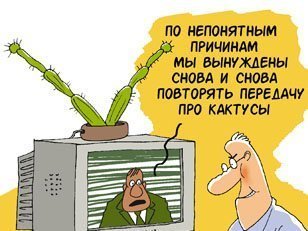 Caricature of Sergey Elkin Polit.ru
 In large cities of Russia, a new culture of information consumption has already developed. Measuring meters show that in recent years the news on the radio has been listening to more and more Muscovites. In the car, people listen to the radio, at home and on the phone watch the Internet. The TV in this media reality has not yet fitted.
Media-style of recent years and in general taking place were to affect consumers of information. And as evidenced by these meters, even affected. According to Synovate Comcon (they are given by Vedomosti), the audience of news radio in Moscow has grown by 87 percent over the past five years, but musical radio remained about the same indicators, even lost a little. It turns out that Muscovites loved listening to the news, although they did not lose interest in music.
What does that mean? Perhaps the audience of news stations grew due to intensified protest moods in the capital? Perhaps, but only you can’t explain.
The market of news stations, strictly speaking, is also not such a long -standing format - since 2007, the market has been enriched with a whole set of news and conversational radio stations. In general, until 2007, there were almost no news or conversational radio in the capital. There was an “echo of Moscow”, with amendments “Silver Rain”, and all of the main ones, perhaps.
It is from 2007-2008 that literally a boom of news and conversational radio projects begins. Just in 2007, Mayak 24 began reformatting with an eye on the youth audience, “Business FM” started in 2007, “Vesti FM” and “Finams of the FM” began broadcasting a year later. Then the “Russian News Service” was seriously changed and intensified after coming to the post of editor -in -chief Sergei Dorenko. Kommersant FM has existed since 2010. In other words: a proposal simply appeared on the market, before it was not particularly. And here - a whole shaft of projects for every taste. It is not surprising that their audience has grown.
The question here is why this segment did not develop until 2007-2008. The very fact of the growth of the number of news and conversational stations a lot of things can mean and much means. The increase in the number of all kinds of credit cars in the news of office clerks, especially strong in pre -crisis, affects? It definitely affects, because the radio has long been entertainment for motorists. The general trend for reducing the viewing of television agencies in the youth environment and the same office workers may well be a factor.
Yes, and the media style quite has to grow a request for news and new formats for their presentation. In the same 2007, the country in general and the capital in particular expected the most boring and fully programmed elections to the State Duma, the policy was entertainment for a relatively small group of aesthetes. In the country there was a time for the already familiar and eternal stability. At the head of the country of the “eternal” Putin, in the capital - “eternal” Luzhkov, officials carry boring nonsense on the topic of economic growth, salaries are growing - this is boring news.
Both topics are long -playing, the crisis so excited people at least until the middle of next year. Firstly, it was incomprehensible: everything would bang finally or not. And if not, then it is interesting - to what extent everything will fall. Where to find out? Yes, to listen to the news, on TV, at first they talked about the “island of stability”, but how everything cracked, so about “overcoming the consequences of the financial crisis that had been affected by Russia, which began in America,” and then-and at all about “successful overcoming the consequences” and so on.
Anyway, even behind the crisis, the “funny presidency” of Dmitry Medvedev was not deprived of events, from the gadgets of the “guarantor” to the series with Luzhkov’s resignation, which was undoubtedly interesting for Muscovites. Let's say the question is - what will the new mayor be? Or - and who is Sobyanin? The TV here is unlikely to seriously help.
The inability to learn from the propaganda speeches of the authorities that are distributed on TV, which happens even in the most general terms, it seems, and caused new mass formats of information consumption to life.
Under these conditions, the entire relevant policy of the fall of 2011 - Winter 2012 with its “castling”, elections (this time in the same requested, but much more nervous against the backdrop of the fall in the popularity of the authorities) and rallies, of course, added popularity to news stations, but not radically. According to TNS, the audience of leading news and conversational radio stations increased compared to the pre-election period of 10-15 percent. A lot, but in general within normal limits.
It is another matter that the elections and other rallies not only gave the radio workers an increase. Numerous Internet projects (the same site “Echo of Moscow” or “The main Internet telekanal of the Snow Revolution” “Rain”) also received their part of the audience.
A clear request - so far mainly in the capital and large cities - to the information and inability to quickly convey the TV channels, it seems that they gave rise to a new information reality. In this reality there is a radio, Internet media, all sorts of blogs and a conditional Facebook as a “collective organizer”. Whether in this reality there is a place for the news of the Channel One, time will tell. Well, or the “time” on the “First Channel”.