
Translated material
How they adopted the Law on slander
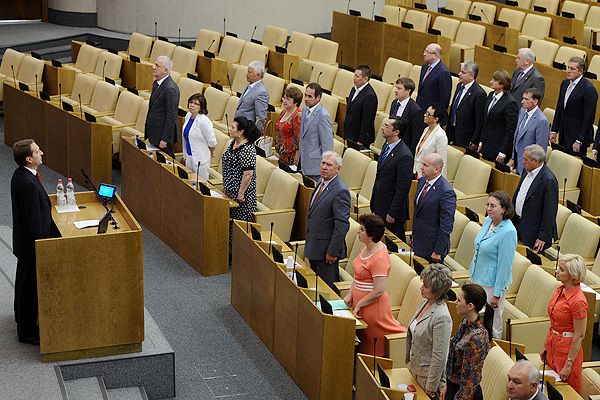 Photo: ITAR-TASS
The State Duma adopted immediately in the second and in the final, third, reading a law that returns an article on slander to the Criminal Code.
After the first reading and intervention of Vladimir Putin, all references to deprivation of liberty for slander were carefully cleaned from the document. But fines began to be calculated by the amounts of six zeros. Compared to the original option, they increased by an order of magnitude and even surpassed dragon sanctions for violations at rallies. Now the “simple” slander is the cheapest - “the spread of knowingly false information that defeats the honor and dignity of another person or undermining his reputation.” The price of the issue is up to 500,000 rubles. The most expensive words are those that are associated with the accusation of a person of committing a grave or especially serious crime. 5 million.
Representatives of the judicial and law enforcement systems are spelled out in the law: judges, jury, prosecutors, investigators, interrogators and bailiffs. In this category of victims, slander is “tied” to their activities during the trial. The simplest example of such a crime is if the newspaper quotes the words, say, a lawyer: "Judge N received an apartment for this sentence." This article also has the amount of 1, 2, 5 million rubles.
Disease causing disgust
The main disputes went around a unique article, which in the first reading was formulated as follows: "slander about a disease causing disgust ...". A similar set of words gave rise to a lot of questions and memories of life situations.
"This is a fascist article!" - the communist Boris Kashin branded her. The last time, according to him, the diseases that cause disgust appeared in the Third Reich. The indicated wording was even confused by the speaker of Sergei Naryshkin, who personally asked the committee to choose other words. Picked up - "slander that the face suffers from a disease that is a danger to others."
As the chairman of the relevant committee Pavel Krasheninnikov explained, such diseases are contained in a well -known international list: HIV, hepatitis, tuberculosis, cholera. But the question “about banal runny nose” in this regard has not lost relevance - this was also noticed by Anton Belyakov: "The flu is recognized as one of the most dangerous diseases, especially if it comes to pandemia." The United Russia missed this argument by the ears, satisfied with the information provided.
Crooks, thieves, liar
The remaining claims to the law were more general, evaluative. “The authorities are trying to isolate himself from the problems of our country. Unfortunately, from this difficult situation, the Kremlin administration found the most incorrect way out - repression and intimidation of the opposition,” the communist Boris Kashin determined.
“We perfectly understand how our courts work and who is primarily accused of slander: the one who will say <...> about United Russia, that he is a crook and a thief,” Ilya Ponomarev picked up and concretized.
“I don’t know who there is a crook and a thief in the hall, but I know who is liable! ..” - Alexander Khinshtein began his speech in a threatening voice. But he quickly changed his tone for the teaching person: “You can’t just say to a person that he is a thief,” the deputy taught, mentioning the presumption of innocence and dignity of man. At the same time, Khinshtein convicted his opponents in inconsistency: “When we canceled this article six months ago, the Communists were against it: they said that the level of culture in our society did not allow you to get slander from the Criminal Code. Now we are returning against! It means that the matter is not in the law, but in the one who offers it,” Khinshtein decided.
Dragged the whole faction
By the way, about throwing from the Criminal Code and vice versa, Pavel Krasheninnikov had to show the greatest ingenuity: it was he who in the previous Duma was responsible for the decriminalization of slander, and in this return. “We tried to take statistics-there is practically no one. In the Coap, the sanctions are 2-3 thousand rubles (an administrative fine-ed.), And practically citizens did not apply for judicial protection, since the sanctions are ineffective, and, accordingly, there were practically no defense!” The Committee chairman explained. “As a result, they did not file a court, but dismantled the offenders with other ways. Non -vegetable. " He did not disclose the details of the methods of the struggle of the slandered krasheninnikov, but he did not object to the wording “outside the angle”. Just added that sometimes they answered the same.
As a result, everyone remained with their opinion: the Communist Party, "Fair Russia" and the LDPR did not agree with the United Russia. However, the same as usual, it did not prevent: 238 votes - exactly in the number of mandates of the majority fraction - for. Next week the document will be discussed by the Federation Council.