
Translated material
: Crimean case is a dark case

In the Crimean district of the Krasnodar Territory, overcoming the consequences of unprecedented floods, which claimed dozens, and maybe hundreds of lives continues. People seeking help today suffer from scammers, false volunteers and conflicts with the Ministry of Emergencies. Who knows, it would be more alive and fewer victims today, if that terrible night in the houses of residents simply worked electricity.
Volunteers and rescuers
We drive to Crimean late in the evening of July 13 from the north. From the outskirts to the center (the conditional border of flooding), the tent camps of volunteers and rescuers were interrupted. We go to the tent camp in the very center of the city at the intersection of Liebknecht Street and Communist Avenue. A banner hangs over the main alley with the inscription "Camp of Volunteers." We are immediately stopped by a guy with a large hunting knife on his belt: “Help you?” “Yes,” we say, “to help. Tell us how you are here? "
Our substantive name is Pavel. He introduced himself as a coordinator of a group of nationalists. Nationalists, as he said, work about 100 people in Krymsk, but there are also representatives of other organizations in the camp (“Here we still have a“ control purchase ”, they are transported to humanitarian assistance,” he says). In total, about 160 people in the central camp of volunteers.
“We are not coordinated with the Ministry of Emergencies. Tried to get a technique for analyzing blockages - there are no results while ",- says Pavel. - “We are working here from July 9. From the Ministry of Emergencies we do not see any help. Until yesterday (July 12 - “Polit.ru”) they did not contact us, just a day ago they only came to get to know each other. ”
Paul’s guys (two camps are “upper” and “lower”, and two mobile groups about 10 people each) find themselves. Coordinated directly with the inhabitants of Crimea, offer help to those who are trying to independently restore order in their yards.
A completely different story in the camp of "Belarusians"(more than 200 people) in the northern part of the city, which stands in front of the Ministry of Emergencies for 1000 people. According to the volunteer from Moscow, Masha, here with the Ministry of Emergencies is complete contact.
“Someone goes to analyze the rubble. But there are few of them. Basically, we accept, unload and sort humanitarian aid here (shows a box that is piercing in the center of the camp for a huge collapse). Here you come to us, where and what is needed. Those who have cars help to transport, and so the Ministry of Emergencies transports everything to us. They help us a lot, ”says Maria.
A similar situation is in the lower bacanke - the village, which was more affected by the flood. Here
At 14 hours a day there is a camp of activists from St. Petersburg "Flynaya-31".Headed by all the volunteer-piter Edward.
“We are not working with the Ministry of Emergencies here too tightly, but only because there is no particular need. Here we brought the pumps for pumping water from the basements. And so they mainly on the analysis of blockages, disinfection, provide medical care. And we accept and distribute humanitarian aid, ”says the volunteer.
However, volunteers to volunteers are different. According to Polit.ru, employees of the Ministry of Emergencies from the metropolitan group,
There are such volunteers that only the flood itself is worse.“Here, to the girls on Lenin Street (in the Lower Bakank -“ Polit.ru ”), incomprehensible people came in T -shirts“ Volunteer of the Ministry of Emergencies ”(distributed such ones). They say: “We are the Ministry of Emergencies”, go into the house, tear off the cornice there, throw them out into the street, break the service (right in an elderly person they grab the tray from their hands). They take pictures and go. How is it? Why? ”Says the rescuer.
But people go for help and there are a lot of work. There are houses at which rescuers work targetedly - where an overly large blockage was formed, where people who require care. It is constantly worth the turn of the Liteiny-31 warehouse, people leave applications, write what and where they need. They try to deliver help from the warehouse only targetedly, they do not give anything on the spot.
And so that no one shows special perseverance, two police officers are on duty at the table - a harsh necessity.
Help and combustion
Together with the trouble to the Krasnodar Territory, as is often the case, scammers also came.In the same place where hundreds of people work to help, there are dozens today to get caught up. There are relatively harmless fraudsters with the announcements “Squeezed the flooded houses”, but there are completely unscrupulous ones that you have to fight, because of which you have to invite police officers to the points of distribution of humanitarian aid.
Eduard from Lateino-31 says: local gypsies at first took everything they could, indiscriminately and in large quantities.
They come, we ask:
- What do you need?
- We need everything!
- Is it necessary?
- Need to!
- And what else is needed?
- Everything is needed.
“Can you imagine? - says Edward, - and they also came, burst right into the warehouse, chose what they liked. Basically, new, packed things, hygiene items.
Then we learned that they are reselling them. We now calculate these and immediately send it to hell. ”There is also a technique: they are approaching the distribution of assistance in masks (in the Lower Bakank and Krymsk now many wear protective medical masks, fearing infection) and look at what is in the warehouse. Then they move aside, the masks remove and return, pretending to be ordinary victims, who "know what to ask."
Due to the resellers of Liteiny-31, all assistance provides all assistance. Collect applications, specifically, what and why is necessary. Then they transport home on their own. Helps. “You see two there,” Eduard shows two strong retreating backs, “approached, asked:“ Do you give at the request? ” “On the request,” they immediately turned and left.
The same situation is in the "warehouse" of the "white -based".
“Previously, we handed out help on the spot,” says Alexander Volunteer. - But people began to appear, fill full bags, load with whole machines.They will be loaded, and then they will come again. Now we are not letting go in the warehouse. We take it, to where we know - we need. ”
Another interesting story about a practical mark in obtaining humanitarian aid was told by volunteer Natalya and St. Petersburg: “The Turks live in the very affected part of the Lower Bakanka. Their houses were badly damaged and they have many young children. So they came up with - the humanitarian trucks stop (drivers see: people, many children and adults ask for help, stop) and scoop up puzzles. One truck, the second. As a result, to the center of the Lower Bakank or to Crimean, the truck began to reach empty. They complained of them, of course. ”
But worst of all, according to Natalia, that
Most of all, those who actively achieve it are received, and not to those who really need it:“On the outskirts, people save at home, dry things and furniture, rake silt from bedrooms and gardens. They often have no time or strength to come to us and ask for something. ”
Catastrophe in the dark
All the inhabitants of the two most affected settlements claim that there was no warning about the disaster either in Krymsk or in the Lower Bakank: there could not be: electricity in the houses was turned off at eight in the evening.
People saved themselves and property in complete darkness.“What a warning?! There was no electricity! At 23:00 I looked into the yard - water rises. I managed to withdraw the car, waited with my family on a hill until 2 a.m., then returned to the flooded house, ”said Sergey, who was living in Krymsk on ul. Sadovaya.
The same says Litvan Benses with st. Lenin in the Lower Bakank: “I was warned by a neighbor whose brother lives in the lower part of the city, on the other side of the [river] Bakanka. They called him, and I ran to warn my. ”
“They were saved in complete darkness,” says Vladimir Berezka from the outskirts of the Lower Bakanka. - Water rose 20 centimeters, I only managed to grab my wife, a couple of pillows, child - and in the car. Thank God, they managed to drive higher. He went down a few hours later, walked along the railway embankment on the chest in the water. They returned to the house only in the morning. ”
And such evidence of Polit.ru dozens.
In the morning we drive through the most affected areas of Krymsk and Lower Bakank. In Krymsk, we are going along the streets of Sovetskaya, Sineva, Sadovaya on a de -energized night from July 6 to 7. In the Lower Bakank (here we were just connected to the delivery of humanitarian aid) - along the streets of Lenin, Mira, Shevchenko and others.
Everywhere the same picture: mountains that turned into a dusty furniture and utensils, after flooding of the rubbish. Pilled cars in the yards. The driver of Alexander, with whom we deliver the humanitarian a month ago, had a wedding. All the furniture that the newlyweds were presented, in the form of a wet porridge, he thrown it on the side of the road.
At Alexei on the street. The house was washed away in Krymsk in Krymsk, it is no longer possible to live in it (“There were no proposals to build a new house. The commission came, recorded everything and left,” he says). Alexei shows to the flat platform of the neighboring courtyard: there was a house in which the mother and the child died during the flood. Through the road opposite - a huge bunch of illegal trash: "There, my neighbor drowned."
Myths and corpses
An employee of the Ministry of Emergencies (and her entire calculation) came to the Lower Bakank from Moscow bypassing the authorities of the authorities (she asks not to name her name). It helps people as it can, but maybe not all: conflicts with residents arise.
“The woman comes to us, says:“ Rescuers in the courtyard of my brother buried the corpse of the dog. ” This cannot be in principle, since it is unacceptable for sanitary reasons. So she also refers to the courtyard, in which our group works purposefully. We come, look - no, not in her yard, but behind the fence, and not rescuers, but local residents, ”the EMERCOM employee complains.
According to the rescuer, people sometimes behave extremely illiterate:“It happens that animals were killed (a lot fell during the flood). We ask people - “There are deaths to the dead?”, And they - “No, we have already buried everything” - helped. And after that we are engaged in exhumation. ”
Another common myth that interferes with the fact that the territory in Crimean and the lower bakank is infected due to the decomposition of the corpses.
“We read somewhere on the Internet that there is an infection. Put on masks, and even chemical protection costumes. Sow panic. And there is absolutely no reason for her, ”says the rescuer.
Regarding the number of those who died in the injured area, in Gelendzhik, that in the Lower Bakanca, in Crimean, the same rumor goes - "the number of dead and missing is strongly understated." The numbers, however, are called different - from 2 to 3 thousand dead. EMERCOM employees talk about underestimated numbers only in private conversations.
One even called one
The numbers that I allegedly heard from high -ranking colleagues: 2000 children and 3,500 adults were killed, another 2500 people were missing.And another employee of the Ministry of Emergencies said: “Well, let's see. A seven -meter wave, people are not warned, there is no electricity. In the Lower Bakank, there are 15 thousand inhabitants, in Krymsk-60. And officially they talk about 170 dead?
Well, feel free to draw a Noler. "Recall that officially the head of the Ministry of Emergencies Vladimir Puchkov on July 12 insisted on 171 deceased and 17 missing.
Photos of Evgeny Ershov
See also: Krymsk as a foreboding of civil society Vladimir Golyshev Crimean stew for Vladimir Putin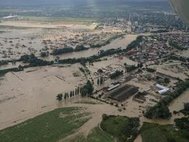 Large water