
Translated material
Fuck
In society
 Fuck
Fuck
July 16, 2012 Julia Latynina
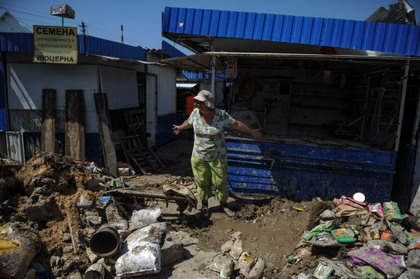 In the language of the Kechua Indians there is a word Huayco, denoting a sudden storm flood in the Andes, especially frequent during the warm course of El Nino.
In English or Russian, such a word, because in England and Russia this phenomenon is rare: we have neither AND nor El Nigno. There is an expression “storm flood” or flashflood. Given what happened in Krymsk (and what happened has a very Latin American character), I propose to introduce the word “huaiko” into the Russian language in the original Russian, which conveys the meaning of the phenomenon of transcription well.
So, Huaiko is a storm flood that forms within a few hours in those cases when in the mountains on a small area in a few hours a multi -month precipitation falls and all this, instantly swollen streams, runs down into one large neck or canyon.
For example, on June 9, 1972, in the USA in the town of Rapid City, 238 people were killed as a result of such a phenomenon and 1335 houses and 5 thousand cars were destroyed. On July 31, 1976, 134 out of three thousand tourists who came to the canyon on the occasion of the holiday were killed in the Canyon of Big-Tompson in Colorado on the highway 34, curling on the bottom of the canyon.
Does this mean that Huayko is a purely natural phenomenon?
No. In densely populated areas there are no purely natural disasters, for the reason that there is no pure nature in it. Technological objects existing in the area - houses, roads, embankments, ponds, reservoirs, nuclear power plants, etc. - are always an integral part of this disaster, increasing it or decreasing it.
For example, the American Flood in 1972 and 1976 were an indicator of the state of the American society, its urban planning norms and the system warning systems for the period.
Now the repetition of the tragedy in Rapid City or on the 34 highway is almost impossible thanks to the creation of a computer and satellite network of early warning, as well as changes in urban planning rules (in Rapid City, all the flooded lands were redeemed from private traders and turned into a park, although ramps for such intensity are there every 500 years).
Another thing is Latin America: there are victims constantly, and the social nature of the disaster is clearly visible on the video. We see how in the same city, for example, the Peruvian Chosika, Huayco blows dilapidated slums , without permission built on the slope of the mountain, and at the same time, without causing special harm, flows along a more civilian part of the city, where a high concrete channel has been prepared for it.
When in 2004, the American writer Michael Croiton released his thriller The state of Fear, he described in him attackers who convene thousands of vacationers in the National Park-and meanwhile they act on an impending thunderstorm, provoking the exclusive precipitation to cause Flash Flood. In 2004, Michael Cruiton did not occur to the fact that the attackers, having arranged Flash Flood, would demolish the American city-this was no longer possible.
The parliamentary commission had to understand what happened in Krymsk. She would have to answer a lot of unpleasant questions. I have no opportunity to answer them. I can only ask them.
First: artificial or natural character of a downpour?
Putin loves to rest in the Krasnodar Territory. Usually, when he comes, as far as I know, they provide good weather according to the Luzhkov method: that is, spraying clouds with iodine silver and thereby provoking the abundant precipitation of precipitation on the approach to the highest residence. Did the clouds spray on July 6? Could this intensify the already strong rain? Do those who ensure Putin’s rest are given to themselves, that spraying clouds in the mountains can lead to results fundamentally different than when the rain on the plain is spilled in Maloyaroslavl instead of Moscow?
Second: Livnevka.
In each city there is a storm sewer, called just, unlike the usual one, to cope with the consequences of heavy rains. It is especially necessary in cities located at the foot of the mountains. As far as I understand, the storm in Krymsk was simply concreted, there were three stalls on it. Who belonged to the stalls? Who needs to be planted?
Third: Samostroy.
Not only in the Krasnodar Territory, but throughout the Caucasus they build where they want and as they want. As in the Peruvian Chosik, in Krymsk, a nakhalovka built by the poorest segments of the population was demolished. She was demolished in 2002, and residents did not receive compensation for 2002. Who, how and for what bribes issued permission to be built in Nakhalovka and turned a blind eye to this?
It should also be aware that the houses built in the line, along which there is a storm flood, not only become its victims, but also give rise to an even higher wave. Water, which rolls through narrow spaces between the walls of the houses, rises higher than the water flowing along the plain.
Fourth: warning system.
The city authorities received a warning about the possible flood at 10 pm. The flood began at 1.20-1.30 in the night. In every Russian city there is a system of civil defense and emergency systems, the maintenance of which is released a lot of money. It automatically enters into force on receipt of the telephone message about the emergency, and it may not even be the mayor to give it a move, but the attendant, who accepted the telephone message. The siren (“Attention” signal) is turned on immediately, immediately patrol cars with megaphones are driving through the streets. In order to prevent the tragedy, it was enough to drive with Megafon along the streets of Nakhalovka and order residents to gather in a high part of the city. Even in Chosika, in a much more terrifying nakhalovka, in April 2012 2 (two) people died! Governor Tkachev told the residents of Krymsk: “What, everyone needed to get around? This is impossible". This statement is outside of good and evil.
Fifth: Pond.
Five kilometers above Krymsk, a small fishing pond is located on the tributary of the Bakanka River; After the flood, the pond twice, and in Krymsk they found mirror carps. In fact, it is intuitive that the shallowing of the pond is not the cause, but by the result of the flood and in any case, the pond Krymsk did not add great water. But I would like to have not intuition, but solid calculations.
Sixth: Road.
The head of the laboratory of remote sensing of the Earth from the Cosmos of the Institute of Geography of the Russian Academy of Sciences Lev Desinov, having studied pictures from space, called the most reasonable, in my opinion, the immediate reason for the 7-meter wave, which poured into the Crimean.
Namely: on the southern outskirts of Krymsk from the A-146 highway, it is perpendicular to it and across the Adagum River goes off the highway, the height above the river level is 7 meters.
On the night of floods, the gate to pass water, apparently, first hid all sorts of garbage, applied from an uncleaned channel, and then this spontaneous dam was gone and a seven -meter wave rushed into the city.
Apparently, this is a circumstance of those that cannot be predicted, but easily explained later (in the Highway number 34). It just illustrates the fact that there are no purely natural disasters in a place where there are technical objects. But in the future design of roads, storm floods in these places should be taken into account.
Seventh: Neberjaevsky reservoir.
Immediately after the flood among the residents of the city, rumors were about that the water that flooded the city was dropped from the Neberjaevsky reservoir to save Putin's dacha (option - Novorossiysk).
This is not true. The dams of the reservoir is a whole (although the technological road is blurred, that is, the water lilled is probably through the top), the reservoir is full of water, there is simply no lower omission in it, and besides, as the independent ecologist Suren Gazaryan showed , the water lifting in the Neberje River (on which the reservoir stands) was lower than the water rise in the river of the rich before their merger.
However, there are a lot of questions to Nebertjaevsku reservoir. The simplest-why was there no lower loss on the reservoir (more precisely, it was concreted due to the emergency state of the reservoir)? After all, the reservoir still drained water. According to Viktor Volosukhin , the director of the Institute of Safety of Hydrotechnical Structures, who developed the project for reconstruction of the reservoir, it did this from 1 to 5 in the morning, through the upper descent, and the volume of the drained water was at least 75 cubic meters per second (the throughput of the upper loss, and apparently drew over the edge).
The descent of water, as it is easy to see, took place in the midst of floods. And although the volume of water, comparable to the Volga’s drain (1000-1400 cubic meters per second), passed through Krymsk, the extra 100 cubic meters could well mean life or death for someone.
If the reservoir had a lower descent and the reset began at 5 pm, this extra water would not have been.
In addition, the Neberjaevsky reservoir is in disrepair and back in 1999, money was allocated for its repair. Where are they? Indeed, in 2009, ten years after their allocation, the reservoir was again recognized as an emergency and under this pretext of a private company of JSC Eurasi, whose owners began to collect money from Novorossiysk for water under the pretext of a future reconstruction of the reservoir. And in April 2012, a state program was adopted, which provided for the reconstruction of the Neberjaevsky reservoir for budget money. Obviously, the parliamentary commission should have evaluated this whole story. Moreover, the owners of the reservoir, Mr. Svetlitsky and the point, who were under investigation for the fraud with the money of VEB, were translated from the accused to the suspects exactly the day after the tragedy. That is, the investigation previously thought that it was Svetlitsky and the Bell (Deputy Chairman of the Web) drank $ 14 million, transferred from offshore to offshore. And now it is not sure. Maybe this did not do a point, but his cat. Such a solution to the investigation is a spit on the grave of the dead and in the face of society.
A month before the flood on the Neberjaevsky reservoir, there was a hydraulic system, all the water was pumped out of it with pumps, it stood empty. Thus, it seems at first glance, as a result of the exceptional coincidence, mismanagement and theft, the Neberdzhaevsky reservoir a) being empty, it absorbed a significant amount of water, which would otherwise hit Krymsk, b) had no lower loss and therefore brought down an additional 75-100 cubic meters of water per second on Crimean when he drowned without that. But these are only assumptions - the commission would have to engage in accurate calculations.
Eighth: Barnavinsky reservoir.
Barnavinsky reservoir is located 10 km downstream of the Adagum River 3 m above sea level. Krymsk is located at an altitude of 11-60 m (depending on the area) above sea level. At first glance, the Barnavinsky reservoir, located below, cannot have anything to do with the tragedy of Crimea, but it seems that this is not so.
According to Oleg Mitvol, who in this case acts as a Newsmaker and the former deputy head of Rosprirodnadzor, the following occurred. On the eve of the flood, the director of the reservoir received a rain a warning. He would have to open the gateways and drop excess water, preparing for a new one. However, the day was sunny, and the director received 18 pieces of various forecasts over the past five days. The Barnavinsky reservoir is intended for irrigation of private rice fields, and if the director had thrown off the water and there would be no rain, then the owners of the fields would simply kill him.
Therefore, the director did not believe the forecast and did not drop the water, but began to drop it only late in the evening of the 6th, after numerous approvals. As a result, the most powerful stream of water, poured from the Varnavinsky gateways, blocked the road to the water going from above, and shot down a stream. There was a support of water, which played its fatal role. This is a theoretically possible picture that requires, of course, additional calculations.
Unfortunately, answers to all these questions are unlikely to be received. Parliamentary - or any other - the commission is unlikely to be interested in clarifying the truth. She will be interested only in imposing the reputation of the authorities.
Once again: in modern society there are no natural disasters, there are only social disasters.
It turned out in Krymsk that there was no state in Russia. More precisely, we have a state that provides 95% of the vote for United Russia in Krymsk, distributes the reservoir to private property and allows you to build houses where they cannot be built for bribes. We do not have a state that is able to repair the reservoirs, to throw water out of them in time and notify the inhabitants of impending disasters.
We have no state. And the huyaika happens.
Photos of sites kremlin.ru and RIA Novosti