
Translated material
Crimes without punishment
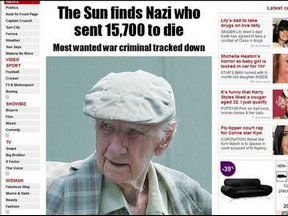
The Sun British newspaper found in the Hungarian capital Budapest 97-year-old Ladislav Chizhik-Cheratari. According to CC Simon Vizenthal , who is engaged in the study of the Holocaust and the search for Nazi criminals, a person discovered using the specialists of the Center is one of the most wanted Nazis.
After the Second World War, in 1948, Ladislav Chatari was sentenced in Czechoslovakia to the death penalty for war crimes.
It is believed that Chatari, who led the Jewish ghetto police in the Slovak city of Koshitsa, in 1944 sent 15,700 Jews to Auschwitz in 1944 - only 450 people survived.In addition, eyewitnesses accused Chataria of an extremely cruelty. According to them, the Nazi beat women with a whip, forced people to dig in frozen ground with their hands, and also shot to defeat at the slightest attempt to escape.
The verdict was passed in absentia. After the victory of the allies, Chatari fled from Koshitsa and moved to Canada, where he began a new life as a merchant of art. It was able to identify it only in 1997. The reaction of the Canadian authorities was unequivocal - Ladislav Chatari was deprived of citizenship and brought a matter of him. At the same time, the lawyers of the former Nazis claimed that he did not know where the Jews were being sent. Their client admitted that he had only an indirect attitude to the deportation of the inhabitants of the ghetto.
When we were talking about deportation from Canada, Ladislav Chatari did not wait for the expulsion and left.
Over the past 15 years, there has been no information about him - until the journalists found his two -room apartment in the elite district of Budapest.Chataria opened the door to them in some socks and underpants. When the newspaper employees asked if he could make excuses for his past, the former Nazi looked shocked and muttered: “No, no. Go away. " The journalist recalled thousands of people who died through his fault. “No, I didn’t do this, get out of here,” the old man said before slamming the door.
According to the publication, its employees watched the Ladislav Chataria for several hours before knocking on his apartment. An elderly man in a light suit walked for four hours, for which he managed to meet with his friend, go to the store for groceries and purchase the right -handed focus newspaper in Kiosk. In general, as the journalist of the publication noted, the criminal leads a measured calm life - the one that he deprived of a thousand people. A similar opinion was expressed by Dr. Efraim Zuroff, Director of the Wiesental Center. According to the latter, time does not reduce the severity of Chatarian crimes.
In this regard, it seems not surprising that the search participants transferred all the evidence to the Hungarian prosecutor’s office and called on local authorities to bring the case to court.
The fate of the elderly Nazi criminals in recent years has caused many disputes.The international community, with the exception, except for neo -Nazis, recognizes the inadmissibility of fascist ideology and the repetition of the crimes of those years, but there are discrepancies about older criminals. And if the Center for Wizenthal considers them “the most wanted”, this does not mean at all, they will appear before the court and, moreover, will receive punishment corresponding to their acts.
You can recall Klaas Karl Faber, who was a volunteer in the Dutch branch of the SS and was included in the list of the center. In 1947, in the Netherlands, he was sentenced to death on charges of killing at least 11 people. Subsequently, his sentence was replaced by a lifelong conclusion. However, Faber stayed in the Dutch prison until 1952, when he managed to escape to Germany. There he took advantage of his right to receive local citizenship, which was guaranteed by the Nazi decree - according to this order, citizens of the Netherlands who served in the SS automatically acquired German citizenship.
At the same time, neither the indignation of the Dutch public, nor the introduction of the Nazis into various lists, nor the entry of the name of Faber into the international wanted list. In Germany, they refused to give out their citizen, as this contradicted the laws of the state. Moreover, in 1957, the Land Court in Düsseldorf stopped the process against Faber in the absence of sufficient evidence of his guilt. Disputes ceased only with the death of their culprit in May of this year.
The same loophole in German legislation was able to take advantage of another Nazi Simona, Simon, Nazi. Since 1999, the authorities of Denmark have been trying to achieve extradition from Germany Serena Kam, who is a former SS. The Danes are looking for him for the murder of the editor of the anti -fascist newspaper Karl Henrik Klemensen in 1943. An extradition request was submitted twice: in 1999, the reason for the refusal was the German citizenship of Kama, and in 2007 - a statement by the German authorities about the uncertified nature of the murder of a journalist.
At the same time, the consideration of the cases of elderly suspects, who already did not live long, is delayed for years.An example of this can be the case of Ivan Demyanyuk, which began to be considered in Germany in November 2009. The verdict was sentenced to him in 2011 - Demyanyuk was supposed to conduct in conclusion the next five years for involvement in the murder of 27.9 thousand prisoners in the concentration camp Sobibor.
At the same time, Ivan Demyanyuk, until his death in March of this year, tried to prove his innocence. According to his defense, the main evidence of the prosecution - the SS certificate in the name of Demyanyuk - was a fake made by Soviet intelligence. The participant in the process tried to justify himself, in particular, in order to restore the US citizenship, which he lost when it became known about his past. Nevertheless, after his death, the Court of Appeal in the United States rejected the claim for the posthumous restoration of American citizenship of John (Ivan) Demyanyuk.
Demyanyuk’s case is far from the only thing that was long in several years. In particular, the Hungarian authorities back in 2004 issued an arrest warrant of Karoli (Charles) Zentay, who was accused of Jews of the state of the state in 1944. However, Australia to the present moment has not resolved the issue of his extradition to his homeland - now the matter Zentai is considering the Australian Supreme Court.
For a decade, the investigation of the former Untershturmführer of the SS tank grenadier division of the Reichsfuhrer SS Gerhard Zommer has stretched for a decade - the German authorities still have not sentenced him. At the same time, the Italians were able to overtake their colleagues from Germany: in 2005, the Italian military court found him guilty of a mass murder, perfectly cruel.
In addition, Canada still cannot resolve the issue of citizenship of Yelmut Oberlander, who was a translator in the punitive group “Einzatskommando 10a” acting in the south of Ukraine. His case has been considered since 2000 - either depriving him of the status of a Canadian citizen, then returning.
Note that all three are also included in the list of the Center for Screening. It also included Vladimir Katryuk, who, according to the center’s specialists, took an active part in the destruction of the Belarusian village of Hatin, Ivan Kalymon, accused of involvement of the murders and the deportation of Jews from the ghetto in Lviv, as well as Algimantas Dailida. The latter served in the Lithuanian Security Service in Vilnius - his name is associated with the arrests of Jews and Poles and their issuance by the Nazi authorities. He received a real term - five years of prison, but the court decided to free Dailid, since he was not a danger to society.
The punishment was also able to avoid another person involved in the list - the Gestapo translator in Belarus Mikhail Gorshkov, who was accused of involvement in the massacres of Jews. He fled first in the USA, and then to Estonia. After the investigation, the Estonian authorities closed the case against Gorshkov.
From all of the above, it can be assumed that Chatari's case is likely to go along a hollow scenario. According to Leonid Terushkin, the head of the Archive of the Holocaust Center, the consideration of the case, as well as Demyanyuk, can be delayed. In addition, according to him, there will be defenders of the former Nazi, who will put pressure on pity and indicate the advanced age of Ladislav Chatari.
The representative of the center believes that the trial of Chatari should take place in any case.“It must be given it to the court. It is necessary to remind everyone that there is no statute of limitations for Nazi crimes. The boundaries of states and any political circumstances should not affect this. Such crimes should not remain unpunished. The Nazi criminal should not sleep peacefully in his bed, ”Terushkin emphasized.
At the same time, according to the expert, the deadline for which the Nazi will be convicted is completely not important. “For such crimes, they give either a life sentence or 25 years of prison. But in this case, the very principle of the inevitability of punishment is important, so it doesn’t matter to me and my colleagues from the Center for Vizenthal how much they will give him - three or five years, ”he concluded.
At the same time, the situation in Hungary is such that Chatari's sentencing is under a big question.It is only worth recalling that in November last year, unknown people inflicted black paint on a monument to the Soviet soldiers in Budapest. In addition, more recently, in June of this year, in the Hungarian village of Chokako, 60 kilometers from the capital, a bust of Admiral Miklosh Horty, the leader of the country from 1920 to 1944,was opened - he sent 437 thousand local Jews to the Nazi concentration camps.
Do not forget about the age of the Nazis: if the chatari lives before the sentence, then until the end of the prison term is unlikely. It is this dilemma that people who are related to his work are to be allowed. What is more correct in this case? To fight for a fair punishment for the offender, or to let the weak old man survive for the past few years and allow to take the ghosts of war with him to the grave. This is a difficult choice - all the more so since people who suffered from his hands are still alive.