
Translated material
About parking
A few days ago I was present in the Moscow City Duma and observed the adoption of the law on the cost of evacuation. Previously, in the MGD, they adopted a law on increasing fines for irregular parking by about 10 times.
The Moscow City Duma is currently a depressing sight - there are 32 United Russia, 3 deputies from the Communist Party and that's it. The elections in it were a million times less honestly than the elections in the State Duma on December 4, as a result, it turned out that only three deputies represent residents of Moscow, of which two are active discussions and generally chopped on all fronts - Andrei Klychkov and Nikolai Gubenko, for which they were a huge respect. The remaining 32 deputies represent the executive branch, such a proportion (93% by 7%) is no longer in any representative body known to me.
* The numbers in this post are approximate, from Mosgorstat and open sources. There may be inaccuracies, the chip is in order of numbers and not exactly
But the post is not about the Duma, but about parking. Now many are outraged and give many arguments in the spirit of “first build parking, and then forbid” or “it’s easy to prohibit everything, this is not a method of solving problems”. I want to write a few words about the meaning of the law as a whole.
Parking occupies a lot of space. One parking space takes a minimum of 15 square meters. For comparison, one workplace in the office takes about 10 square meters. In Moscow, on average, one person accounts for about 25 square meters of living space.
It turns out that the parking space takes 150% of the office area and 60% of the housing area. It turns out that in order to accommodate everyone, about a 20-storey residential building should park 12-storey parking. And about a 20-storey office building-30-storey.
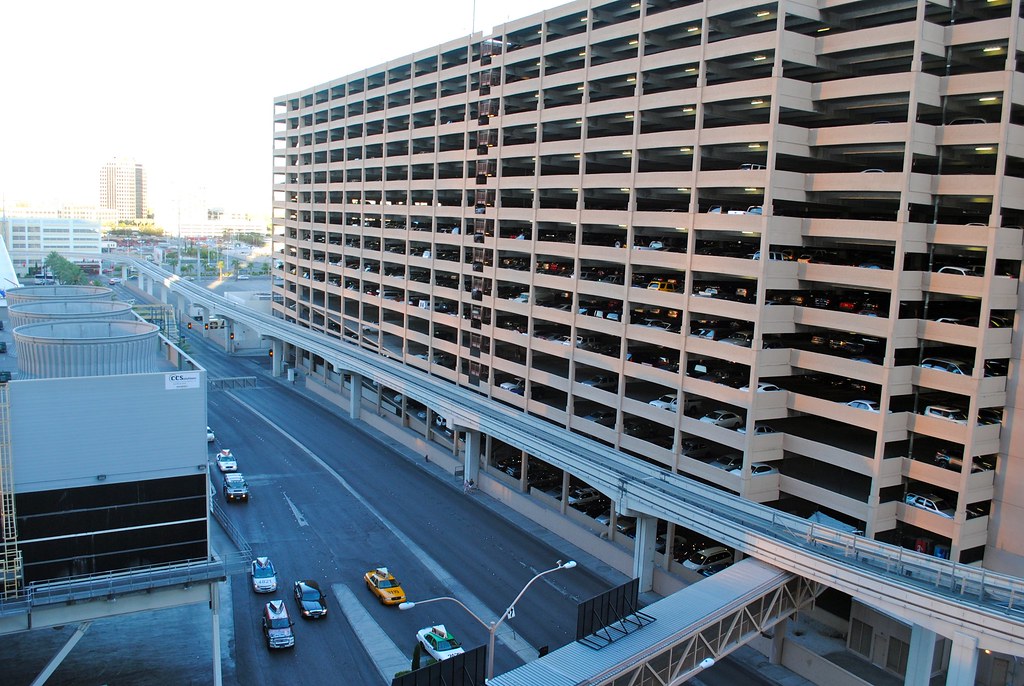
In countries where everyone moves only by car, something similar happens
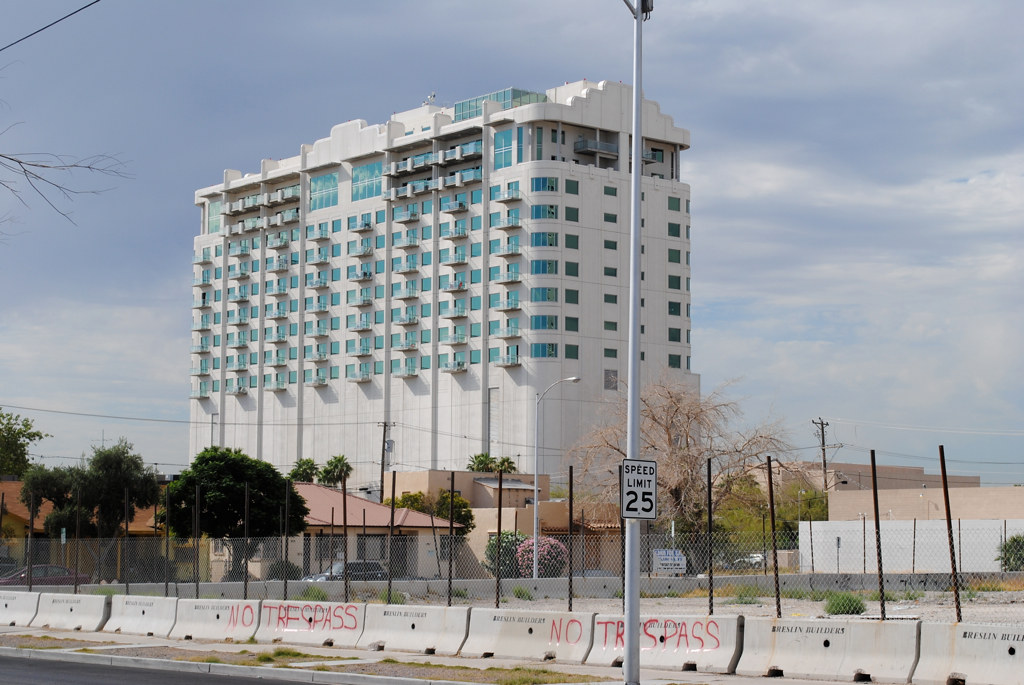
The dull lower part of the building is parking
Parking in the center of Las Vegas
The level of motorization in Moscow is now 370 cars for 1000 inhabitants, so we need fewer parking lots than indicated above-for a 20-storey residential building, we need 4.4 floors of parking lots. For a 20-storey 4-pounding house (~ 26,000 m² of housing), even at the current level of motorization, approximately 5,800 m² of parking lots. If you place them at the same level, then approximately the area of a full -fledged football field will come out.
It is more complicated with office centers-for example, in Moscow City it is planned to build 563,000 square meters of office premises (namely, purely offices, without common territories, stores, etc.). At the current level of motorization, there will be 312,000 square meters of parking lots (54 football fields), if they are located at the same level, they will take about the entire area:
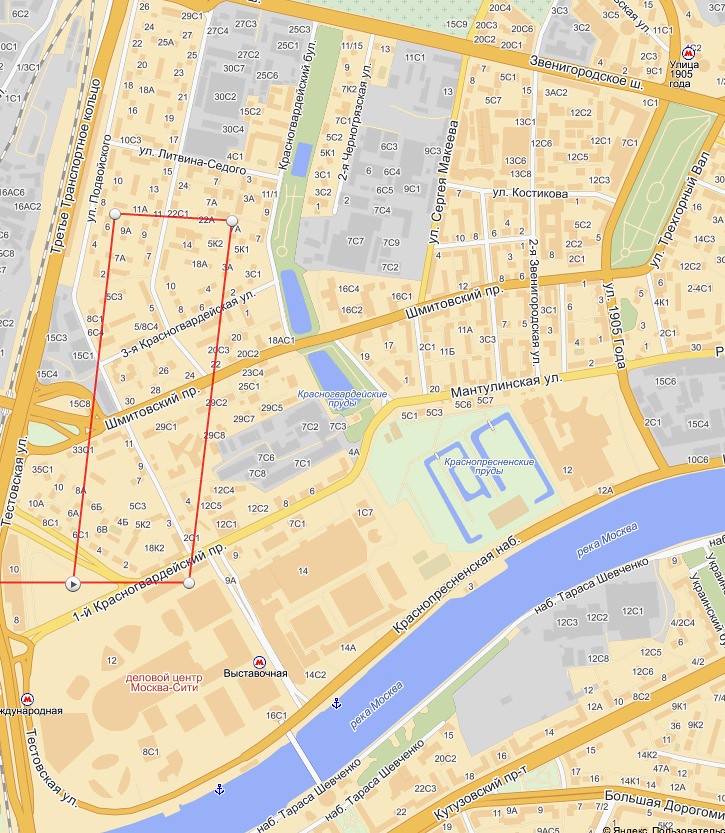
And in this huge parking, along which it will go for about 15 minutes on foot, the place will be exactly in order-it will be scored all in the afternoon, you will not find a place there at all.
Instead, you can build a nearby parking building on 107 floors. Well, or 10 buildings of 10 floors.
In the Central District of Moscow, the length of the streets is 510 kilometers. If you allow parking along all these streets on both sides (except for intersections, pedestrian crossings, etc.), you will get approximately 102,000 parking spaces. And even though you will be trained at the bloody regime, so that it provides the opportunity to park everyone, but you can’t place cars on the current streets. In fact, 102,000 digits are high, since not on all streets you can park on both streets, but we will leave it for now.
If you scream very loudly, then the authorities can hear and allow in some places to park on the sidewalks, where they are wide. This is about 15% of all streets. In some places, the authorities can turn a blind eye to parking in two rows, this is another 15% of the streets.
In total, we get about 130,000 parking spaces.
About 2.5 million people are now going to the center of Moscow daily. At the current level of motorization, about 37% of them should come to the center, that is, 925,000 cars should come to the center daily.
Due to the lack of parking lots, large traffic jams and other difficulties, not all car owners drive a car in the center, a total of about 13% of people who come to the center do this on a car. These are approximately 250,000 cars (some travel not one at one).
That is, in our city center you can place ~ 102,000 cars without prejudice to the urban environment and ~ 130,000 cars with great damage. Maybe you can even get a little even a little, draw parking in general everywhere, cancel all the sidewalks in general, take all areas with monuments, allow parking in several rows and get 150,000 parking lots. But no longer fit. Just physically, nothing. Regardless of what party the mayor is from and how much city officials saw, there are no more cars on the streets. And you need 250,000 seats.
Yes, by the way - if you place 150,000 cars instead of 102,000 cars, then the effect will be approximately the following:
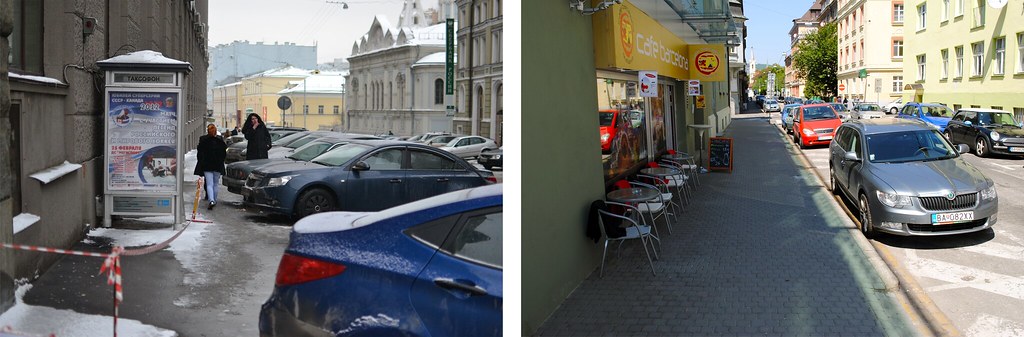
In the first photo there are 7 parking spaces, on the second on the same area 3
The remaining 100,000 cars should be placed in some special structures-in total, it is approximately 500 floors of parking lots. If you build three -story underground parking lots, then they need to build 166 pieces in CAO (for comparison, metro stations in CAO 53). The cost of the only construction of one machinery in the underground parking is ~ 676,000 rubles.
To build 100,000 cars, you need to spend 67 billion rubles. Each resident of Moscow must throw up 6k rubles.
Just in case, I remind readers that the “state” cannot build it without collecting money from one or another residents of the city or country, because the state itself has no money, but only distributes taxes collected in the country. The fact that ~ 30% of money is stolen is not special to do with the case, if we optimize the amount for these 30%, then 4K will come out from each resident of the city.
More than money, the city parking lot will be approximately like that. At each blue point - or a three -story parking building or an underground parking with a new house above it (building underground parking under the buildings with buildings is many times more expensive, we don’t even consider it)
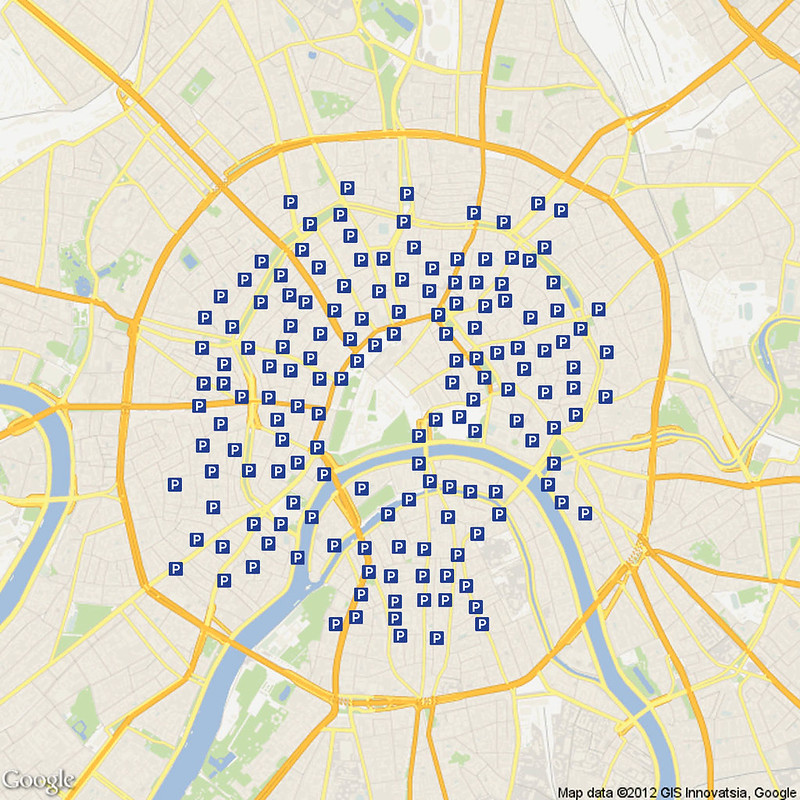
But what will happen if we still build it? Let's make 100,000 parking spaces. Finally, it will be possible to freely find a free parking lot? Of course not.
After all, as we have already seen above, only 13% of the people who come to it drive daily to the center by car, despite the fact that 37% of these people own the car. It turns out that 600,000 thousand people come to the center by public transport, although they themselves have a car (I myself, by the way, rarely go to the center by car in the afternoon).
If we make 100,000 parking spaces in the center at the cost of unrealistic efforts and money, then these people will stop going to the center on the subway, they will get into cars and go to work. And again we will have a problem - with 250,000 parking spaces to the center will come daily 850,000 cars!
Even if we omit the problem that we will shut up all the roads at the entrances to the center and the road itself in the center itself (since there is not enough throughput), we still need to build another 600,000 parking lots! The visual perception of the situation by drivers will not change in any way - how it was impossible to find a parking lot in the city before, it will also be impossible to find it now.
But what will happen if we spend another 405 billion rubles (34k per resident) for the construction of underground parking, we will rebuke the entire center, build the wide highways and build underground parking everywhere? Now can you finally find a place?
Again not. Firstly, now the whole city will stand in one huge traffic jam, because there are not enough streets. Secondly, we still have people-1.750,000 people go to the center by public transport daily and do not own the car. Of course, some of them do not have the opportunity to buy it, but at the current prices of cars and despite the fact that we are considering the center of Moscow, there are hardly more than 50%.
The remaining 50% simply decided that they did not need a car, since there is nowhere to park it, and there are huge traffic jams in the city. As soon as we begin to solve these problems, then another 875,000 cars will decide to go to the center. The situation with parking and traffic jams will not change - it will still be impossible to drive and it is impossible to find a place.
Despite the fact that nothing will change by the possibilities of parking, we will not have a city at all - it will look like this:
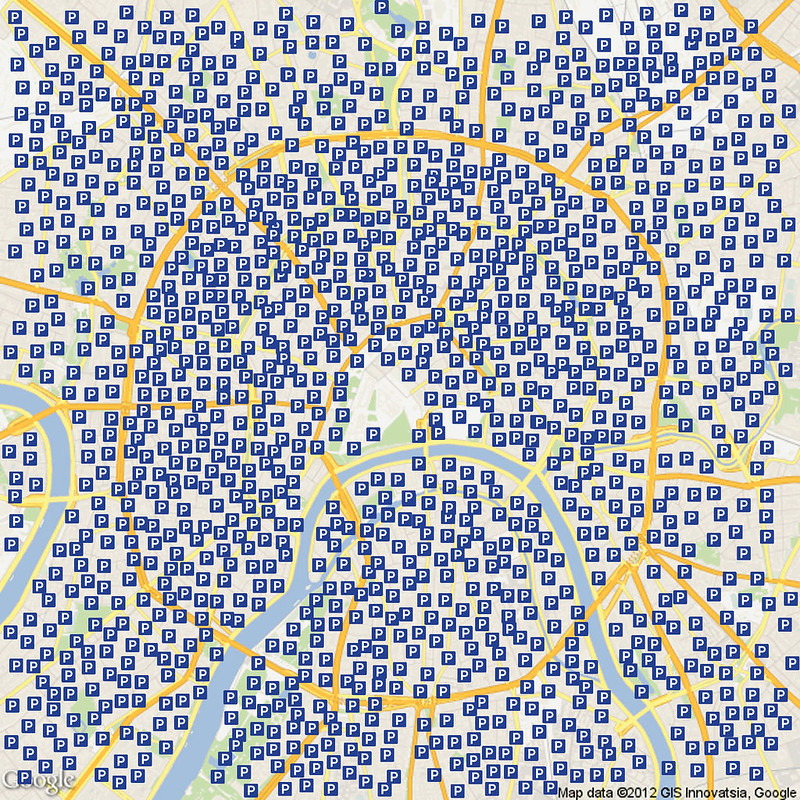
Demand for free parking, as well as for free roads in the center, is a demand that cannot be satisfied. He will always be ahead of the proposal exactly as much as people on average are acceptable to experience inconvenience.
That is, if people on average are ready to go to work in the center for 1.5 hours by car, then no matter how much you expand the road, but there will still be 1.5 hours, and only the number of cars standing in the cork, and not their movement speed, will depend on the width of the road.
Also with free parking-it is impossible to build so many parking lots in the city so that everyone can park for free-no matter how much they are, but demand will always exceed the proposal for some constant amount.
Therefore, it is possible to solve the problem of traffic jams (in the particularity of parking) exclusively by repressive measures - we need not to increase the offer of roads and parking lots, but to reduce demand for them. This can only be done with money.
There is another interesting detail with the roads - their throughput falls very much if more cars leave for them than they are able to skip. A separate post should be done about this, but if briefly and very approximately - 700 cars without traffic jams will drive 1 kilometer in 1 minute, but if 1000 cars come out on such a road, then there will be a plug and they will go a kilometer for almost 6 minutes.
The throughput of the road will decrease from 700 cars per hour to ~ 116 cars per hour.
That is, if you adjust the number of cars traveling to the road, you can very much increase the throughput of roads: if we send the extra 300 cars to the subway, then the remaining 700 reach work 6 times faster (since they do not go in traffic and go quickly).
But how can you do it? Only with the help of money. Parking fees, as well as the car for using the car, is not at all in order for someone to profit from-it is needed in order to regulate the number of cars that travel to the city center and other busy places where not everyone has free space. And, unfortunately, as we see above, the philosophy does not work here “first make an alternative, and then forbid”-in this matter it is impossible to make any alternative, attempts to solve the problems of traffic jams by the construction of roads and parking are turning into money without getting any result.
The money should not be directed to the construction of interchanges and parking lots, but for the construction of fast and comfortable public transport, the development of metro, bicycle infrastructure, etc. - In general, to develop such methods of moving around the city, which require less free area.
Commercial underground parking should also appear.
But both, and another is possible only when people came out of the head of the fact that driving around the city freely and park their car for free anywhere is an integral right, and all these signs and prohibitions are like nonsense. While the philosophy in the head is such, then there will be no demand for underground parking, there will be no demand for good public transport.
The first who benefit from the payment of parking lots will be motorists. For them, if you establish a normal price policy, exclude free places and clearly take fines, it will be clear - either you pay a certain amount and travel around the city without hellish traffic jams, or you go to the subway. Those ~ 60% of motorists who decide to pay will drive much faster. Those 40%that will transfer to public transport will create a request for normal transport. In my opinion, such regulation is much more adequate than our current “who is ready to endure 1.5 hours of traffic jams is by car; Who is not - travels to the subway "
The Moscow Transport Department is surprisingly correctly: instead of just starting to write out 3,000 rubles from the date of introduction of a fine and evacuate everyone instantly from the date of introduction of a fee for evacuation, they distribute such cute leaflets with a warning - they say, carefully, we will soon fine
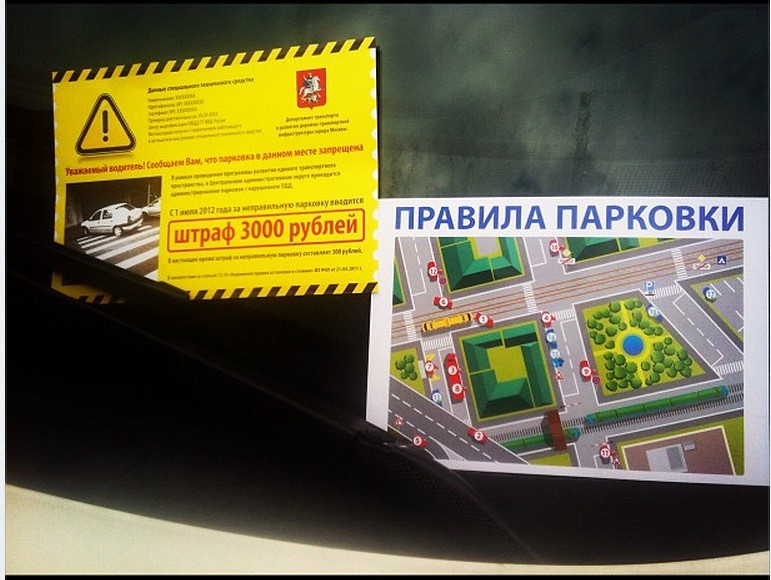
A completely unusual way of doing business and very correct - all drivers know about the new rules, the only thing, I would explain in these leaflets why it is necessary to introduce such fines and why it is impossible to build parking lots first so that everyone can calmly put cars, and then introduce fines.
But still it is very correct.
The faster the authorities find that this demand is not to satisfy, the faster they get acquainted with the US experience of the 30s and Europe of the 50s, the faster free parking in the center and in the yards will disappear in Moscow, and the faster the city will turn into a more convenient life.