
Translated material
Amazons among bacteria
If you can imagine a murderer bacterium, then, of course, these are the bacteria of the Wolbachia group, which settled in insect cells and also affect their development and reproduction. In some cases, Wolbachia kills its male masters. Although this phenomenon is well known, the molecular mechanism of the death of males infected with volbahia is unclear. Employees of the Higher School of Agriculture and Natural Sciences of the University of Tokyo, led by Professor Yukio Ishikawa), dealt with him.
Scientists worked with an OSTRINIA scapulalis bristle moth, infected with a WSCA volbahia strain. They followed the development of larvae and the ratio of floors in the offspring of healthy moths, females infected with Wolbachia, and females delivered from infection. In the initially healthy insects, both females and males are removed from larvae. The lines of infected moths are supported by crossing infected females with healthy males. All the offspring of such steam are infected, males die during embryonic development or at the larval stage. Females can be cured of bacteria, adding tetracycline to feed to larvae. At the same time, only female individuals survive, but they are free from Wolbachia. However, in the offspring of the healed females, the ratio of the floors is broken: this time only males survive.
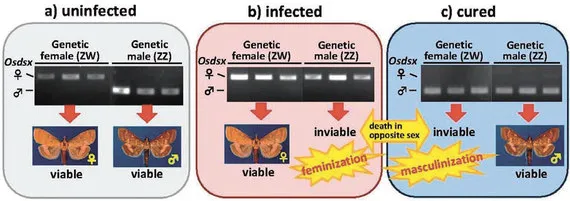
As Japanese scientists found out, a bacterial infection causes a mismatch of external (phenotypic) signs of sex and its genetic essence. Paul O. Scapulalis determines the ZZ chromosomes in males and ZW in females. In the core of a weekly cell, a female W-chromosome forms dense sex chromatin, clearly visible in an optical microscope. By the presence or absence of sexual chromatin, it is easy to determine who should develop from an emrion-male or female. However, in order to make an adult individual from a cage with the ZZ genotype, which looks like a male, the development program still needs to be realized. The implementation depends on many genes, the work of which is regulated by the OSDSX gene. After the synthesis of the MRNU of this gene, the genes are subjected to, that is, the enzymes cut certain sequences from it, and the remaining fragments are again connected to one molecule, after which the MRNA is ready to participate in the synthesis of the protein. In the processing process, the OSDSX MRNK in males and females lose different fragments, therefore it exists in two versions, male and female. They differ in size and sequence, respectively, in different ways regulate the development of the insect, which ultimately determines the male or female phenotype of an adult moth.
Japanese researchers determined the presence of sex chromatin and the OSDSX RNA type in three lines O. Scapulalis. In healthy moths, the ratio of sex in the offspring is classic, 1: 1, and remains such throughout the development. Individuals with the ZW genotype synthesized, as expected, the female version of OSDSX, moths with the ZZ genotype - male. In the offspring of females infected with WSCA, genetic males (ZZ) die at the larval stage. At the same time, in all embryos, both male and female, the female type OSDSX is synthesized, i.e. Their development, regardless of the set of sex chromosomes, went along the female path. And, on the contrary, in the offspring of females healed from Volbachia, all larvae with the female ZW genotype die and only males survive. At the same time, all the caterpillars, regardless of the genotype, synthesized only the male type of RNA OSDSX, preparing to become a moth with the body of a male. Those larvae in which phenotypic and genetic features of the floor did not coincide died. Actually, the possible phenotypic features of the unfortunate insects can only be judged by the OSDSX MRNK type, since neither the larva nor the O. Scapulalis embryos do not have external signs of the floor.
Researchers suggested that WSCA carries a feminizing genetic factor that destroys the system of determining the floor of the insect, but in exactly how this happens, remained unclear. The larvae of males infected with WSCA are in growth, but they have no morphological disorders. They all die, but at different stages of development. Therefore, developmental disabilities cannot be the cause of death, otherwise the caterpillars would die, having reached a certain one, the same for all age. Perhaps the feminization factor that Wolbachia has directly affects the synthesis of OSDSX RNA. All this remains to be found out.
Why the bacterium tries to change the ratio of sexes in favor of females, it is clear. Volbachia is transmitted to the following generations only through female germ cells, it does not fall into sperm, and it pushes the males as unnecessary. The reaction of the bacterium to the cure of the owner is similar to revenge: “Do you get rid of me? Did you want the boys? Well, there will be boys for you, but now the girls will not wait! "
Natalia Reznik
TN SUGIMOTO, Y. ISHIKAWA. “A Male-Killing Wolbachia Carries a Feminizing Factor and IS Associated with Degradation of the Sex-Determining System of Its Host”, Biol. Lett. June 23,2012 8 412-415; Published ahead of Print January 4,2012, DOI: 10.1098/RSBL 2011.1114.