
Translated material
Hair is not superfluous
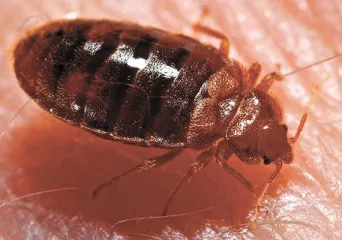
Photo: "Wikipedia" (Phil.cds.gov/Phil)
A person stands out among primates with his hairlessness. In theories, explaining why he has lost the wool, there is no lack. And there is nowhere to hide the parasites on bare skin, and it is more convenient to climb into the water, and adjust the body temperature. But, despite all the “advantages of naked life”, the same number of hair follicles on our skin as the humanoid monkey has the corresponding sizes, and the hair itself grows there, though thin and rare. Either they did not manage to “remove” them during evolution, or for some reason they are needed.
The traditional explanation is that the hairs on the human skin perform the functions of mechanoreceptors. British entomologists from the University of Sheffield led by Professor Michael T. Siva-Jothy suggested that thin hairs help a person feel the presence of ectoparasites and confirmed their hypothesis experimentally.
The studies were attracted by the female bed bug CIMEX Lectularius, which find a person in a few meters by heat and carbon dioxide that he distinguishes. Before the experiment, bugs were not fed for a week, so they were hungry and ready to bite immediately. But who? The experiments were attended by students of the University of Sheffield, 10 girls and 19 boys aged 19 to 27 years. The authors of the study claim that their participation was voluntary. All volunteers warned that they risk being bitten, and the bite is fraught with a pronounced skin reaction. Fortunately, not a single person was injured during work.
Researchers compared how much time the same person needs to feel the presence of a bug on a shaved and hairy hand. The hair was shaved between the wrist and elbow from the outside. The blade was new, soap colorless, for everyone the same. If they worked with an unshaven hand, it was also washed so that the smells did not differ. Then, a plot of 5 by 10 cm marker was circled on the skin to be visible, and with a petroleum jelly so that the bug did not escape. They asked a person to turn away and released an insect. Volunteers had to celebrate whenever they felt a bug on the skin or something extraneous.
The bug, meanwhile, wandered around the arm, looking for a suitable place for a bite. Finding him, he attached himself, straightened his proboscis, and then the experimenters took him away. Then they still fed a bug, but before the second meeting with the same person, he again did not eat anything. Preparations for a bite occupied a different time from parasites, from 10 to 70 seconds, and scientists later calculated how many times during this time a person would feel the presence of an insect. They also developed a way to assess the hairy - a hair index, which is the average density of follicles multiplied by the average hair length. According to this indicator, young men are superior to (238 and 89).
It turned out that on unshaven hands the bug has been looking for longer a place for a bite, and a person discovers it faster and more often. The higher the hair index, the more efficiently the hairs perform the function of the parasite sensor. The difference is noticeable in men, and girls practically do not feel advantages from vegetation on the skin, because their hairs are rare in their hands.
On the one hand, it is more convenient with bare skin, because it is easier to clean off parasites from it - it is difficult for them to get lost in thick wool. And bugs, lice and fleas would certainly be hired there, given the habit of people to settle in groups and in a permanent dwelling. On the other hand, complete deprivation of hair does not eliminate document insects and even slightly facilitates their life: on bare skin they find a place for a bite faster. Of course, in the open space, the bug is more noticeable than in thick hair, but its light tread is almost not noticeable. If he bites quickly, he will remain unpunished.
According to researchers, the abundance of thin hairs on the body is a compromise. On the one hand, there are no thickets in which insects could hide, on the other hand, there were hairs that prevent the bug from feeding and perform the functions of the mechano-domes, helping to detect the parasite. Under such conditions, it is more profitable to choose hairless bloodsuckers with bloodsucker insects. A bug that stomps on the skin for a long time, attached between the hairs, attracts attention more. Therefore, Michael Sayw-Joti suggests that human ectoparasites should feed mainly on the hairless parts of the host body. It remains only to get bit statistics.
Natalia Reznik
ISABELLE Dean and Michael T. Siva-Jothy "Human Fine Body Hair Enhances Ectoparasite Detection", Biol. Lett. June 23,2012 8 358-361; Published ahead of Print December 14,2011, DOI: 10.1098/ RSBL 2011.0987