
Translated material
Radio Astro: Slowly but true
On July 18, it will turn a year since the launch of the Radio -Astron space radio telescope. The case is moving, the radio telescope was successfully tested in the fall in the interferometer mode with ground radio telescopes. The other day, two press releases were published, for numbers 13 [1] and 14 [2]: the first reports on the next methodological promotion, the second is devoted to the first scientific results.
The main methodological result is to obtain an interference signal at the shortest wavelength of the Radio -Astricon range - 1.3 cm. The shorter the wavelength, the more difficult it is to find an interference signal, but the angular resolution is higher, and most importantly - on short waves there is less absorption in the source, so you can see deeper areas of active galactic nuclei. This is fundamentally important, since in such objects there are ultra -massive black holes, and the resolutions of the “radio -Astro” are basically enough to see their horizon.
An interference signal of 1.3 cm was obtained from the quasar, which is close to the line of the ground telescope - the space telescope (the projection of the base is a quarter of the earth's diameter), with this orientation, the signal is easier to detect. A 100-meter radio telescope in Germany served as an interferometer ground station.
Another methodological result is the measurement of coherence time. The problem is that the interference signal “leaves” over time due to the turbulence of the atmosphere. In ground radio interferometry, the coherence time is from 1 to 15 minutes - it is important, since this is actually the time of accumulation of the signal. The results obtained - 10 minutes on a wave of 6 m and 2 minutes - 1.3 cm. That is, stability is no worse than the ground radio interferometers.
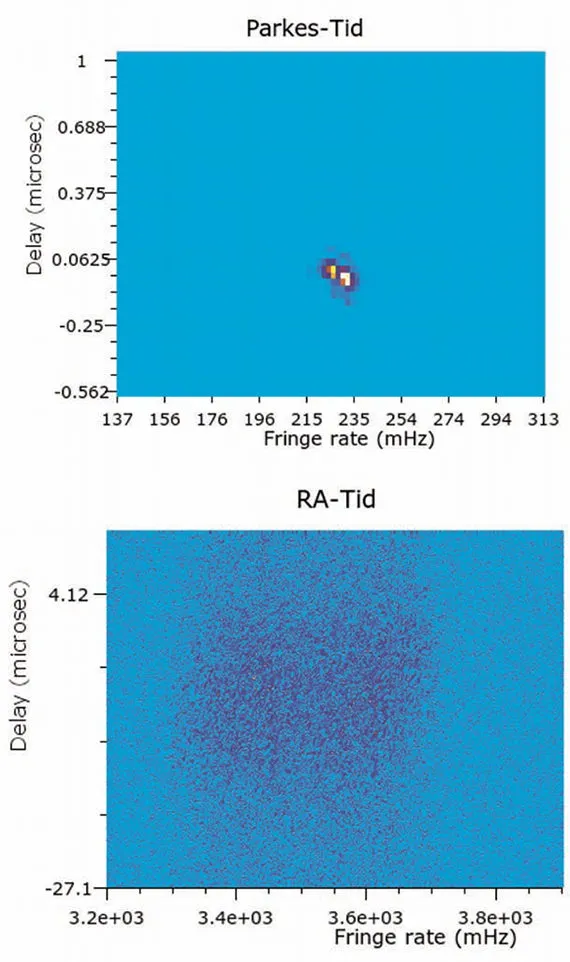
Below is an interference response obtained from a 10-meter space telescope and a 70-meter radio telescope in Tidbbinbill. The area of interference response covers a wide range of delays (± 10 μs) and interference frequencies (± 0.2 Hz). The scattering circle is allowed, which allows you to explore its structure and evolution
The second press release is devoted to the first scientific results.
Blazar 0716+714 was carried out (similar “names” are composed of the source coordinates and are called “telephone numbers” in scientific expansion). Blazar is an active galactic core that throws a relativistic stream of substances directed exactly at us, which is why the source is seen very bright (as a spotlight aimed at the observer). This Blazar is at a red shift of 0.3, which in the light years will be about 3 billion. "Radio Astron" has so far defined only the upper limit on the size of the radiating area of this blazar - 40 microseconds of the arc, or 0.2 parsec. This means that Blazar's stream (Jet) radiates not far from his source.
Compact details in the active galactic nucleus (Quasara) OJ 287 were found. This quasar is famous for containing two black holes that circulate around the general center of mass with a period of 12 years. One of them has a record mass - 18 billion masses of the Sun (as a mass of the middle galaxy), the other is 100 million. The resolution is 10 times higher than the resolution of ground interferometers, and this is not the limit.
A review of the nuclei of active galaxies continues.
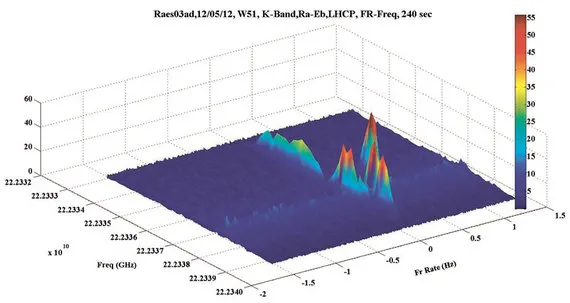
From the galactic objects, an interference signal from the water ointment was obtained 1.35 cm in the area of starship W51, located 5.4 kiloparsk from us. Several bright details corresponding to various radiation areas are clearly visible (Fig. 1).
Finally, the scattering of radio waves was first measured on the heterogeneities of the cosmic plasma, which twist, scatter and focus radio lights. A pulsar was used as a radio source in the constellation Sails. The scattering circle is first allowed (Fig. 2). Identification of the structure of this circle and its change will over time allow the first time to investigate the heterogeneity of plasma on the ray of vision.
B. Sh.