
Translated material
Change or perish
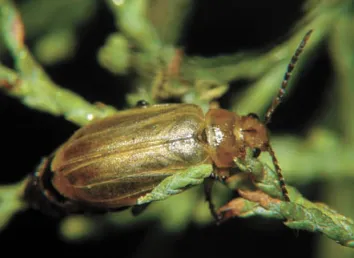
American biologists from the University of California at Santa Barbara have developed a new method of struggle with the malicious weed of Tamarisk using a beetle of a leaflet eating this plant. By adjusting the number of the beetle by changing its life cycle, they achieved more effective extermination of the weeds. Research results are published in the journal Evolutionary Applications.
The decorative shrub Tamarisk was imported in the United States from the Old World in the 19th century. Since then, he has flooded the coastal territories, successfully competing with local vegetation for light, water and nutrients. “This worsens the conditions for the growth of other wild species. In addition, it increases fire hazard in the region, since Tamarisk easily ignites even when green and healthy, ”explains the co -author of the study of Tom Dudley.
Fortunately, this weed has a natural enemy-a Tamariscor beetle of a list, also from Eurasia, fed exclusively by Tamarisk leaves and wintering under a leaf dump. After almost ten years of research, the US Department of Agriculture in collaboration with the authors of the project T. Dudley, B. Bin and others decided to release insects to the American territories clogged with Tamari.
Initially, not everything went as smoothly as the scientist would like. The beetle, successfully settled in the northern regions of the United States, where the length of the day was fully consistent with its historical homeland - Kazakhstan and Western China, stubbornly did not want to breed normally in other conditions. Less length of the day in the southern regions, from mid -spring to the end of summer, not only reduced the temporary segment for the reproduction of offspring, but also “misinformed” beetles, forcing to go into a state of peace in anticipation of winter. Instead of eating and breeding, insects fell into the range early and spent all their reserves long before the onset of spring, which led to death.
Despite such a discouraging beginning, the researchers still continued to observe beetles and found that seven years after their introduction into the southern regions, joining the Dizaza began to linger for two weeks. Beetles noticeably adjusted the winter time so that the next generation was better adapted to the new season. Now the population of beetles in the River of the Colorado River has not gone hibernation since the end of July, but remained active until mid -August.
This led to the first successes of the program of biological regulation of the number of Tamarisk. The competitiveness of depressed vegetation increased, and in a number of areas it gradually began to recover. In other areas where the organ shrub grows with the greatest density, additional measures will probably be taken to restore the natural flora. True, the complete destruction of Tamarisk is unlikely, and such goals are not even set. It should be noted that in some areas Tamarisk became the usual habitat of the willow Mukholov, which nests in a shrub, which squeezed the native species of plants preferred by this bird. There are fears that excessive defoliation and impoverishment of the crown can disturb the most careful individuals, but in the near future, native species of vegetation will be restored, preferred for long -term nesting nesting and to maintain ecological balance of ecosystems of the coastal zone.
Of course, the spread of new species and their fast evolution always cause concerns. However, if we talk about a Tamarisk sheet, it is unlikely that this highly specialized type of insect will spread to other plants. According to long -term research, it feeds and propagates exclusively in Tamarisk. It was also noted that the growth of the population is inhibited with a decrease in food sources, for example, with the progressive lean control of Tamarisk. And these beetles have enough natural enemies: after all, becoming part of the ecosystem, they serve as prey for birds and other predators.
Note that this is far from the first time that insects are attracted to extermination of weeds. Earlier, we already talked about how, in the fight against Ambrosia, a wormhole on the Black Sea coast, an ambrosive striped leafist was successfully involved (the TRV-hunger No. 81 of June 21, 2011 [3]). And in the Astrakhan region and Central Asia in recent years, the biological method of combating the malicious weed of infection has been used. An infectious flush of phytomise helps to deal with it.
Tatyana Borisova
1. Dan W. Bean, Peter Dalin, Tom L. Dudley. Evolution of Critical Day Length For Diapause Induction Enables Range Expansion of Diorhabda Carinolata, a Biologic Control AGAINST TAMARISK (Tamarix spp.). Evolutionary Applications, 2012; 5 (5): 511 doi-http: //dx.doi.org/10.1111/j.1752-4571.2012.00262.x
2. Press Release: Tamarisk Biocontrol Efforts Get Evolution Boost - www.iacsb.edu/pa/display.aspx?pkey=2780
3. Http://trv-science.ru/2011/06/21/rozhdennye-polzat-mogut-i-letat