
Translated material
Woke Viya
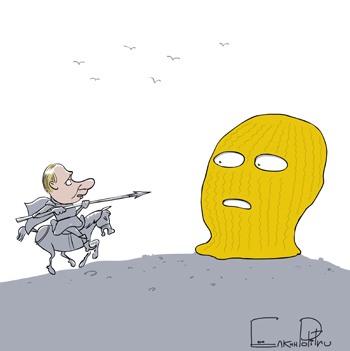
Our stolen happiness
In recent years, Russian political discourse and Russian thought have acquired one important feature: everything that happens with the country is somehow interpreted as part of the concept of the Golden Age and lost paradise. In almost any dispute on socio-political topics, the Soviet (less often pre-Soviet) past plays the role of the standard, a sample for thorough copying or, conversely, for all avoidance. Even such an important attribute of ideas about the Golden Age as a Bon Sauvage appeared - most often the former Afghan or Veteran of the First Chechen, who heroically resists the world of Chistogan (one of the brightest examples - Danila Bagrov). There is also a competing mythologist,
The opposite for Russia is the opposite of the “noble savage” - this is a “scoop”, the simplicity of which is considered a sign of no nobility, but at best stupidity.
The rapid growth of the significance of the past that we recently quite easily said goodbye-this is to some extent forced process, the natural reaction of society to too sharp changes, as a result of which many were surprised to find that they lost not only something specific as that picture of the world, the comfort of which became obvious only after its disappearance. This intangible concept, consisting of a number of mythologists associated with the exclusivity of the nation (its territorial, cultural and historical quantities, as well as Russian messianism), as it turned out by the outcome of the 90s, had great value for Russian citizens, much more than for citizens of other countries. Perhaps the most intense and conflicting part of the Soviet mythological space is the myth of the inhabited culture.
For the first time, this myth manifested itself in Russia in connection with the reforms of Peter, the activation of Western trends in the 19th century and, of course, the October Revolution. The tension of the “cultural question” in Russia is due to the fact that while the collapse of the USSR or, say, privatization, there are a minor, degradation in the field of culture and education continues.
This circumstance pushes the layman to the idea that somewhere a certain “Chubais from culture” secretly acts
(most often for this role, M. Helman, already retired by A. Fursenko and M. Shvydky or, for example, unnamed persons who seem to “stand behind Pussy Riot ”).
Guardians of myths
The natural consequence of this understanding of the problem was a sharp strengthening of the protective principle in the cultural sphere. The legislation is quickly reoriented to protect such ephemeral constructs as “morality” and “spiritual values”. So, on July 20, a message appeared that the State Duma deputy Tatyana Moskalkova (which represents not even “United Russia”, but “Fair”) promises to petition the introduction of the criminal article “For attempted morality and gross violation of the rules of the hostel, for actions encroaching on the honor and dignity of citizens, moral foundations of society.”
It should be noted that
Culture itself really needs restrictions, as they play a formative role.
This thesis non -trivial for modern consciousness is implicitly contained in traditional cultures and, of course, in the Christian tradition, so it is now a response not only for officials, but also among Russian intellectuals of the neoconservative direction, which are almost without exception around the Orthodox tradition.
However, culture is not restrictions, but overcoming them .
The culture is inconceivable without frames, it is, but not a framework creates a culture. Unfortunately, now the whole potential of that part of the society that yearns for the lost culture is aimed exclusively at restrictions, at building fences and towers, to wrap the territory with barbed wire. Show us the guilty!
The dialectic of what is such that the struggle for culture that has unfolded in the country (spirituality, morality, etc.) leads to the opposite result. Instead of the growth of spirituality, we get Chaplin, instead of strengthening statehood - hill and Medinsky. Is it possible to explain such a reverse result of our undertakings by simple bad luck? No, this result is natural. Our current “prohibition” is a consequence of the same phenomenon, which led to the crisis of culture. By the 70s, the ways of developing European culture have exhausted themselves, and for this circumstance, Russia was ready much worse than the Western countries.
For Russia, which made a bet on the development of culture and deliberately abandoned the consumption society for the sake of planned achievements, the cultural impasse has become a kind of end of the world in one individual country.
At the same time, Soviet mentality did not allow accepting a new situation as a given. The Soviet man is accustomed to believe that such global issues, which the crisis of culture belongs, should solve the state. Without learning to realize his individual responsibility, but as a result - not knowing how to determine the boundaries of competencies, the zones of the possible and impossible, he out of habit began to look for the guilty.
The post-Soviet consciousness automatically began to personify the socio-political changes that disturb him, so that there was someone to assign responsibility. In society, conspiracy theories quickly spread, which to date have practically replaced other methods of interpretation in the mass consciousness. For example, a formula that I came down to me recently on the Internet, in which this thought (or rather, thought of miracle ) is very clearly expressed: "Juvenile justice, abortion, early sex, all this is part of the program of white -open creatures." Either one more thing: “The collapse of the Soviet Union has already occurred, and a fairly large number of people already know for sure that all these leaves of cigarette paper (we are talking about Samizdat - M.S. ) can really lead to the collapse of the state and the death of millions of people who will not fit into the next attempt to build a liberal paradise on Earth.” In the 80s, the phrases “today wears Adidas , and tomorrow they will sell their homeland” only in the form of a joke, now very many quite sane people seriously say that from white tape and leaflets-a direct path to early sex, the deaths of millions of people-to anything!
Now that the mechanism itself has earned the “laying liability for all its troubles”, guilt is no longer needed, because you can declare anyone a criminal. This is clearly visible from the recent statements of lawyers who suffered from the actions of the Pussy Riot of the guards of the Cathedral of Christ the Savior. “A group of defendants, led by Tolokonnikova, is only a small visible peak of the iceberg of extremists, seeking to break a millennium sustainable Russian Orthodox Church, to provoke a split, deceiving the flock not to God, but to Satan. Behind all this are the real enemies of our state and Orthodoxy, ”said this, the coordinator of some“ Orthodox fraternities ”said, but a professor, doctor of legal sciences Mikhail Kuznetsov. “In the main temple of one famous monastery, some demoniac climbed onto the salt and also began to rain in a sacred place: jumped, cursed, shouted something, and soon the bloody Russian-Japanese war began,” lawyer Sergei Stin echoes him.
The temptation of prohibitions
It is important that the mechanism open at the beginning of the tenths is important: any objectionable public can be called a source of apocalyptic disasters. No one is mocking anyone. They really think so. This is such a way to bind causes and investigation. If misfortune happened, there should be people responsible for him.
The inability to find the perpetrator for changes that have an objective reason makes us activate the search for an invented attacker.
The country falls into a vicious circle.
Pussy Riot is a symptom of the disease, not a reason. The desire to prohibit everything that is possible in response to the February dance is a symptom of the next stage. It is necessary to treat her already. The crisis of our culture, spirituality and morality is in no way depending on the Pussy Riot , or on the preachers of “actual art”.
From the very fresh: according to state prosecutors, it was the actions of the Pussy Riot punk group that provoked attempts to kill the famous Tatar religious figures of Ildus Fayzov and Valiulu Yakupov. They killed, sir. Such legal logic, penetrating in judicial practice, gives a formal opportunity to build, no less, the processes of the “pests” of the model of the 30s.
They say that Russian people are evil. This is not true. All anger in Russia is from stupidity, Gogol wrote about this. Like here: they fought for culture and spirituality, and the beneficiaries will be those forces that would be better not to wake up. You can’t say anything here except “ Tu L ' as voulu , Georges Dandin ”!