
Translated material
Krymsk. Ten days after the tragedy. Part 1. Mulyak
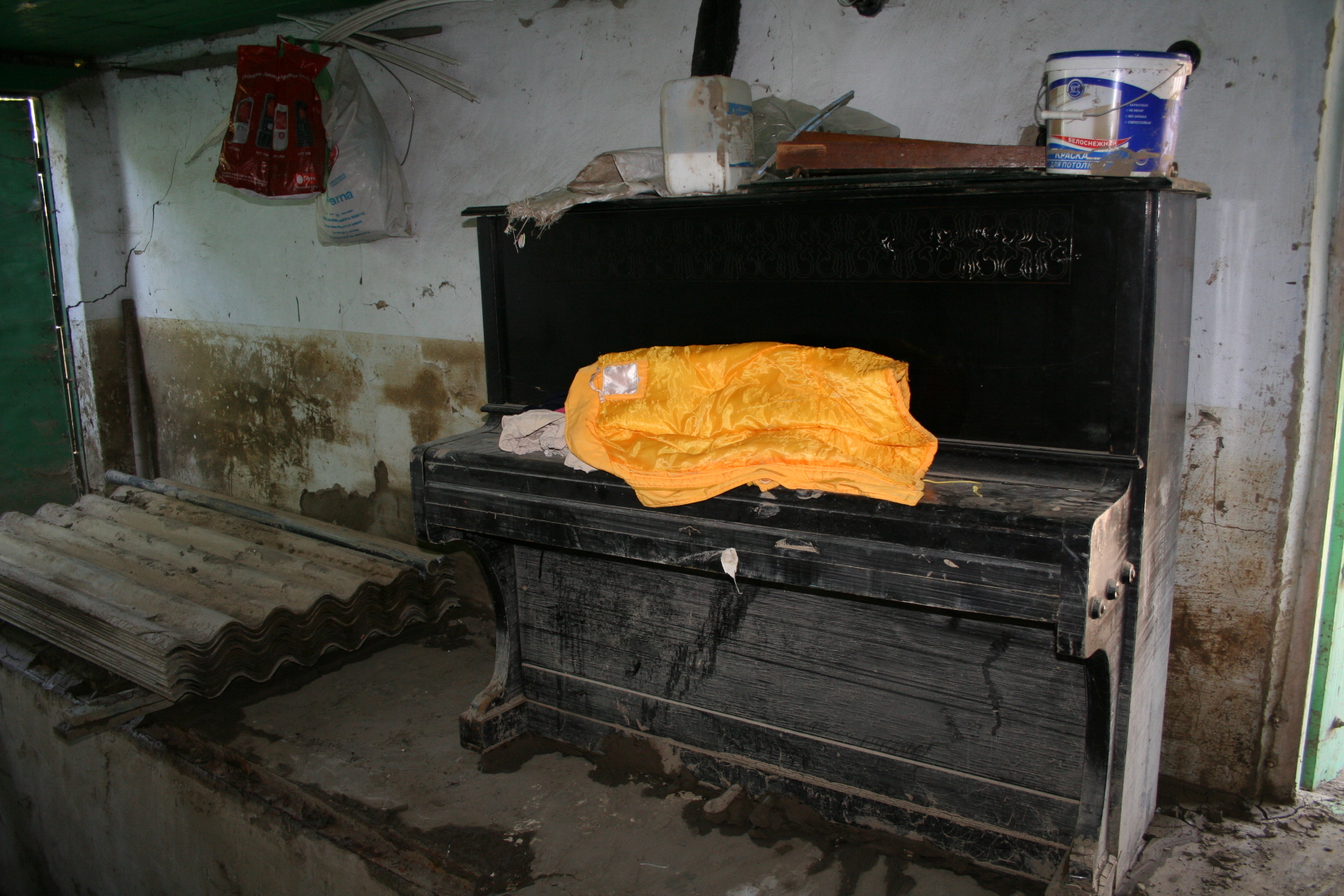
Mulyak is exclusively Crimean. Already at one hundred kilometers they do not know him. It denotes the silt raised from the channel of the Il river with rotting organic, which water brought to the city. By the consistency and color of the mulyak, it is similar to a thick cement mortar. And when it dries, it becomes approximately the same hardness. The smell due to rotting organics in her is specific. Perhaps the description “stinks of a rotting garbage dump” will be closest, although it is not entirely accurate. The smell is quite strong, unpleasant, but quite tolerant. Of course, he is far far from the cadaverous smell, which is impregnated with half of the lower bancam.
Mulyaka is now littered with half of the city. After the firefighters from the Ministry of Emergencies pumped water from the yards, the mulyak became the main problem. She is everywhere. Courts, gardens, rooms, cellars, kitchens, toilets ... The main trouble, of course, wells. You can’t drink from them now, and when it is possible, I don’t know. With a request to clean the well, they turned to us in every courtyard where it is, but it is impossible to clean them with improvised means, despite the fact that in the car I arrived, among other humanities and medicines there was a whole box of disinfecting tablets - in an open source they are useless. To disinfect all the wells in the city can only the state, but it is busy clearing the rubble and is in no hurry with the wells. Not so significant, apparently. Therefore, the problem of drinking water in the area is quite acute - the city is not so much, of course, but in the villages, in private houses without a water supply, this is now one of the main tasks.
The heat that came to the city after water was set tightly. The dried mulyak with dust clubs rises into the air from under the wheels of equipment. At times, the smell of decaying animals is mixed with garbage stench. Breathing in the city is hard. The traffic cops are all in masks.
By the way, Krymsk, perhaps, is the only city in the entire latest history of our country, where traffic cops really fulfill their duties and regulate the movement at intersections, and do not chop the loot from the passing. When the traffic police works, it is felt right away. There are not many traffic jams in the city clogged with a technique as you might expect. Calling them "cops" this time does not turn. And in the heat, and even in the form of them, perhaps, even harder than others.
The city itself was not injured as much as one might expect - not Tskhinval, and even more so not formidable, but a third, if not half of the Crimean, to one degree or another, was destroyed. Actually, the entire lower city is washed off. Only what was on the slopes remained untouched. I will not say about the seven -meter wave, but in the very lowlands, directly near the channel of Adagum, the water reached about four, four and a half, and there may be five meters. This is what I saw with my own eyes.
The most powerful impression on me was made by parallel Red Army and Krasnoflotskaya streets. Everything washed away there. Brick houses resisted, although more or less strong destruction in every yard, but the Summanny demolished almost completely. Here and there, either the prompting of a chopped house is gaping, or there are three walls with a breakdown instead of the fourth. Inverted machines, the blocks brought by water, the fallen fences, stuck above human height on the trees furniture ... people are taciturn. Everyone has some abandoned detachment in their eyes. The feeling of bombing here is already fully present. I was there on the tenth day after the flood and by this time, in my opinion, no help had arrived yet.
Most of all I remembered a man to whom we brought a humanitarian at his request-bedding, T-shirt, something else on trifles. A one -story self -propelled house with broken windows and a cracked rickety facade. The courtyard, forced by things that they still hope to return to use. Natalia's wife, who rakes the slurry from the yard. The old Opel baked in the crust of dried mulyaks. Open in the last hope for drying the hood. What a drying - there are ten centimeters of the captured silt ... The owner is a hefty tall man of about forty, in full height, with a mandatory wrist of his right hand, tries to manage a car. He came up, specified the address. “Yes,” they say, “we are.” I gave the package. The owner took out a T -shirt, was delighted with her as the most precious thing - it is almost impossible to work under the sun with a bare torso to work for ten days. Then he approached and quietly like this, looking to the side: "Guys, do you have stews?" He gave him the whole grunt that was.
Such things hurt the most. When you bring help to lonely grandmothers, this does not catch so much. Grandma is her grandmother, she is definitely helpless. And in our country it seems almost natural, no matter how blasphemous sounds. And when a healthy big strong man asks for a T -shirt and a can of stew for the family ... The power of the tragedy and the defenselessness of the Russian person in front of the trouble is fully felt.
There was a house - and not at home. There was life - and there is no life. There are not even t -shirts left. He asked if he needed help, he answered that he was needed, of course, but the house is in an emergency state, it will collapse at any time, so they are afraid to let people go inside, work themselves. And - Mulyaka, Mulyak, Mulyak ...
Residents rak the rubble and clean the mulyak on their own. Occasionally, in cars, mainly - shovels and buckets. Manually. With the help of only volunteers. Tons of mulyaki. The work here was done by Adova.
Medican volunteer Dasha provides the necessary assistance to the lonely resident of Krymsk:
Vika volunteer (I can make a mistake with the name), meanwhile, was laundering a grandmother's house from Mulyaka:
Front of work. Former kitchen. At first, the men volunteers scooped up all with shovels here, now the girls wash the remaining mulyak manually. In general, everyone who responded and came to help people should be awarded with a sign "For Crimea". Eighteen -year -old girls plow just selflessly. This is what is called the "labor feat". But, since our state wanted to spit on their dedication and asceticism, and instead of gratitude, it introduced the bill "On Volunteers", I express my gratitude to the girls myself. The main work, and in the early days, is generally all the work, did the volunteers. And only they organized a humanitarian in the city.
The city looks something like this. Krymsk, Molodezhnaya street:
Another lonely granny. The neighbors came up and asked to give her food - she herself was shy. In ten days, the state never reached it. They gave, everything that was with them was in this walk, then they brought again.
In these piles of garbage here and there comes a dead bird. This is the tenth day, heat, I remind you, plus thirty -five. No one removes the corpses. A local resident on our advice floods the decomposed chicken with chlorine. They recorded the address, handed it to the headquarters so that the car came and took away the decaying carrion:
From a heap opposite the cadaveric smell comes more strongly. But there can no longer be reached - the working Tajiks in the T -shirts of the Ministry of Emergencies filled up the corpses with a mountain of garbage, which they clear from the rubble. The fool to pray to God ... How much this will now stink and decompose, it is not known - these mountains can now be analyzed only by technology, but until my departure this work has been started: neither Tkachev, nor Putin, apparently, were not going to inspect this street. By the way, on the night before Putin arrived in the volunteer camp, the Emcheesites walked in crowds and all those who wanted to hand out such T -shirts with the inscription on the back of the Russian Emergencies Ministry. And since there are enough t -shirts for one day of work, they took them willingly. So everyone is now working in such shirts. You go around the city - and everywhere there is one continuous Ministry of Emergencies. Specifically, these Emchetovites in Russian understand one word in two. From the secret Tajik unit, probably. The fact that in Krasnodar for construction companies where migrant workers are involved, they come from the FMS and say: “Either let Tajikov in Crimean, or we begin to check“ I themselves told the Krasnodar.
In the middle of these cadaveric heaps, children run and play. Dust with decay products rises into the air and settles on the nipples that they pull in the mouth, and in children's lungs. A stinking heap, as you can see, right behind the back of the child:
Sovetskaya Street:
Some work is already underway:
Former living room:
The first and most importantly that they ask for all houses - mattresses, pillows, blankets and bedding. This was really missing:
Dvor:
Kitchen
Now, two weeks later, the soldier in the city is full - in each courtyard, the top ten, Crimesk is filled with them, they took the case into their own hands and plow each for ten. But truly the army and the Ministry of Emergencies entered the city only two weeks later. As I understand it, two weeks - this is the average speed of the response of our services in emergency situations, which, by definition, are considered "immediately response services." That is, as I said, we have no state. How will you survive in the city without water with a well -lit fed, with corpses of animals lying on the streets at a plus of thirty -five in a collapsing house for two weeks - these are your problems.
Dasha was again found work - measure pressure, sugar, make a list of necessary medicines, well, and it will work a little: a psychologist:
The whole city is littered with a humanitarian. People responded from all over Russia. But the problem is that they very poorly imagine that in such situations it is necessary in the first place. And mostly they send clothes. Often old, worn. Those worn shoes, worn bras - I unloaded it myself - rubber boots on winter fur. Once I even came across a backbone to beat off meat of the Soviet era. In general, God for you, that I am not good. Of course, thanks, but it is unlikely that anyone wants to wear other people's old bras even after flood. And one guy generally swore that some sex shop sent several boxes of rubber women-he unloaded them personally. Now all this junk will also have to be taken to the trash:
Field kitchen:
Camp "Nashists". By the way, a political truce was established in the city. Nationalists, opposition, "nurses", leftists and democrats worked shoulder to shoulder. They worked on a par.
And here it is a little like the formidable:
Here, on the Soviet, opposite this nine -story building, there is quite a whole cafe in the German style. I remember, at first I was still surprised - now, I think, the owner now in the church beats: the whole street was smashed, and his water went around. And then, when he arrived at this place a second time, I realized that it was not a matter of bow. Over the past ten years, the city has flooded four to four! - Once. The first in 2002, then the water did not rise so much, but then the dead were also, several dozen. Then two times weaker. And now it’s very strong. And all these ten years neither people nor the authorities took any steps to protect themselves. The atomized society lived each of its worldly, and in the end something happened that was supposed to happen. It must have happened. And it happened. It just carried it before that, but this time it did not carry it. And this tragedy will certainly happen again. The houses will be rebuilt, millions will be allocated, and even repaired the siren-they will already repair it-but the problem will not be solved systematically. Because where there is no civil society, the fourth, fifth, tenth hit on the same rake is provided. Everyone expects that their problems will begin to solve for them to be solved. And someone else thinks that the main thing is to have time to drink more.
And this man, the owner of the cafe, did not wait. And in his tank -hazardous direction was the cleaned concrete drainage and a two -meter fence contained in order, cutting off the flow of water - it always comes on one side. And his house escaped with minimal losses. Unlike the rest of the city. And now one of the headquarters is located in his cafe, a hot nutrition point, a telephone room, representatives of the administration, lawyers and psychologists work. I did not succeed in photographing a surviving cafe, unfortunately.
While the humanitarian was transported right in front of us shot down a man on a scooter. Dashka again leaned the work. Nothing serious - abrasions and cuts. A man, of course, without a helmet. But there were no concussion, although he had a pretty head with his head.
City:
Lermontov Street. Multi -storey houses. The second focus in the city. At the time of photographing, I recall once again ten days. The horse in this area has not yet been lying.
Photo from the local newspaper:
Well, as always: to whom the war, to whom the mother is relative.
In general, I have no sensations of a common misfortune from the city. The flooded Nizhny Krymsk - it seems like in itself, surviving the upper - on its own. Locals, of course, helped to transport humanitarian aid, but the number of cars that came to the camp was calculated by dozens. Catching a passage from Nizhnebakanskaya back to the camp is a problem. Moreover, people see that volunteers vote, and still pass by. One stopped, after which he was thrown into a request, he said that he was driving around the city for seventy rubles. I don’t know, maybe this was not so lucky, but the feeling that it was one and a half thousand miles, collect the carrion in the heat, to carry a humanitarian and rake a mulyak only I and a couple of hundred volunteers, and not at all the inhabitants of Crimean - this feeling was stable. In a local taxi, six people to the Krasnodar to board the Ministry of Emergencies answered the local taxi - please, a thousand nine hundred rubles a car. Unfortunately, we do not have not only the state. We have no society. And the first is the logical result of the second.
Although, of course, ten people gave them for ten people, and taxi driver Max threw a job and drove volunteers and humanitarian aid from morning to evening and many others did not remain indifferent. But I did not feel the feelings of general unity in the city. In principle, the ratio of bastards, indifferent and heart -opened people has not changed. It just displayed brighter.
And again, and again and for one hundred and twenty -fifth time - if you do not want to decide your fate yourself, others will definitely decide it for you. And this solution - also necessarily - will not be in your favor. And instead of drainage channels, hidden and cleaning of the channel and a working warning system you will receive three -story officials. And one hundred seven-thousand corpses in washed away by a small, in general, and repeating from time to once, the city. This is the logical result of the policy "My hut with the edge". And there could be no other result.
Now regarding the causes of the disaster and the number of dead. As I said, there are no thousands of corpses in the city. Five thousand dead in the fifty thousandth district is ten percent. To hide such an amount in this situation, when people on a platoon is simply impossible. Just representing how many people would be involved in this - those who cleaned those who loaded, those who delivered, those who unloaded in the morgues, morgue workers, orderlies, head physicians of hospitals, administration workers, police, and so on. And even more so there would be crowds of relatives looking for their loved ones. It is impossible to imagine that not one of this mass of people has been talked. Certificates would certainly appear. Photos would certainly be posted. The feeling of the scale of the tragedy is a physical feeling. It hits the city. In such situations, you do not need to look for evidence - people will provide you and show them themselves. People are sure to start telling - here in that house they died, in that house they died, there the family died there. In Krymsk, I did not hear such conversations. This is the first.
Second. Castellation arguments "took everyone away to the sea/reservoir/fell asleep in the riverbed. The water came at night and the vast majority of people died in their homes. So that thousands of people are covered with silt in the riverbed, it must be assumed that thousands of people who do not have relatives, at once in the middle of the night, went to swim in the praised river-perepluyka, in which no one has bathed at all-she is not swimming at all-she is not swimming To allow such an assumption, it would be absent to the rampart, by the way, the water arrived very quickly, but still not a wall. I have no evidence of this information, I am ready to allow them.
Third. My colleague from the Rostov newspaper Timur Sazonov sent me the following SMS: “Arkady, do not believe the rumors. There are no one and a half thousand dead here. He climbed the morgue, cemetery, morgue in the next city, everything is formed in the offices. Almost no one saw the bodies.” And I completely share his opinion. I also recommend reading Timur: http://sazonov.livejournal.com/
Fourth. One hundred and seventy dead - this is a lot. So many.
Regarding the reasons, I also wrote everything earlier. In addition, Ivan Dniester, who himself originally from Krymsk and lived there enough time, in his article "Water Val Adagum" laid out everything on the shelves using formulas, and I also completely share its conclusions. In short, the main reasons for the tragedy: pouring rains, plus the uncleaned riverbed of the river (it is not cleaned at all, there are already half -century trees sprouted), which created a cork with the course, the water accumulated, broke through and poured - not in a wave, but with a fairly strong stream - on the plain. Выходя из практически прямого в ущелье русла, она попала в очень сильно скривленное и также нечищенное русло в самом городе, что застопорило водоооток. Плюс воду стали задерживать дома, которые жители строили самовольно в затапливаемой зоне еще с семидесятых годов прошлого века. Все в купе и привело к такому результату. Иван также приходит к выводу, что при той пропускной способности русла, которое выше по течению имеют Адагум и впадающая в него Баканка, наводнение на равнине могло быть как минимум в два раза сильнее, и я также разделяю и эту точку зрения. Никакого слива не было и быть не могло. Водохранилище вообще смягчило удар, взяв на себя часть воды с гор. Что, безусловно, не отменяет отсутствие оповещения, отсутствие помощи в первые часы и даже дни, безалаберность и наплевательское отношение к людям, спасание своих чиновьих задниц в первую очередь и так далее, и так далее, и так далее.
Но для этого, как и говорилось, у нас должно быть государство, а для этого, в свою очередь — общество. Которое будет отчетливо понимать, что только оно, объединившись, способно влиять на власть и заставлять её решать наши проблемы. А такого общества пока еще нет ни в Крымске, ни вообще в России.
Завтра будет репортаж об уборке трупов животных в Нижней Баканке. Там все еще хуже, чем в Крымске. Stay in touch.