
Translated material
Experts stated: the transport collapse in Moscow has come
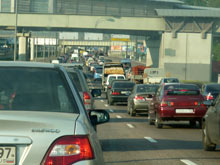
The average speed of cars on Moscow streets in the first six months of 2012 decreased by 10%, and the evening hour of the peak stretched until 12 a.m. These are the research data conducted by specialists "Echelon Geolaif". According to the results of the study of the speed of transportation, the company stated: in places the expected transport collapse has already arrived.
The company analyzed the data of the satellite system of protection about the movement of 40 thousand cars and stated: now cars drive around the city at an average speed of 23.9 km/h, this is extremely slow, last year this indicator was 26.6 km/h. The speed below 30 km/h is considered critical, and the speed below 20 km/h means transport collapse. By the way, in the sections of the flight highways, where there is a reconstruction (on Kashirsky, Warsaw, Dmitrovskoye Shosse), the speed is just 20 km/h. So the local collapse has already happened, MK notes.
The problem is not even how to drive around the city (the metro will always come to the rescue), but how to get to the MKAD. This is also evidenced by official statistics. According to the results of the Mosgortrans report, traffic on electric trains and metro increased very much. And there is practically no growth on ground passenger transport. "And the authorities are making efforts to transform precisely the system of ground transport - to take the same organization of the allocated stripes. Alas - their appearance did not affect the passenger traffic at all. But on Andropov Avenue (in the direction from the center to the region), the average speed decreased from 36 to 23 km/h, on Volokolamsk highway - from 35 to 29 km/h, on Borovsky - from 34 to 28 km/h. It is much more important to concentrate efforts outside the capital - for example, to build transport and relocation nodes not inside the Moscow Ring Road, but at the entrances to Moscow, ”experts say.
The authors of the study claim a sharp change in the hourly dynamics of car traffic. If in the morning an hour is a peak from 7 to 10 a.m., then in the evening it stretches until midnight. From 17:00, the fall of medium speeds begins, reaching an absolute minimum at 19 o’clock. Until 20:00, speeds are trampled in place, and then growth begins - though very unhurried.
An extremely complex movement on the Ryazan and Volgograd Avenues. The third ring has long stopped performing the functions of the highway.
And in the coming years, the situation will not improve - due to the reconstruction of the highways. The metropolitan authorities themselves do not hide: the improvement of the situation on the roads will occur only at the end of the implementation of the transport program (2016). True, transporters predict that road capacity will grow by 15-25% depending on the area. But - for a short while, according to experts - for 3-4 years.
Like in Europe
The current average speed of the Moscow movement is quite comparable with an average speed in the most loaded cities of Europe, where it ranges about 20-26 km/h.
If you estimate that on the empty streets of the metropolis, the average speed of movement (taking into account the passage of intersections and stops at traffic lights and before pedestrian crossings) is approximately 40-45 km/h, it turns out that the “averaged” Moscow traffic jams increase the road on the way almost twice. According to this indicator, our capital will easily argue with the most dysfunctional cities of the Old World, notes Drive.ru . According to the July data of TomTom, which records the movement of a huge number of cars in the 31 European city, the most common and dense congestion in the first months of 2012 were in Warsaw. In it, the time on the road on a weekday is on average by 42% more than the time on the same route at night, when the streets are almost free. And in the morning hour, the peak of this overload index reaches 89%even. In second place is Marseille with indicators of 41% and 79%, respectively, and in the third position - Rome with an indexes of 34% and 76%.
Warsaw has been spinning in the "winners" among the most damaged European cities for many years, and in the last couple of years it is completely leading.
Moscow, having worsened its cork indicators compared to the previous year, fell into a company to such cities as Munich, Berlin, Marseille and Vienna, where the situation on the streets in the year was similarly complicated. And in terms of road congestion, Lisbon, Bern, Amsterdam, Milan and Rome experienced some relief in terms of road congestion. This is where to send for the exchange of experience in the organization of movement.