
Translated material
Where is politics
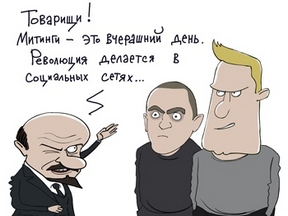
For more than six months, I read the columns and posts in the social networks of acquaintances, weak -digested and completely strangers from the series "Protest, the fate of the Russian revolution and the future of Russia." In them, with varying degrees of enthusiasm and persuasiveness, scenarios for the development of the situation in Russia are drawn. Of course, in the light of thousands of rallies in the capital. The scripts are different - from frankly catastrophic to incredibly blessed.
From a certain moment (somewhere in the end of January), all this entertaining futurology, even when it came to purely tactical things, began to bore, later-frankly annoyed. My patience personally ended when in a week I got acquainted with the three texts of my colleagues. Vladimir Golyshev, Ilya Azar and Ekaterina Vinokurova. They are all about different and the same at the same time.
When Katya Vinokurova complains that she doesn’t give her about a protest, they say, some boring topics - the Kremlin, the Duma, the party (I understand what), I just want to agree. Well, what is the presence of a politician? Have you seen these from the Duma? Well, there is Sergey Neverov or Andrei Vorobyov, we’ll keep silent about Boris Gryzlov. Are they politicians? Or is the one that, for someone’s thoughtlessness, first got into the presidential chair, and then in the chair of the prime minister-what is he a politician?
The public political space in his sector fenced by the Kremlin looks like a natural kunstkamer. But outside the current limits are interesting: hundreds of thousands in the squares, creative posters, incendiary speeches. The Kremlin inhabitants, the revolution on the threshold, tremble. He will sweep away all this evil and enter the Kremlin in shining armor ... Who will come? Is Pussu Riot with Peter Verzilov that in the version of Vladimir Golyshev, the whole country was put on the ears and torn a template, or daring from horseback on Nemtsov (or vice versa)?
Take a closer look, and the heroes of the text of Ilya Azar (" children of Abay ") are a panoptic of the worse than Duma aunts. Even from the frankly complimentary text, endless contradictions in the tactics and strategy of the “revolutionary struggle”, a binnit between even ideologically close people, and partyness are visible. A narrow revolutionary between the manner. These people are very likely not able to take power, even if five million protesters come to the streets of Moscow. Unless Putin himself comes to them and asks "Get into the Kremlin, lads, to rule the country." They consider themselves politicians, but in fact they play politics, having no abilities to do it really. There is no politics there, on Abai. He will not achieve any changes in the near future.
And real politics and real changes occur and will occur just in the "boring", as it were, non -political space. Where men are in expensive jackets and bl. Ded with a long legs with Mikhail Prokhorov. Where Gazprom, Rostelecom or some Suek with Ilm Palp. Where Oleg Deripaska, in exchange for a handle, bargains in Putin a discount on raw materials for his production. Where the case is the "three whales" and Patrushev with the Circassian and "Chekist hook." Where prosecutors are in full investigators and Chekists for the casino. Where collective Sichin plants the collective Khodorkovsky. Where at least one trillion out of five is sawn on public procurement.
Not there is a politician where collective Danilkin pronounces the verdict of the collective Pussy Rait. And certainly not where the collective Vsevolod Chernozub curses on Twitter with the collective novel Dobrokhotov or collective Vladimir Burmatov. Where there are many “politicians”, but there is no politics, you can discuss Brodsky and Godard with Zizhek, think about the fate of the homeland and revolution, and even sow some reasonable and eternal, from which, in some future, a new “bloody bathhouse of the 17th year” can grow, since the hundred-year anniversary of the Supreme Arbitanier is not along the mountains. Or vice versa, real democracy - how it will turn out. But only politicians - in almost any of the “household” meanings (the struggle for power and its retention, the management of the distribution of resources, the decision -making process, and so on) - there is almost no. And it is very likely that it will not appear there.
By the way, there would be numbers. What was the capitalization of Gazprom on the eve of the crisis? 300 with a tail of billions of dollars. What is his net profit now? For 2011 - 40 with a small billion. How much is the capitalization of the entire protest? If it burns out, then it can be more, but how not? How much do all protesters "cost" together? How many funds can attract? Four million for Rospil and 3.5 per stage plus one and a half million dollars from Sobchak. Impressive, but compared to Gazprom alone - almost an official wallet of power - is clearly not right.
No, the protest and the formation of civil society is also beautiful, important, not to react to this for politicians of all stripes is stupid, only there is not there (for now?) Political space, in a more or less narrow, “domestic” meaning of the word. The only potential “politician” is among the entire opposition, “politicum” of varying degrees of demoshasa - Alexei Navalny , and even then with reservations.
And where is the collective Chernozub, the conventional Pussy Raiot and the “Swamp Article” of varying degrees of severity - there I am unbearably bored there. If only because everything is unicellly there and there is no object for research or reasoning (this does not apply to the very phenomenon of the December protest, as, say, to the reaction of conditional security forces to performances of activists or journalists). There is a political sect, living in the world of his own illusions, as if Putin will soon fall and generally crashed.
No, I remember, the flame was burned out of the Spark ... and the RSDLP, that “b”, that “m” was a small radical political sector until the spring of 1917. And that in their St. Petersburg apartments, the cadets with the Octobrists wrote lists of the shadow cabinet of ministers, like Ilya Ponomarev today, and then these "cabinet members" suddenly became a natural temporary government. And that "revolutions are made in the capitals," and "ten percent of active dissatisfied are enough to pull up the remaining 90." And I know that when the tops cannot, and the lower classes do not want, it is very difficult to hold the authorities.
But I also remember Strugatsky’s novel “Inhabited Island” (by the way, there is, perhaps, a description of the opposition - directly about today's Russia). At the end of the novel, after the destruction of the zombie the population of the television center, a dialogue occurs between the main character Maxim Camer and the galactic security agent Rudolf Sikorski, nicknamed the Wanderer, directly about “politics” and politics:
“-Now, they will immediately understand that they are oppressed, that their life is crazy, and rise ... - Where will they rise? - said the wanderer sadly. - Who will rise? Unknown fathers live and hello, the guards are intact and sound, the army is mobilized, martial law in the country ... What did you count on? ”
And the domestic “unknown fathers” (in the terminology of the opposition from the novel, if anyone does not remember, unknown fathers - “anonymous group of the most experienced intriguers, the remnants of the patchmen, preserved after the twenty -year -old power struggle between the military, financiers and politicians”), in addition to riot police, there is also “Gazprom” with Rosneft, and the so -working one working so far works Telecenter, and experienced political technologists. And do not tell me that “in two or three years it will all crash”, the hand to Mauser himself reaches. I have been heard about these "two or three years" for 20 years.