
Translated material
Moscow transport conflict
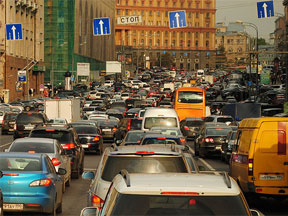
The transport system is not in a state of complete non -conflict prosperity in any major city in the world. Even in the richest and most successful of them with one or another frequency, traffic jams and crusts in public transport are observed.
Many developed countries in the world of the “clash of cities and cars” [1] successfully solve the problem of “clashes of cities and cars”. This became possible only as a result of rethinking the role of personal and public transport and awareness not only professionals-transporters, but also political leaders of that The fact that the use of cars in the city, with all its individual and public utility, is associated with much higher individual and environmental costs than traveling public transport. So, in France and Germany, priority in the movement was entirely given to buses and trolleybuses. Strips for public transport, moreover, separated by concrete barriers, in Paris forced many motorists to transfer to buses and metro. And in Berlin, even businessmen and high -ranking officials do not disdain to use the subway.
The task of the Moscow administration recently is also a solution to the sore issue of the fight against traffic jams by popularizing public transport.
Over the past year, Moscow in a European manner painted a roadway with a marking, proudly decorated with a large letter A, as part of a program for the reconstruction of the "flight" highways, a total of more than 460 kilometers for buses for buses and half -explosions is released.
However, the traffic jams on the roads that became the hallmark of the Russian capital did not disappear, and Moscow motorists still prefer to get to work by personal car. And the point here is not only that the rolling stock of public transport is uncomfortable, the routes are inconvenient, the schedules are often not respected (largely contribute to the inhabitants of the turnstiles located in the salons).
To achieve the goal of optimal redistribution of passengers between personal and public transport, the main measures of transport policy in two possible areas should be carried out, preferably coordinated:
1. Promoting the use of public transport.
the introduction of a system of high -speed trams, light metro,
Increasing the comfort of public transport (climate control, Wi - FI ),
Increasing the speed of passenger service with existing systems (the release of bus lanes, the introduction of a new system of validators, allowing to land and landing passengers faster, reduction of rolling stock traffic intervals),
decrease in travel prices, the organization of a single ticket,
Construction of new stations and metro lines.
2. Destimulating trips on personal cars:
Increasing the cost of using personal cars (parking tariffs, entering the central and cultural and historical parts of the city, gasoline taxes, for the purchase of cars),
transfer of car lanes to public transport,
Reducing the number of parking spaces in cities.
Together, these measures will contribute to an increase in both passenger traffic by public transport and the average speed of movement of people around the city (due to the fact that the roads will become freer).
Unfortunately, the Moscow authorities pursue an irrational policy, simultaneously stimulating the use of both public and personal transport. On the one hand, the throughput of the Moscow highways increases both due to the reconstruction and expansion of existing tracks, and the construction of new roads-fools; Reconstruction and construction of parallel public transport lines of roads. On the other hand, measures are being taken to stimulate the use of public transport - new metro stations are being built, lines are allocated for travel and trolleybuses.
I will explain one more point: between the conversion of the strip - the provision of it in favor of public transport (thus, the throughput of the road for personal cars is reduced) and the creation of an additional lane (construction of additional lanes for public transport without reducing lanes for personal vehicles) there is a huge difference. The method of "strip conversion" improves the conditions of public transport and restrains the use of personal cars. The method of “creating an additional strip of movement” encourages the interest of car owners.
In other words, investments are sent to two competing transport infrastructures. This fact is also confirmed by the distribution of budget costs: 59.49 % - in the development of roads, UDS and parking space against 38.9 % - in the development of public transport [2] . Thus,
Despite the nominal (political) tasks, the real (investment) priority is still given to road construction.
For a systemic solution to the problem, it is necessary to reduce auto -sex use by increasing the cost of using personal cars, shocking public transport through the conversion of the lanes, while expanding the capabilities of foot and bicycle routes. And most importantly , it is necessary to root in the general public the realization that the car owner is in the last place among the applicants for urban space, since his behavior is not only the least effective and most costly, but also directly dangerous, harmful and destructive for society.
The street network should belong to pedestrians, public transport, cyclists and city mobile services. And only if there is a place on the street - lanes for automobile traffic, provided that the obligatory technically regulated and controlled traffic rules are obliged to give way to all other participants in the movement.
Of course, the restriction of traffic traffic using special planning and engineering solutions always causes public debate. Groups lobbying certain special interests, as well as some mass media, oppose any restrictions on the interests of car owners. But here it is worth looking back at the best world experience, in which a clear “anti -automobile” focus is a common feature of the arrangement of city centers.
Many Western cities today begin to reduce the road network, destroying primarily transit overpowering high -speed driveways: they have already realized their destructiveness for the urban environment. The problem is now in the cost of their disassembly, so exotic use options arise-walking and park pedestrian zones, for example, as in Seoul, New York and Paris. In Paris, today they reduce the speed of travel with obstacles, systematically narrow the carriageway, the main auto -tacing highway of Georges Pompida is narrowed by 25%, for example, embankments are made by pedestrian. Why do we have to erect that tomorrow we will have to painfully disassemble?
There are many examples of decisions on stimulating the development of public transport. The development of the subway is not the only way out, since its "traffic jams" are formed in the subway - today 41% of the lines - 125 km - They are overloaded 1.1-1.3 times, the conditions for the transportation of passengers during the “peak” hours reach 6.0 people/sq. m With a norm of 4.5 people/sq. m. In particular, this applies to central nodal stations, intersections of radial and ring stations, as well as metro stations at Moscow auto and railway stations serving Maximum passenger traffic and do not have a reserve to increase freight ability. The result of the construction of new end stations metro There will be additional tens of thousands of passengers.
The metro must certainly function in the context with other rail systems: the suburban-city railway message and modern tram lines. Compared to the metro, the tram transports a little less passengers (20-30 thousand per hour, against 60-70 on the subway). However, the cost of building new lines is about 4 times lower than for the new metro lines, and comfort, reliability and speed [3] messages - Almost at the level of the subway.
One of the successful examples can be considered the resuscitation of the Moscow District Railway, previously used for cargo transportation. The Moscow authorities expect to increase passenger transportation by rail inside the city by 2016 by one and a half times.
Simultaneously
It is worth thinking about the optimization of passenger and automobile traffic due to factors in the placement of jobs and resident household behavior.
According to the famous Russian urbanist A.I. Strelnikova, 38% of all workplaces available in Moscow agglomeration is concentrated in the central patch that occupies only 6.5% of the nominal urban territory. This incredible concentration of jobs causes powerful pendulum flows (to the center in the morning, from the center - in the evening). Resident mobility, that is, the frequency of change of place of residence, usually taking place in connection with the change of place of work, helps to reduce the range of trips of citizens, the total transport work performed in the city, and, therefore, to reduce passenger and automobile traffic.
***
Of course, the problem of a large influx of people to Moscow is the problem of the whole of Russia, each region, regardless of its location. Everyone is eager to work in the capital, because only it gives many opportunities to earn any citizen. And transport problems should encourage our managers to start developing the regions not only in their favor, but also to the benefit of the capital. Then the problems of the movement of residents of Moscow within their city will significantly decrease about themselves.
Notes
[1] Vuchik Wukan R. Transport in cities convenient for life / Per. from English. A. Kalinin; under scientific. Ed. M. Blinkina. - M .: Publishing House "Territory of the Future", 2011. - 576 p. [2] State program of the city of Moscow "Development of the transport system for 2012-2016." [3] The speed of message on the tram: 25-35 km/h, on the subway: 35-45 km/h/h