
Translated material
The first color photo appeared on Twitter Curiosity.
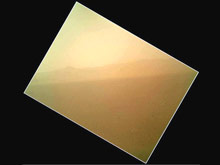
The first color photograph taken on the surface of Mars appeared on the Twitter Account, which is conducted on behalf of the Curiosity Mars. It is visible on it part of the Gale crater where the apparatus landed.
Prior to this, the Mark Road transmitted only black and white photographs in which the mountains are visible on the edge of the Gale crater, part of the Mars-Rosa itself, and the shadow of the apparatus is visible in one of the pictures.
According to RIA Novosti , the Mars -Rosa navigation chamber (NAVCAM) is posted on a special mast next to the most powerful Marshore chamber, the Mastcam double -megapixel camera, almost two meters at an altitude. Navcam consists of two pairs of cameras that can receive a stereoscopic image of the landscape. Their resolution allows you to see an object of 2 centimeters in size from a distance of 25 meters.
Pictures from these navigation cameras will be used to control the movement of the rover and its manipulator. In the near future, experts plan to calibrate the Mastcam camera.
To date, scientists have already received data from the RAD radiation detector, and also began to work with the REMS Meteoist, created by Spanish scientists.
In addition, the MRO probe (Mars Reconnaissance Orbiter), located at an altitude of about 300 kilometers above the surface of Mars and equipped with a ultra -high resolution camera, photographed the place of landing of the margin - in the picture you can see a thermal shield, parachute and the upper protective cover of the descended apparatus, the "heavenly crane" and the rover itself.
NASA employees also posted a video on YouTube, which shows the process of planting Curiosity on the Red Planet. The video is "glued" from almost three hundred pictures.
Mars Science Laboratory (MSL) worth $ 2.5 billion and weighing about a ton is the largest robotic apparatus in the history of Mars. There are ten scientific devices on board the Mars -Road, including the Russian neutron detector Dan, designed to search for ice under the surface of the planet.
The device has three pairs of wheels with a diameter of 50 centimeters. Each wheel has its own motor, the front and rear pendants are equipped with special rotary mechanisms. This allows the Markout to overcome obstacles 75 centimeters high and make a 360 -degree turn almost in place.
On board Curiosity, 10 scientific tools are installed, which will allow the Mars -making to conduct detailed geological and geochemical studies, study the atmosphere and climate of the planet, look for water and its traces, organic substances and determine whether Mars was once suitable for life, and whether there are places suitable for life now. As expected, the device will work on the planet at least one Martian year - 686 days.