
Translated material
Having evaluated the hundred days of Putin’s presidency, experts did not exclude new protests in the fall
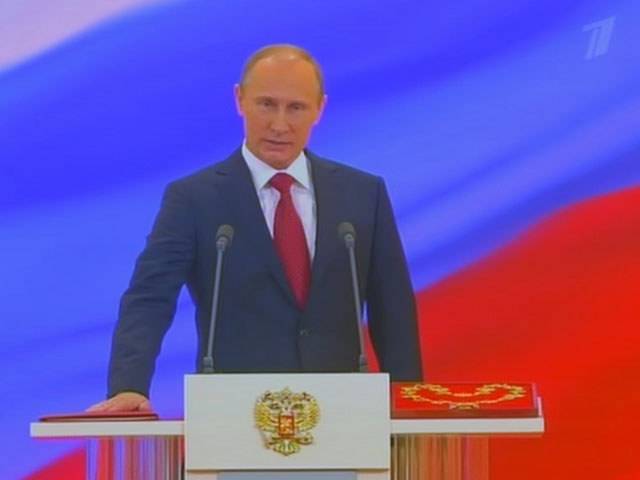
On Tuesday, there are one hundred days of the presidency of Vladimir Putin, for whom this is the third term at the highest post. Assessing his activities during the first sign, political scientists note that the head of state managed to remove the acute phase of the political crisis, but the crisis itself did not stop, it simply “got”. It is possible that the protests will continue in the fall, experts say.
The grounds are considered to be the fact that in the country, in their opinion, the middle class, according to various estimates, from a quarter to a third of the country's population, has already grown enough. And this layer categorically does not want to exist in the political and economic system that Putin has created and is trying to preserve.
Moreover, the further development of the economy as before the scenario, which does not allow Russia to develop technologically, will only strengthen the degradation of both industry and the armed forces, and all this poses a threat of state collapse if oil prices fall too much. The assessments and forecasts of political scientists collected RIA Novosti .
Under Putin, a political counter -reform began
It is noteworthy that the experts dispersed about Putin's politics in relation to the opposition. So, according to the observations of the expert of the Institute of Humanitarian and Political Research by Vladimir Slavinov, fears about the “twisting of the nuts” were justified. He recalled that the “liberal” Medvedev reforms followed the tightening of a number of laws, which clearly looks like a tough political counter -reform. In addition, the atmosphere itself has become more confrontational, the political scientist notes.
His colleague and journalist Pavel Svyatenkov also believes that "some twisting of the nuts occurred," and it was directed against the city middle class. He gives an example not only the tightening of laws, but also the arrests of a number of participants in rallies.
The CEO of the Center for Political Information, Alexei Mukhin, is on the contrary, is convinced that "the country and the political system manage to keep from frankly repressive measures regarding the so -called disagreement and protesters." "What almost everyone was suspected of Vladimir Putin, this does not happen, this is obvious. The course on relative liberalization, to untwist the nuts, is largely preserved," he believes.
Putin has no single program since election articles
However, experts did not notice the unequivocally sustained, tough political course in the first hundred days. According to Slavitinov, this does not allow to do a "double government" model with the advantage of the Kremlin. Putin mixed the functions of the presidential administration and the Cabinet of Ministers, creating a certain large government around him, in which various players and groups of influence "balance" each other. The president himself in this design remains a supreme arbitrator who makes key decisions.
Such a model is “good for Putin in that it still retains the status of a dominant player,” says Slavinov, but it does not allow us to launch a clear strategy of economic and social policy. In fact, it is not even declared, the expert indicates, noting that the theses expressed by Putin in the election software articles did not initially be a single strategy, were not united by any methodology. So they are realized now - fragmentedly, separately from each other.
Instead of developing a clear and holistic program to solve the main problems of the country, Putin has focused on maintaining his popularity from the very beginning of the presidential term. It was not to lose her the main task, standing in front of the president after being elevated for a third term, and that is why he has recently “quite regularly and persistently” fulfill his pre -election promises, Mukhin believes.
Putin was able to strengthen his legitimacy, but the crisis remains
Pavel Svyatenkov expressed the opinion that Putin "managed to strengthen his legitimacy, and the public, including the opposition, admitted through his teeth that he won the elections and is a legal president." However, this does not save from the crisis - he simply "acquired a sluggish subfloid form."
In general, as a result of Putin’s return, “we received a very interesting structural contradiction,” said Vladimir Slavinov. “In the sense of numbers - the last elections to the State Duma and the series of elections of regional and numerous surveys - they all show that Putin support 50 with a ponytail of the population. That is, the Putin majority is. But this is the majority of the paternalistic, conservative,” he explains.
“And at the same time, a sufficiently ripened and more and more awareness of its interests has arisen in Russia, which categorically does not want to exist in the political system that Vladimir Vladimirovich is trying to preserve,” the political scientist said. According to him, while maintaining the Putin majority, about 25-33% of Russian citizens "requires serious deep political changes," and the format of the proposed political reform of these people does not suit.
Tasks for the future: to prevent a social explosion and collapse of the state
The mood of this layer of society partly dictates the scheme of Putin’s further actions as president. But the main thing is that he has to make very serious efforts to make the situation associated with a significant gap in the incomes of the population does not provoke a real social explosion. Plus - you need to literally save the Russian state from collapse, which threatens it with the current economic model, experts warn.
“Putin is a lot of tasks now. And the basic task is a departure from the economic model that has been created for the past 12 years with the participation of Vladimir Vladimirovich himself, which implies an excessive support for the Russian economy for the export of raw materials to the West,” Svyenkov emphasizes.
In his opinion, “if the Russian economy develops according to the scenario according to which it is going on now, then it will accumulate significant vulnerability, because the current economic model does not allow Russia to develop technologically.” "There is degradation, including the armed forces, industry, and all this poses a threat of state collapse if oil prices fall too much," the political scientist said.
Alexei Mukhin expressed the opinion that "there is a very stringent need to formulate a new strategy for the country, so that in the context of the growing crisis in the world: financial, economic, it feels some confidence in tomorrow." Slavitinov agreed with the need to develop a clear strategy. "But it is difficult to develop a strategy in the conditions of this political structure, which should provide for certain compromises," he said.
In turn, Valery Khomyakov, CEO of the National Strategy Council, believes that the time has come to seriously engage in decentralization. “It must be understood that the vertical is powerful, it no longer works. It is necessary not to engage in the reinforcement of the power vertical, but to transfer powers to places. We must deal with decentralization, recall, in the end that we are a federal state. Vladimir Vladimirovich somehow does not say about this, although the passages were during the election campaign,” the expert said.