
Translated material
Cleaning the century
Brazil is fighting corruption
The case of Mensalander. In Brazil, a trial began, nicknamed here "cleaning the century." In the bench of the defendants - 38 high -ranking officials, bankers and entrepreneurs accused of large -scale corruption. All of them belong to the top of the ruling in Brazil for more than 10 years of the left party of workers and in the very recent past were listed as the closest associates of the Brazilians, ex-president Luis Inasiu Lula da Silva. The sentence is expected in early September 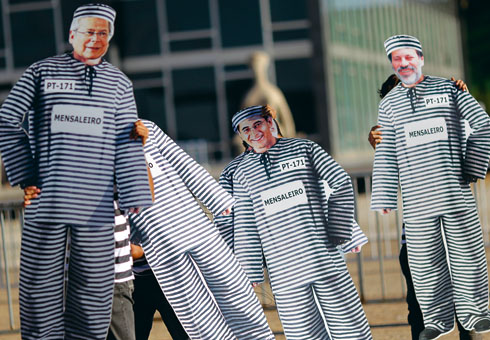
Recently, the phrase "this is our way, in Brazilian" is extremely popular among Russians. It means that both of us and there, behind the sea, where “many wild monkeys”, supposedly everything is done the same - through one well -known place. Be that as it may, a person who came up with this joke is clearly poorly acquainted with modern Brazilian realities. Brazil is not Russia at all.
Brazilians, first of all, have much more modest requests. Judge for yourself: our musician Andrei Makarevich in an open letter to President Putin complains about “kickbacks”, reaching up to 70%. In Brazil, the voices of congressmen and senators were bought, as follows from the testimony of witnesses in the process, for a symbolic amount by Russian standards - within $ 10 thousand. But they paid them regularly, once a month. Therefore, the Brazilians sharply in the language nicknamed the whole process over Mensalao corruptions-“menstruation”.
Stamp-Start
Speaking seriously, then the fundamental difference between our countries is different. In Brazil, for the first time in its entire history, they begin to judge for theft of people belonging to the political elite. The defendants in the case of corruption were, in particular, the former leader of the ruling party of workers Brazil Josa Zhoino, the main party treasurer of the businessman Suaresh, the head of the presidential administration Jose Dirsuu. (Imagine that Gryzlov, Surkov and Kudrin are sitting in our dock - can you?)
Against a group of 38 people, a total of 1089 accusations are brought forward to, first of all, the practice of direct bribery of legislators from 2002 to 2005. According to the investigation, the functionaries of the ruling party spent about € 35 million to bribes, trying to achieve a favorable balance of power in Congress (parliament). The first cabinet of Lula was swore to the oath on January 1, 2003, but the Presidential Party of Workers remained in Congress in the minority. In order to get freedom of hands, the surroundings of Lula went to bribe lawmakers. Receiving "menstruation", the deputies regularly stamped the decisions in the interests of the ruling party.
Raspberry portfolio
The trial in Brazil is investigated not only by the mechanism for bribing the votes of the people's chosen ones. Judges are also interested in data on the personal enrichment of both the political elite of the country and entrepreneurs and journalists close to it: about the large -scale laundering of money, tax evasion, fraud, inappropriate use of public funds and much more, which is included in the concept of “corruption”. So, the focus of the prosecutors was Eduardo Duda Mendons, who led the PR campaign Lula da Silva in 2002. During the investigation, he admitted that the party of workers posted the most funds for the services rendered in his bank accounts in offshore zones. Another important person involved in the case is a certain Marcos Valerio Fernandez, who had the nickname "Man with a suitcase." It was he who delivered cash to the deputies of the parliament, although not in a box from under a photocopy, but in an elegant leather briefcase of raspberry color. Senor Fernandez did not forget about himself: in the period from 2003 to 2004, his personal condition increased more than 60 times! 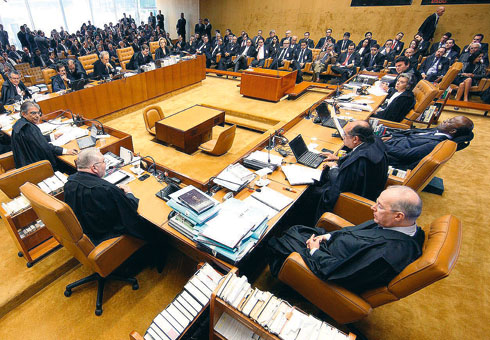
In 2005, against one of the already involved in the defendants in the case-Jose Dirsuu, the head of the administration of the President of Lula, an administrative charge was already brought forward, which led to his resignation in 2006. However, to collect all the facts of corruption, to interview all witnesses (there are about 600 in total) and only now it was possible to start the process. And if the fault of Dirsuu and his accomplices from the top of the party of workers - the main conductors of the corruption scheme will be proved, each of them faces a prison conclusion for up to 45 years.
Family dream
The Brazilians are watching the “cleaning of the century” with great interest, not yet believing that the matter will come to the conviction. Corruption in this country throughout its history was the same integral part of life as a carnival or sex on the beach. And the Brazilian crooks and thieves never expected a serious punishment, even if they were in the ruling party, even in the opposition. And if someone was removed from the authorities for faciality, then by law a guilty politician could return to public service after eight years. Here are just a few examples. The ex-governor of the Brazilian state of San Paulo, a former presidential candidate Paulo Maluf, has been looking for Interpol for many years on charges of theft and bribery. But, despite the accusations brought against him in the United States, he continues to be a deputy of the Brazilian parliament. Former president of the country Fernando Afons Color Dee Melu in 1992 voluntarily resigned to avoid the impeachment process. But now he is a senator. And with the name of his father Arnon di Melu, the most bloody drama in the history of the Brazilian parliament is generally connected. On December 4, 1963, Arnon, a deputy of the parliament, approached the tribune, which was his party comrade Sylvester Perikl, and killed him with three shots from a pistol. But until the end of his life, Arnon was not only not prosecuted, but also continued to remain a senator - he died in 1983 in his bed, and not on prison bunks. "
For Brazil, where a politician can kill a person and not be arrested, the process of Mensalao is an unusual and positive signal
”The well -known Brazilian writer Joao Ubaldo Ribeiro says with bitter sarcasm of the corruption and impunity of politicians.“ Every Brazilian family, ”he wrote in one of his essays, dreams of having at least one unclean politician who could solve all the problems.” The Brazilians want the authorities to finally begin to be responsible for their actions, so that those who steal are put in prison.
Million march
Although the first accusations against the closest associates of the ex-president of Lula were made back in 2005, he himself ended his second presidential term in 2011 with a trust rating of 87%! The nation was grateful to him for many social promises - for the built hospitals, roads and aqueducts, for the fact that he pulled out millions of fellow citizens from a vise of poverty, having developed and launching the Microfinancing Programs for former inhabitants. No, the prosecutors have no complaints about the Lule itself. But you need to face the truth: the process that has begun calls into question his political heritage. And not only. “Honestly, many in the country have doubts about Lula's personal honesty and infallibility,” Brazilian journalist Fernando Coutinho admits a conversation with The Nw Times.
However, his successor, the current president of the country Dilm Russuff, helps maintain the reputation of Lule. For a little more than one and a half years, who passed after her victory in the presidential election, she fired seven ministers of her office and other high -ranking government officials who, to one degree or another, were involved in corruption. And most importantly - with its full support this year, the so -called "Law on Pure Personal Affairs" was adopted. From now on, candidates can only be allowed to participate in the primary elections with an impeccable biography, and special commissions will be verified by checking them. For the first time, the law, the initiators of which for the first time in the history of Brazil were ordinary citizens - a million (!) Signatures were collected in its support, will be applied in practice in the elections to local authorities this fall. However, the “acting” political elite will also not stand aside: the law prohibits politicians of all levels-members of the government, senators, deputies, Alcaldam-to occupy state posts if they have ever been prosecuted. Almost 2 thousand people can fall under the ban, and in particular, 25% of the deputies of the federal parliament. And if, according to the old law, officials who passed through arrest and prison could automatically return to the civil service after an eight -year -old quarantine, now only the Supreme Court can justify them. And for this procedure, Brazilian experts are sure, can leave for decades. 
True, Dilma Rousseff was not immediately able to drag the law through the Congress, even having the support of a million fellow citizens. At first, the courts torpedoed the bill under a far -fetched pretext - supposedly he is contrary to the presumption of innocence of any politician. But - Dilma won.
“Now in Brazil the word“ Mensalao ”is on the lips,” comments on the process in a conversation with The New Times, Joao Augusta Di Castro, a consultant in Latin America from the Eurasia Group consulting group. - For a country in which a politician can kill a person and not be arrested, "cleaning the century" is a very positive signal. " However, Di Castro is stipulated, it all depends on what conclusions the court will come to: “An acquittal will give the nation to understand that politicians in the country are still not subject to law, but the indictment can completely change the Brazilian political culture.”
Brazil is a federal presidential republic, with strong powers of the state authorities. Presidential elections in the country are direct and pass simultaneously with the election of state governors. The parliament (Congress) is chosen separately, although the elections often are adjacent to the presidential - in 2010, for example, the president was chosen at the end of October, and Congress at the beginning of the same month. Senators (there are 81 people) and deputies of the House of Representatives (513 seats) are also elected for four years. So the two branches of the authorities work in parallel.
Now the Party of Workers has a relative majority in the lower house of parliament - it has 88 seats, the closest competitor has a centrist party of the Brazilian democratic
According to the consolidated corruption level, compiled by Transparency International, Brazil in 2011 took 73rd place in the world. The least corrupt country in the Western Hemisphere is Chile-22nd place. On the 24th are the United States of America. Russia takes the 143rd place in the list, sharing it with countries like Nigeria and Belarus.