
Translated material
25 years without an ordinary miracle Andrei Mironov
25 years ago, on August 16, 1987, Andrei Mironov was gone. As a truly great artist, he died on stage: in the final of the play “Crazy Day, or the marriage of Figaro”, barely agreeing on a replica, unconscious to the floor. Later, doctors diagnosed extensive hemorrhage in the brain. The cause of the tragedy was a tremendous voltage in which the actor has been in recent years. In a sense, Mironov killed himself, not knowing how to do anything in half as, working for wear, endlessly speaking on stage and acting in the cinema, completely giving himself acting, which he preferred to call fate. 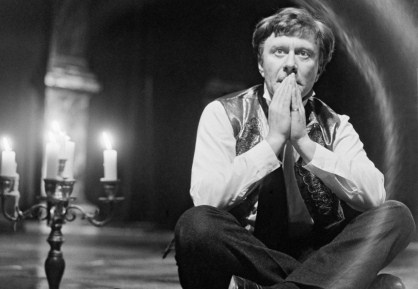
The key phenomenon in the fate of Andrei Mironov was the scene: he died on the stage, spent most of his life on the stage, on the stage, one might say, was born. On March 7, 1941, his mother, actress Maria Mironova, was taken to the hospital right in the middle of the speech. The date of birth was recorded on March 8, to make the fact that the newborn is a festive “gift to all women”. The joke turned out to be a prophecy: over time, Mironov became almost the first actor of Soviet cinema according to the number of fans.
It's hard to believe, but at the dawn of an acting career, being a student of the theater school. Schukin, the future idol of millions did not stand out with anything special, was a young man in quiet, shy, pimple and hollow. Patience, effort and work have done their job. The first performances at the Satire Theater, where subsequently Mironov served a quarter of a century, the roles in the ribbons “My Younger Brother” (1962), “Three Plus Two” (1963), “Beware of the Car” (1966) and, finally, “Diamond hand” (1968) firmly fixed the image of a charming, slightly plumber -eyed handsome man.
In the minds of the Soviet layman, the actor embodied the image of a “foreign person”. He always dressed elegantly, had elegant manners, drove BMW, passionately loved Jazz and Frank Sinatra, often, even by current standards, traveled abroad. Most friends and acquaintances spoke of Mironov as a merry and balagur, a drawer of a draw and a pijon. But at the same time they added that “he was a very lonely person,” constantly tormented by doubts, not as often laughed as he cried. External gloss and ease, the image of a person-festival, were given by incredible labor.
Without exaggeration, Andrei Mironov, was the most famous and beloved actor in the USSR. Sometimes we do not attach importance to how much his image and his work entered our lives, because neither our cinema, nor our theater, nor even our epic, in the best sense of the word, are unthinkable without it. Which of us did not look at the "Diamond hand" holiday? Who has not heard a strange song about a butterfly, which is “wings of Byak-Bayk-Bayk-beac”? And which of us from time to time does not repeat the golden words spoken by one of his heroes about how to “take a bath” and “drink a cup of cofe” now?
To this day, the best of the images created by Mironov are familiar to everyone. At the same time, the spectrum of his work is unusually wide. He played cynics and altruists, adventurers and romantics, lovers and heart -eaters. Millions remembered the images of the elegant smugglers of Kozodoev in the “Diamond Hand” and the small speculator Semelov in the “Beware of the car”, the great combinator Ostap Bender in “12 chairs” (1976) and the great comedian Jerome K. Jerome in “Three in the boat” (1979). Meanwhile, there was still the role of the great revolutionary Friedrich Engels in the film “Year as Life” (1965). Mironov’s voice was said by the main animated intellectual pacifist Cat Leopold and his militant antagonists white and gray mice. In the theater, the actor’s business card were heroes, whose name became synonymous with controversial and worship: Don Zhuan and Figaro. But the actor himself was closer to the roles of strange little people, dreamy eccentrics, like autistic Pharyvyev in Fantasies Pharyvyev (1979/1982) and selfless Johnny Feost in the “man from the Kapucin Boulevard” (1987). But whoever Mironov played, fantastic charm and unsurpassed professionalism remained unchanged in any role.
In an effort to overcome the role of a comedian and a merryman who has established behind him, Mironov added shades of tragedy to his most sparkling roles. He combined incompatible things, thanks to which he revealed the usual images in a new way, filled with unexpected features familiar characters. So, he made Khlestakov a deeply tragic character, and Grushnitsky endowed the qualities of incorrigible romance. Perhaps, only closer to the end of his career, he was able to realize in roles that are truly close to himself. For example, a quiet intellectual in “Be my husband” (1981) and a self -forgotten scientist in the “blonde around the corner” (1982/1984). The cornerstone and, perhaps, the best, was the role of journalist Khanin in the drama of Alexei German “My Friend Ivan Lapshin” (1982/1984). The hero of Mironov is outwardly cynical and relaxed, vigorous and independent. But inside it is full of longing and despair. To the surprise of the viewer, the actor does not sing and does not dance here - he unsuccessfully tries to commit suicide and writhes in the mud, ridiculously pushing himself at the fink of the criminal.
The parables of the actor, his restless desire to achieve perfection, became the parables in the tongue. The well -known enchanting dance on the deck from the "diamond arm", performed with such ease and ease, was worked out for weeks. The dashing tricks that Mironov gives out in the “Harvest of the Republic” (1971) and in “Incredible adventures of Italians in Russia” (1973) were made without an understudy. Being a theater director, Mironov brought his actors to exhaustion at rehearsals, but always sought the desired result. He worked at the limit of his capabilities and demanded the same from his colleagues.
They say that Mironov was completely devoid of musical hearing, but probably performed the most famous songs of Soviet cinema. Here is the “island of bad luck” from the “diamond hand” and “my sail” from the “12 chairs”. In the “Ordinary Miracle” (1979), he sang the most ambiguous song of Soviet cinema - about the already mentioned unfortunate butterfly, ruined by an evil sparrow. But there, one of the saddest melodies of the Soviet screen, “Farewell Song”, with the words: “Let's quietly / let's forgive the brightest, unexpectedly sounded there. / Week, different, / and we will calm down, / What was, it was, passed. "
The best roles of Andrei Mironov are the roles of people who have a dream. Only this dream, as a rule, alas, does not come true. Either the heroes swing into something unattainable, or something external interferes with them. Mironov, although he himself admitted that it was a sin to complain about the number of roles in the cinema or in the theater, he did not fully realize his dream. During his lifetime, he did not receive proper recognition as a dramatic actor, he did not play many of the desired tragic roles, for example, Hamlet or Oblomov. But in the memory of millions, he still remained a charming romantic, a person who is giving his energy, incredibly sincere and relentlessly following his goal.
Five main images of Andrei Mironov in the cinema:
01 . Elegant smuggler Gesha Kozodoev in the " Diamond hand " (Leonid Gaidai, 1968)
The most famous role of Mironov, who made him a favorite of the public. It has a complete set of everything that other directors later tried to reproduce in the actor. There are memorable songs, and phenomenal dances, and aphorisms that have gone into the people, and charm incredible for a negative character. But if you still think deeper into the image of Kozodoev, no matter how ridiculous it may seem, then here you can see both the traditional critical bifurcation for the heroes of Mironov and deep tragedy. Some in a word, even a crook by a great actor is not so simple, and, perhaps, this is the secret of a popular love for this hero, and for this picture.
02 . Journalist Khanin in “ My friend Ivan Lapshin ” (Alexey German, 1982/1984)
The most non -standard, but the most important role of the actor, probably because it was here that the real Mironov was manifested to the greatest extent, such as no one knew him. The hero of the radiant vaudeville fell into a gloomy picture of longing and despair, but, in an amazing way, looked completely organic there. Director Alexei Herman loves to poison stories about what torment of hell had to go through the actor in this picture. So, he was terribly afraid of the performer of the role of a criminal who, in the plot, attacks Mironov with a knife, because This man was indeed the views of the criminal. And in order to make the necessary makeup in this scene, Mironov had to be smeared with his face in shit. Twice.
03 . Johnny Feust romantic in “ Man with Kapucin Boulevard ” (Alla Surikova, 1987)
The last finished role of Mironov in the cinema. The actor appeared in the image of a romance, fascinated by the magic of the newly emerged art of cinema. In one of the interviews, Mironov said this role: “Employed by the throat, I could not refuse the role of Fyst ... because of the noble idea, the character of the hero. Something bribed me immediately in Feest, made friends with him. And the fact that he is in his own way Don Quixote, and that, if I can say so, he is not just an eccentric, but a very peculiar happy loser or an unsuccessful lucky one ... "
04 . Cynical Minister in the " Ordinary Miracle " (Mark Zakharov, 1978)
Another of Mironov's most famous roles. The actor plays a cynic and a misanthrope, is important, cuts, magically soar into the sky and performs the famous song about a butterfly and a sparrow, which, according to Mark Zakharov, "anticipated a sexual revolution in Russia."
05 . The hopeless dreamer of Faryli in the Fantasies of Pharyeva (Ilya Averbakh, 1979/1982)
The role of Faryryeva was the first truly dramatic role of Mironov in the cinema. Director Ilya Averbach saw in Mironov something more than Balagur and Lovelas, and dared to destroy the established role of the actor. The latter appeared on the screen by a deeply unhappy, forever lonely little man, not adapted to life, panting in the stuffy reality and hopelessly drowning in his dreams. The first viewer was puzzled, and it took time to appreciate the picture.