
Translated material
75 years to the "elevating deceiver" Andrei Konchalovsky
August 20, 2012 marks 75 years old Andrei Konchalovsky. Despite the impressive age, one of the largest modern domestic directors, glorified not only in their homeland, but also abroad, is still active, cheerful and favorably differs from his familiar relative with common sense and adequacy. In addition, Konchalovsky continues to work on new projects in the cinema and in the theater, writes articles and leads a blog, where he recently experienced a political performance. 
Fate did not offend Konchalovsky, giving him in life, it seems, everything that a person can dream of. He was born in a more than prosperous family of honored Soviet poets, Sergey Mikhalkov and Natalia Konchalovskaya. His childhood was happy. He made the choice of his life path on his own. Konchalovsky’s VGIKOV teachers were masters of Soviet cinema, like the legendary Mikhail Romm, and friends were the most talented people of that generation: Andrey Tarkovsky, Andrei Smirnov, Gennady Shpalikov. In the life of the director there was an innumerable number of novels: a rare actress of his films, did without increased attention. Five times he was married, and today it boasts seven children and eight grandchildren. 
Konchalovsky rarely had a shortage of work, and most of his paintings enjoyed recognition. The filmography of the "lift deceiver", as he calls the great directors, is impressive with its vastness and diversity. In his career there were loud discoveries and unexpected turns, significant successes and annoying failures. Konchalovsky is famous for his ability to combine incompatible, to be dual, but consistent. Working in a variety of genres and formats, he always retained an individual creative emphasis, skill and a sense of taste. Rarely compromises, he found a place in the Soviet system of film production, and in the Hollywood and in modern Russian. 
In his works, Konchalovsky combined realism and surrealism, philosophy and action, children's fairy tale and adult horrors, author’s vision and mass taste, the coldness of a professional and the ardor of the artist, and finally, the crushing and eternity. The debut full -length “First Teacher” (1965) was a revolutionary parable. Weaved in the “Romance of Lovers” (1974) elements of the rebellious rock opera and ura-patriotic agitation, the plot passages of the “Sherburg umbrellas” (Jacques Demi, 1964) and “Soldier of Ivan Brovyna” (Ivan Lukinsky, 1956), Konchalovsky sang the hymn of the love of young hearts and valor of the Soviet army. The state criticized for “formalism” its exquisite film adaptations of Russian classics, “noble nest” (1969) and “Uncle Vanya” (1970), while a certain Charles Chaplin called Konchalovsky “great director”. The Soviet intelligentsia scolded Sibiriad (1978), accusing the author of "corruption of the Bolsheviks", and in the USA the tape was studied in film schools. This four -hour epic about oil workers and the Russian people was erected to the status of “state orders”, while a decade earlier “History of Asi Klyachina, who loved and did not marry” (1967/1987) was subjected to a categorical prohibition. 
Having emigrated in 1980 in the United States, the director maneuvered between chamber psychological dramas, such as “Beloved Mary” (1984) and “bashful people” (1987), and “existential militants”, “Train of the Fugitive” (1985) and “Tango and Cache” (1988). After returning to his homeland in the early 90s, Konchalovsky turned to painful topics of Russian history in the “Middle Circle” (1991). Then he switched to modernity in the “Ryaba Kurochka” (1994), “House of Fools” (2002) and “Gloss” (2007). The analysis of the quirks of Russian reality alternated with work on large -scale international projects based on myths and legends, television series Odyssey (1997) and Leo in winter (2003). The director’s world recognition did not shake even a phenomenally failed “Nutcracker and Rat King” (2010). The free film adaptation of the Hoffmann not only caused universal bewilderment, but also competed in idiocy with the “tired sun-2” (2010, 2011), the ourselves of knowledge. But the director confidently proved: the only thing that is categorically does not combine in the cinema is a fairy tale and Nazism.
In his memoirs, Konchalovsky openly admits: "I love myself ... I adore myself." And, it seems, there is something. He was successfully implemented in his career, and, as they say, in his personal life. At the same time, for the eighth ten years, he did not survive the mind and still retained gunpowder in the powders. The secret is probably that he was always extremely sincere with himself. In particular, the cinema shot as he considered fit, that is, investing the soul, intelligence and skill.

5 films of Andrei Konchalovsky, who are worth watching:
01 . “The story of Asi Klyachina, who loved, did not marry” ( “Asino happiness” ) (1967/1987) 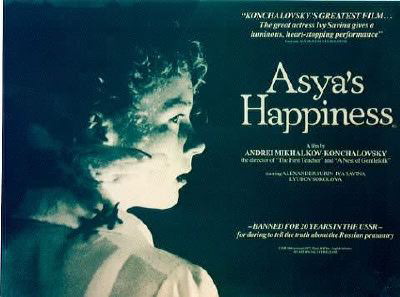
Probably the best tape in Konchalovsky’s filmography. Completed in the revolutionary style of hyperrealism at that time, the picture was sent “to the shelf”, and reached the viewer only twenty years after the creation.
“I think that the effect of“ Asi ”on the sophisticated viewer was to rely for a simple reason. Accustomed to socialist realism, to a certain manner of the image of life, people saw reality. Just a real Russian life, as it is. And it shocked. For this life was pure and bright and at the same time pierced with her pain, with her poverty, and her frozen. ”
Andrey Konchalovsky
02 . "Siberiada" (1978)
A giant film -romance comparable in scale except perhaps with the “twentieth century” (1976) Bernardo Bertolucci. A rare and instructive example of how an official order, if there is a talent with the contractor, can become a masterpiece.
“... the picture was not only not“ state orders ”, socialist, but initially alien to official ideology. It was a story about how technical civilization kills culture, nature and man ... I once again proved to myself “Siberia” that there are no boring stories, everything can be the subject of art - the story of a party member, any official topics. Interpretation, interpretation - this is what art lives. The directing profession is primarily the art of interpretation. ”
Andrey Konchalovsky
03 . "Bug train" (1985)
The most successful picture of the American period of Konchalovsky’s work. The director managed to make an intellectual militant, supplementing the exciting history of the Eaten Crimparrons with the lines of Shakespeare.
“The train here is a symbol of the era, the embodiment of a digging out of the control of civilization. At the same time, the narrative is witty ... It is strange that many perceived the “Bug train” as the film typically American ... What an American film is when a person in response to the words: “You are an animal!”, Says: “No, worse! I am a person!” ””
Andrey Konchalovsky
04 . "Odysseus" (1997)
Konchalovsky made the almost three thousand -year -old epic Gomer's epic fascinating and accessible to the modern viewer.
“We wanted to make this story understandable to everyone. Odysseus - husband, warrior, leader, man, father, son. He has a mother, he has a wife, he had a son. He has friends, there are enemies. There are responsibilities - to the family, to the tribe, to the country. He goes to war - such is his duty of man, warrior, leader. He is fighting, becoming a hero. Mother is waiting for him. Waiting for a wife. The son is waiting for ... absolutely understandable earthly things, and today as obvious as in any previous times. “Odyssey” may well occur today. This is a person’s journey to himself. ”
Andrey Konchalovsky
05 . "House of Fools" (2002)
The phantasmagoria about the madhouse, symbolizing modern, and, perhaps, to always Russia.
“In the“ House of Fools ”I was interested in the aspect of Chechen events, neither to the military, nor to the political strategy and tactics, I did not directly have a relationship ... We did not want to shake the audience either with the horrors of war, nor the singing of heroism of any of the parties. The most important thing was to lead the audience to the simplest and most necessary truth at all times: a person should and may remain a person in the most difficult circumstances. ”
Andrey Konchalovsky