
Translated material
Social Deputy Prime Minister Olga Golodets promises a “neat” completion of pension reform and individual pensions for the middle class
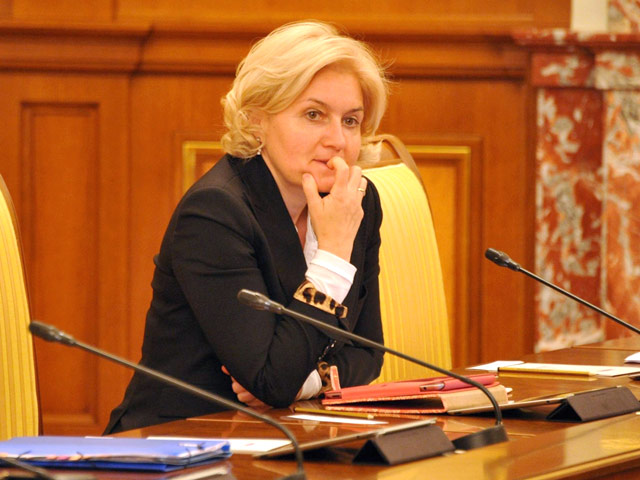
The Deputy Prime Minister of the Government of the Russian Federation Olga Golodets told the Kommersant newspaper, what tasks the authors of the new project of the development strategy of the Russian pension system have to solve, which is planned to be completed before October 1, 2012.
Among his main tasks as deputy head of government, Olga Golodets also calls the balancing of the pension system by launching a separate funded system for the middle class, bringing labor relations to the modern form and the “neat” completion of already begun reforms.
The amount of funds that enter the Pension Fund (PFR) does not correspond to the volume that people receive. In the PFR, only 48 million people are regularly and in full, and this despite the fact that in Russia there are approximately 87 million residents of working age. This Olga Golodets considers one of the main problems of the current pension system.
The reason for the "unbalance of the system" she calls early retirement. Recall that, in accordance with the current laws, hundreds of categories of harmful industries, military personnel, law enforcement officers, residents of the northern regions of the country and so on have the right to go earlier for a well -deserved rest.
"Emergency pensions will unbalance the system: the tariff that is transferred to employers in this category allows you to pay a pension of 40% of the substitution coefficients, starting from the retirement age, from 55 years old. But when a person goes to this pension, there is a deficit. It is necessary either an additional tariff or a change in rights. The Ministry of Labor and the Pension Fund are located in negotiations with trade unions and employers about which direction to move. ”” says Deputy Prime Minister.
Currently, negotiations are underway with employers on the organization of corporate pension systems and possible options for their support from the state. This, in particular, is a preferential taxation of funds allocated to pensioners.
However, not only people to the state, but also the state are underpayed. The higher the salary of the future pensioner, the greater his disappointment will be when the time comes to receive a pension. But the FIU contributions received by the law received all the premiums.
"Now in the pension system, the problem for the population with an annual income to an average level has been relatively resolved, up to 513 thousand rubles. Today, the pension is 9.7 thousand rubles on average in the country. However, a pension of 9.7 thousand rubles is absolutely insufficient if you have a salary of 100 thousand or more ... Now there is a" elimination point "at the rate of social contributions. 513 thousand rubles a year, after which the tax rate of the tax tax rate It is reduced from 26% to 10%.
About the increase in the rate of contributions to the FIU, according to the Deputy Prime Minister, is not yet. The accelerated development of voluntary accumulative systems should solve the problem, which should provide people with high wages with a solid increase in the state pension.
At the end of June, it became known that the Ministry of Finance of the Russian Federation intends to offer the Government of the Russian Federation to reduce the number of categories of citizens receiving early pensions and transfer the obligation to pay early pensions from the state to employers.
And in mid -August, the Moscow authorities thought about the problem of pensions, which made only to indigenous Muscovites with the initiative to pay full -fledged “capital” pensions.