
Translated material
Prosty snakes prefer relatives
Snakes are poked by asocial animals; If there are relationships between them, then for the most part hostile. They do not even remember and do not recognize kinship. This is a common opinion about snakes is refuted by the research of American biologists conducted under the leadership of Dr. Rulon W. Clark from the University of San Diego and Harry W. Greene, professor of the Faculty of Ecology and Evolutionary Biology of the University of Kor-Nelskiy.
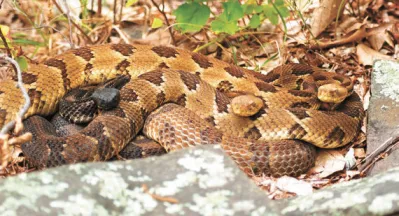
Scientists worked with striped rattles of Crotalus Horridus. For some reason, the Americans love explosive snakes. Winter C. Horridus is carried out in burrows, in hibernation. In the spring they awaken, warm up for several days in the sun, and then spread out to return and fall asleep for the winter in the fall, often in the same hole. They have a very developed philopatrium - love for their native places. Pregnant females do not crawl anywhere, but spend summer in the "family nest", hold in groups, combined in the sun. Researchers suggested that snakes gather in groups according to a related principle. To check their hypothesis, they took tissue samples from 29 pregnant women C. Horridus of 12 groups, and in spring and autumn the material was collected from the rattles of different sexes and age, crawling together for hibernation. Scientists established the presence of related connections between snakes by analyzing their microsatellite DNA (short repeated sequences).
It turned out that on a related basis, young rates of both sexes are united for hibernation, most likely, young people from one masonry. Among the relatives, the summer and pregnant females are conducted. These are the most vulnerable categories of C. Horridus , and in such periods when it is vital for them to stay together, they prefer to be among their own. The most good reason for unification is thermoregulation. Young snakes are more sensitive to the temperature difference than adults, since they have higher the ratio of the surface of the body surface to its volume. Pregnant females also have special temperature requirements: it should constantly be high. It is easier to adjust the body temperature to snakes together than one by one. Here, much depends on the position of the animal in the ball, it needs to be changed regularly, for which the group should act in coordinated, and, perhaps, for some reason it is easier for relatives to interact. Females who are heated in the sun are open to the eyes of predators. It is possible that C. Horridus, defending himself from enemies, coordinate actions, distinguishing special pheromones.
In scientific periodicals, reports on the social life of reptiles appear from time to time. The researchers have already found the simplest family relationships in the Emydocephalus Annulatus sea snake, the ordinary copper Coronella austriaca, and some species of vipers. The work of American biologists is another link in this chain. The social life of the snake is not striking, because they do not attract each other's attention with gestures, loud sounds and bright colors. Most likely snakes communicate using chemical signals.
So there are more social animals than it seems. Researchers hope to discover hidden related interactions with the help of molecular genetic approaches.
Natalia Reznik
Rulon W. Clark, William S. Brown, Randy Stechart, and Harry W. Greene Cryptic Sociality in RatTlesnakes (Crotalus Horridus) DETECTEDED BY KINSHIP ANALYASIS BIOL. Lett. August 23, 2012 8 523-525; Published ahead of Print February 22, 2012, Doi: 10.1098/RSBL 2011.1217