
Translated material
Syrian symposium - from the past to the future
Syrian language is subtle matter. Its carriers in the world are few, most people know nothing about its existence, others consider it a dead language, and very few are professionally engaged in it. There are only about three hundred people in the world, and they know that Syrian is a special Aramaic dialect.
That is, the language that Christ spoke with the apostles, on which the Talmud was written and on which most of the Persian Empire from the Achaemenid to the Sasanid era spoke.Simply put, Syrian is a Christian Aramaic, East Semitic language, one of the six main languages of the non-Greek Christian East, along with the Coptic, Arabic, Ethiopian, Georgian and Armenian.
In the II-XII centuries. Christians who spoke Edessa (from the Greek name of the Syrian city of Urch - Edessa) dialect of the Aramaic language created great literature and a very serious cultural tradition. In the heyday of the heyday, it was called the "Syrian", Suryaa or Suryóyo.
The fact that Syrian is sometimes called the language of the inhabitants of the state of Syria is a misunderstanding.Modern Syrians speak the Syrian dialect of the Arabic language. However, in the village of Maalula in Syria, you can still hear the dialect of modern Syrian - Turoo, although it is also a special language that is different from an ancient, sometimes called “classic Syrian”. There are carriers of modern Syrian in Eastern Turkey (region of Tour Abdin), in Iran and Lebanon. Syrians live in Sweden, in Russia, in America and in Australia.
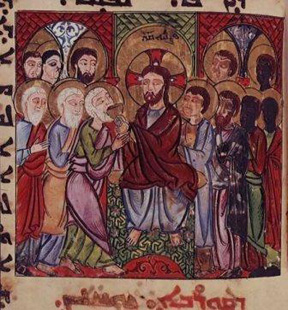 Ancient Syrian miniature
Syrian research in European science began for a long time, already in the 16th century. In Paris, the famous Bible of Polyglotta, which included the Syrian text of Scripture, was printed. A large breakthrough was made in the 17-18 centuries. Thanks to the activities of the Syrian, Stephen, Evodia Al-Simeani, known as the Latin “nickname” Assemani. In the 19th century The departments of Semitic languages in Europe opened, the training of students with a degree in Syrian language began, magazines began to be released. At the same time, the Catholic structures in the Middle East, primarily in Lebanon, contributed to the creation of centers and magazines on Syrian topics. Specialized ongoing publications began to be released, and Syrian problems became an important part of the oriental forums and conferences.
In 1972, the first Syrian symposium gathered in Rome. Since then, such symposias of syarologists (as it is customary to call specialists in the Syrian language) gathered every year. Until 1995, they gathered in Europe (Cambridge Groningen, Luven, Uppsala), then two symposiums took place in Australia (Sydney) and in Lebanon (Kaslik). In 2008, the syrologers returned to Europe and gathered in the Spanish Granade, where one of them took the post of bishop of this city. Finally, this year the symposium gathered in Malta, in the capital of this country Vallette. Such a place was chosen at the proposal of a professor of local university Martin deputy minute. There is no syrological science in Malta, and the local university does not prepare syrup. The fact is that in parallel with the Syrian symposium (more precisely, immediately after it), another small but important forum of researchers of Christian-Arabic literature is held. And the Arabic language in Malta is studied very intensively: after all, the local language, the Maltese, is a mixture of the Maghribian dialect of Arabic and Italian and English. That is why this year both the Syrian symposium and the Arab conference were held in Malta.
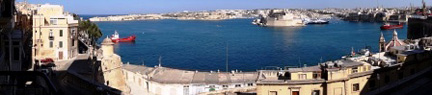 Malta. Valletta
  Sebastian Brock
Compared to previous symposiums, several things are noticeable. Firstly, there is a change of generations of scientists. The elders, who set the tone in 1972, left, and the main aksakal of syrology (albeit without a beard) was the English researcher Sebastian Brock, who celebrated the 75th anniversary this year. Secondly, it is noticeable from the symposium to the symposium to increase the number of ethnic Syrians performing at the conference. For them, a symposium is not only a scientific platform, but also an event to maintain its own national-cultural identity.
The most striking figure of the conference was the researcher and publisher of the Guevargis Kiraz, the deacon and the popularizer of the Syrian language living in America. I heard him spoke in Syrian with his little son - amazing devotion to his culture! Thirdly, the current symposium includes much larger than topics related to the use of computers and in general information systems in syrology. There are computer databases, and the Syrian Implement in existing language standards (for example, unico), and the creation of text buildings, and much more.
For example, syrologers forced the great and mighty Microsoft to include Syrian in the number of standard Windows languages, well, is this not an achievement?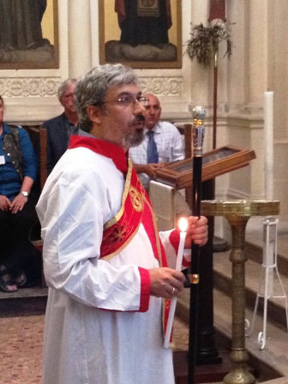 Guevargis Kiraz
Finally, one cannot fail to note with a sense of patriotic pleasure that the number of Russian participants rose to six people. More recently, I remember that I was the only representative of Russia. Not all Russian scientists live and work in Russia, but the fact itself cannot but rejoice. Syrology in Russia is relatively young: before the revolution, such scientists as V. Bolotov, A. Dyakonov, N. Meshchersky, P. Alyavdin laid some foundations of discipline, but after the revolution the St. V.V. Pigulevskaya, the students of which continued her case in 1970-80, remained almost the only symbol. The most famous of them is E. N. Meshcherskaya. In Soviet times, syrology, like the whole study of the Christian East, fell victim to the anti -religious struggle: libraries have not been completed, students have not been taught ... But now Russian syrologers are working on the international arena at the level of their European and American colleagues. This is the result of globalization, by the way, no matter how much scold it. In the early 1990s, it became possible to go to work and study in Europe, contacts began, now there are even Internet conferences, mini communities in Facebook and LiveJournal. The world narrowed, scientists became closer. For example, the conference was performed by the Syro-Catholic Patriarch Ignatius and said several bitter words about Syria: Christians feel the threat of “Arab spring”, feel trouble, rebels destroy ancient monuments, war buries the centuries of culture in Syria. Scientists heard him ... and thought about the connection of science, culture and politicians. Someone even shared his thoughts on the network.
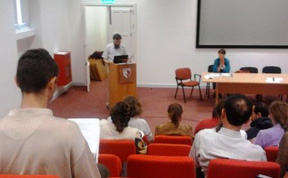 During the symposium
Syrologists try not to lose sight of each other-after all, there are actually few of them. For mutual communication, in addition to the Internet, they organize different small conferences, try to contribute to the inclusion of Syrian themes in the conference on Byzantinism or in the Middle Ages in general. Of course, on the part of academic chiefs around the world, an understanding of why all this discipline is needed and what is a good from it is a rarity. Most often, syarologists are considered eccentric. They are engaged in the Christian East, but do not fit into the “church” discipline, because the Syrians for the most part do not belong to either the Greek-Russian Orthodox world, or to the Western Catholic. They are close to Arabistic, but they are very few of the Qur'an and Islam. Therefore, even on your symposia, you have to collect with the world along the thread, to throw off the whole world. However, the joy of seeing many colleagues who have not seen four years, much more sadness about high contributions for participation. In the end, science is not only research, it is also a social environment.
The next CoMPOPPOMENUM will be held in Rome. There is a hope that we will live before the Co -Poposium of Syrologists in Moscow - but we must work for this. We need a scientific school, we need infrastructure to invite poor colleagues to the capital, you need a will and much more. But the main thing is that you need to work in the direction of the development of our scientific tradition. It is already inconvenient to show the shadows of the past, to boast of scientists, whose affiliation includes Oxford, Marburg, Gettingen, and not Moscow and St. Petersburg, are also not very decent. But syrologers hope for the best, because they are used to working with large time periods - for them that II, the XII century. - equally an object of interest and research. After all, the experience of creating your small corner in the world is an important experience in the sense of a social organization. When we create our own small circle, closely related to others, having educational and scientific meaning, we participate in the enrichment of the institutional palette, we connect the domains. In the era of universal discretion, this is very useful.