
Translated material
Why is it still worth producing oil in the Arctic?
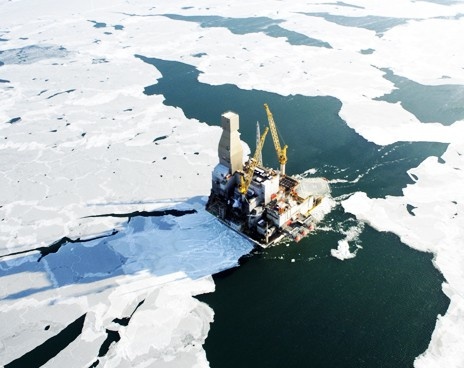
All week the dramatic confrontation between Greenpeace activists, who attacked the Prirazlomnaya oil platform in the Pechora Sea, with employees of Gazprom Neft Schelph, poured them with ice water from the Brandspoits, trying to dump uninstalled guests at sea and so on. The bright action Greenpeace is part of the global campaign deployed by this organization against the industrial development of the Arctic. Now Greenpeace on its website collects signatures under the call to “save the Arctic”, demanding, in particular, to completely refuse to extract hydrocarbons in this region. Typically, the author of these lines refers to the opinion of ecologists with proper understanding and support. Environmental protection is a key condition for ensuring normal living conditions in the modern world and preserving it for future generations, and environmental organizations do a lot to attract public attention to the problems of nature pollution and the search for solving these problems. In particular, we have an absolutely common position with ecologists, if the need to curtail the construction of nuclear power plants.
However, a complete ban on the development of the hydrocarbon potential of the Arctic is an idea that is not just difficult to support. This is actually a rather harmful idea, and that's why. Firstly, supporters of a ban on hydrocarbons in the Arctic are usually appeal to the experience of the Antarctic Treaty, which also completely banned the industrial development of the Antarctic. However, the conditions of two polar regions are difficult to compare: if in the case of Antarctica we have a whole continent hidden under the ice, which avoids human development and is therefore a great scientific value, then in the case of the Arctic, the situation is obvious - with all the undeniable uniqueness of the region. It must be proved that the industrial development of individual territories of the Arctic will cause irreparable damage to this territory - so far there is no convincing evidence.
Secondly, the prospect of the development of oil production in the Arctic applies only to a limited number of districts-only a few pools with, probably large resource potential (shelf of Barents and Kara, Greenland and East Canada, Alaska), are identified. The oil and gas is a relatively small territory of the Arctic near the continents. The central part of the Arctic Ocean, above the 80th degree of northern latitude, is the so-called abissal plains (from the word ABYSS-abyss), with large depths (on which humanity will not begin to industrially produce oil for another hundred years) and almost a complete absence of promising oil and gas resources. Any geologist will tell you that the main resources are concentrated on the shelf near the continents, and in the deep -sea ocean it is pointless to look for them. Therefore, talking about some total destruction of the Arctic as a result of industrial oil and gas development is a strong exaggeration. In the next half a century and then it is necessary to talk about the development of a rather limited territory of the Arctic near the continents.
Well, thirdly, it is important to understand that the main resource of the Arctic is not oil at all, but natural gas. The ratio of evaluated resources is approximately 75:25 in favor of gas. The Arctic is a key promising region for the development of new gas fields, other such, in general, does not exist in the world.
Roughly speaking, the ban on hydrocarbons in the Arctic, if it were implemented, would mean that huge resources of natural gas in the coming years will not fall on the world market. What will be the consequences of this? To begin with, humanity will have to look for an alternative to natural gas as a fuel for power plants, and coal and atom will most likely be selected. Is it necessary to talk about how bad this environmental consequences will have?
Gas is an obviously more environmentally friendly energy carrier than any of the traditional ones. It gives 45% less carbon dioxide and about the same amount of emissions of harmful substances into the atmosphere, compared to coal, with electricity generation. The burning of natural gas is not associated with a small share of those problems and risks that arise when using atomic energy. It is for these reasons that the expansion of the use of natural gas was traditionally considered by ecologists as an acceptable alternative to renewable energy sources. A few years ago, a report on this subject, contrasting the “undesirable” atomic scenario of energy development, a more favorable “steam -gas” scenario, published by Greenpeace itself.
And now Greenpeace, calling for a complete blocking of hydrocarbons in the Arctic, actually wants to stop the development of the most promising global gas production region, again opening the prospect of coal and atom? Strange story.
Attacks on the Prirazlomnaya platform also look strange. To put it mildly, it is difficult to suspect me of sympathy for Gazprom, I have repeatedly loudly criticized the project for the development of a bay deposit. But this platform was made at Sevmash enterprise for almost 20 years, spent many billions, now they have installed. And what, Greenpeace suggests taking it now after all this and dismantle it, or what? It would be more honest to try to prevent the drilling of exploration wells in non -combined territories (although I am not a supporter of the Greenpeace direct action), but what does the platform, which has been invested in time and money and which will definitely work, even if you’ll definitely work, even get out of the greenhouse into a cake? It is not very clear, he gives the usual PR with not very thoughtful consequences.
What really causes fears is that the standards for ensuring environmental safety in the development of the Arctic deposits by Russian state -owned companies are clearly lower than the necessary level and in the future can lead to serious environmental disasters. Not so long ago, Greenpeace, along with WWF, published materials, from which it follows that the operator “Prirazlomnoy”, “Gazprom Neft Shelf” has no normal plan for the elimination of emergency oil spills. This cannot but bother: knowing how dismissively the Russian authorities and state -owned companies relate to environmental issues, it is worth assuming that the situation is exactly as the environmentalists say.
But this is an occasion to force our officials to seriously take care of developing a real plan of struggle with the consequences of possible accidents. As the sad story with VP and spill oil in the Gulf of Mexico showed, it was the absence of such a plan (the accident of this kind was recognized as “unlikely”) did not allow to quickly plug the emergency well and led to catastrophic consequences. Therefore, the efforts of environmental organizations aimed at ensuring the observance of strict environmental standards during the development of the Arctic and provide all the necessary measures in case of accidents should be supported in every possible way.
But this does not mean support for the ban on the industrial development of the Arctic. For all the sympathy for ecologists, a petition that requires stopping oil and gas production in the Arctic, I personally will never sign it.