
Translated material
Why did the Russians create their own party in Serbia
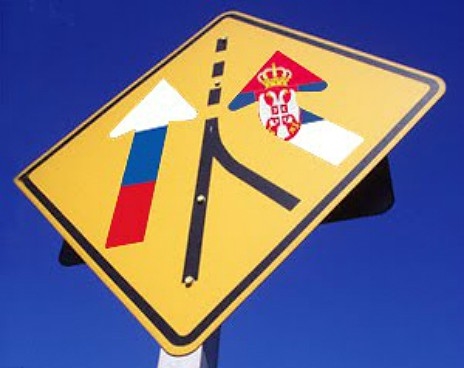
Another political party appeared in Eastern Europe, which protects the rights of the Russian ethnic minority. This time - in Serbia. On August 21, the local Ministry of Justice entered its register at number 91, a movement called "Party of Russian Serbia". The party was headed by Dragan Tsvetkovich, a little -known Serbian politician in the maternal line, who until recently was a supporter of the “Democratic Party” of former President Boris Tadich.
The place of registration of the Serbian "Party of Russians" is Belgrade, but its center is the city of Sremski-Karlovsi in the autonomous region of Voevodin. This is the historical center of white emigration. In 1921, the highest leadership of the Russian Orthodox Church abroad moved here. Here is a monument to General Wrangel, buried in Belgrade. On the eve of World War II, about 30–35 thousand Russian emigrants lived in the then kingdom of Yugoslavia. But under Tito and during the collapse of the Federation he created, the Russian community gradually decreased, so in 2002 the census of the population of Serbia recorded a modest figure of 2588 Russians .
The creation of the new batch was most delighted with the Serbian Orthodox Church - on the day of registration, she presented the new defenders of the Serbian Russian room with an area of 3000 square meters. m in Sremski-Carlovtsy. 1850 people have already become members of the “Russian Parties”, of which 1370 - Russian origin. Compared to the leading forces of the country, this, of course, is not enough. The ruling “progressive party” has 300,000 members , the opposition “democratic” has 178,000, the rest of the parliamentary has at least 50,000. On the other hand, dead souls among the Serbian party members are at least alive. For example, the “Radical Party” of Voislav Sheshel distributed more than half a million party bits, but this did not help her go to the 7 millionth Serbia parliament in the last election.
Therefore, the leader of the “party of Russians” Flykovich is full of enthusiasm and promises to attract a loyal electorate of 250,000 people. The party, which scored so many votes in the last elections in May 2012, would receive 6.5% of the vote and 19 places in parliament - it is enough to join the ruling coalition.
However, Tsvetkovich remains a realist and states that the party has a minimum task - "to gather more than 15,000 descendants of Russians in our Fatherland and engage in preserving their culture and traditions." 15,000 - the number is not accidental. That is exactly how many votes are required in Serbia of the Party of an ethnic minority in order to get one place in parliament by quota.
The question remains-how to eliminate the difference between the data of the census and the minimum program. The response is given by the founder of the party by a personal example - the party may be interested in the Serbs with the Russians among their ancestors. There are many of them in Serbia: for example, successful tennis player Viktor Troitsky - his grandmother is from Rostov, and grandfather - from Tver.
The party plans to begin the protection of Russian culture with the return of Russian language lessons in schools. The question is really relevant. Despite the difficult relations of the USSR and Tito, the Russian in Yugoslavia was part of the school curriculum. In the 1990s, interest in the language fell, and in 2003 it was completely excluded from the general program.
But now interest in the Russian language is growing again. In 2008, the number of people wishing to study Russian at the University of Belgrade twice the number of available places. In 2010, every tenth Serbian schoolboy showed interest in the study of Russian. This is much less than those who want to study English, but quite comparable with the number of those interested in German and French.
Another trump card of the “parties of Russians” is foreign policy slogans. “Serbia should not succumb to blackmail of the European Union and the Western world,” says Tsvetkovich. This position can attract many conservative Serbian nationalists to the party who have nothing to do with ethnic Russians, but the West hate no less from this.
Some Serbian media call the Putin party, however, for many Serbs, this is rather praise. Therefore, the leaders of the Russian Party themselves openly talk about cooperation with the Party of Vladimir Putin. Although no real evidence has yet been discovered, most likely, United Russia is not yet suspected of the existence of their new Serbian allies.
In general, ethnic parties in Serbia are not such an exotic. Of the 91 political traffic registered in the country, 51 states that it protects the rights of some ethnic minority, of which only 14. 11 parties have Serbian Muslims (about 230,000 people). Another 6 - Hungarians (290,000). There are 2 Croatian parties (56,000). Many of them have their representative offices not only in Serbia, but also in Brussels.
In the creation of the “Party of Russians” there are not only cultural, but also economic motives. The party based in Voivodina can receive a faction in the regional parliament of this autonomous region and become there a reliable ally of pro -Russian politicians in the leadership of Serbia. And a friendly attitude towards Moscow of the authorities of Voivodina is very important for the interests of Russian oil and gas exports. On the territory of the region, the largest in Serbia gas storage "Banatsky Dvor", which is jointly used by Gazprom (51%) and Serbiyagaz (49%), is located. The main assets of the Serbian oil company NIS (two refineries and several deposits) are located here, which belongs to Gazprom Neft by 56%.
A new batch of ethnic minority will come in handy here. The stability of the region is needed both by Belgrade and Moscow. The “Party of Russians”, unlike the Hungarian or Romanian, will definitely not insist on receiving the voivodna of a greater autonomy. And he can successfully add a few votes in the regional and republican parliaments, if the pro -Russian parties of President Nikolich and Koshtunitsa will not be a little to be done to the majority.